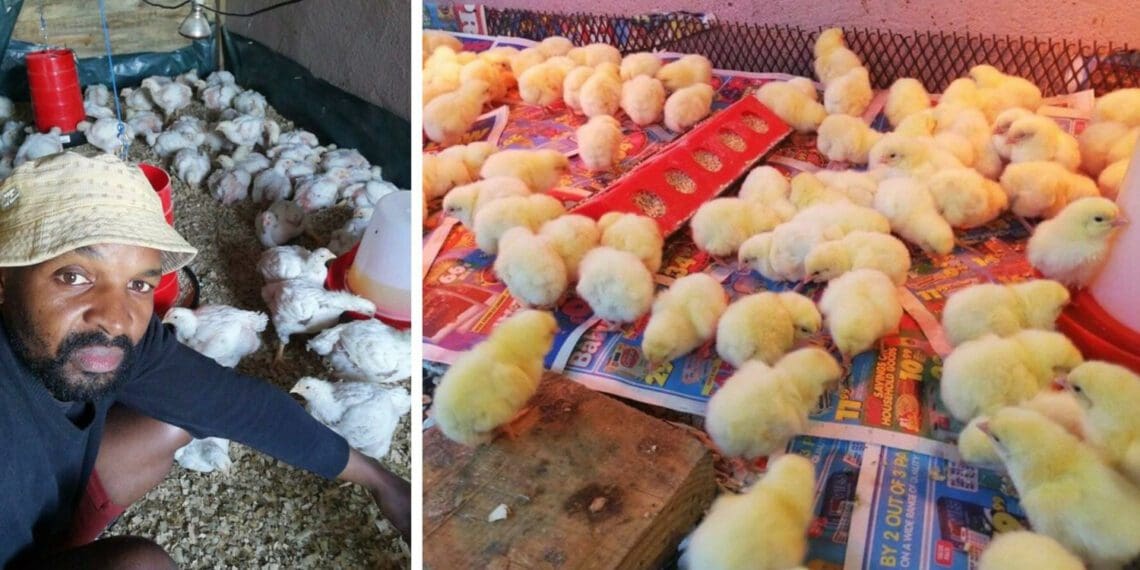
Like many South Africans, Manuel Mapossa lost his job during the Covid-19 pandemic after dedicating 13 years of his life to the hospitality industry. However, this didn’t break his spirit and he turned his misfortune into a successful poultry business.
Mapossa comes from the small rural village of Zhombe in Zimbabwe. About 14 years ago he came to South Africa in search of greener pastures and ended up in the hospitality industry working at a hotel in Mossel Bay, Western Cape.
Working in an industry he thought he would spend the rest of his life in, Mapossa was never ready for what transpired in 2020. The country was forced into hard lockdown as a result of the pandemic, with the hospitality industry suffering the most.
Many people lost their jobs and Mapossa was certainly not spared.
As a husband and father to two beautiful kids, Mapossa says sitting around and wondering where his next meal will come from was not an option.
“I had a very difficult conversation with my wife,” he says. “[But] she finally agreed that we should take our savings and start a poultry business. We really didn’t know much about the business at that time, but we took our chances.”

History of farming
Agriculture wasn’t all that new for Mapossa. Back home in Zimbabwe he used to help his family grow vegetable gardens and look after the livestock.
In a country where 76.3% of Zimbabwean children living in rural areas are affected by poverty, Mapossa says it will always be important to him to break the cycle of poverty.
So, with barely R5 000 in their savings account, Mapossa and his wife, Danisha, bought 100 chicks, feed and other essentials and built a chicken shack at their home in Kwanonqaba, Mossel Bay.
From selling chickens from the boot of his car, Mapossa has quickly progressed into a well-established businessman. He now processes the chickens and sells packaged meat under his brand name, DeeMap Poultry.
ALSO READ: For this poultry farmer, her side hustle
Using the whole chicken
“I sell everything edible coming from a chicken. The locals love chicken feet, heads, necks and gizzards. I also distribute my products to local tuck shops and (directly to) customers,” he says.

As with many small-scale farmers, the business comes with challenges. Mapossa wants to expand his business so he can employ more people. However, the lack of land, machinery and other essential equipment are proving to be an enemy to his progress.
“The turnover isn’t that high because of the small number of chickens that we grow due to space. But I don’t allow this to affect the quality of my product. I am building a brand based on quality, so it’s the best or nothing. If we get the foundation right it will be easier going forward,” says Mapossa
He adds if only big food retailers could buy his products and put them on the shelves, they will be able to reach more customers and get market exposure.
“Retailers need to give us a chance to compete with other companies. We also desperately need any kind of support from the agricultural sector, either in government or other relevant stakeholders.”
But while the struggles are plenty, Mapossa says he loves farming too much to even dare think about giving up.
“I love agriculture for the simplest reasons, such as witnessing a seed turning into a vegetable or a day-old chick turning into a chicken that can feed people. I believe that one day DeeMap Poultry will become a national brand,” Mapossa declares.
ALSO READ: Chicken farm guide: Preparing the poultry house
Get Stories of Change: Inspirational stories from the people that feed Mzansi.