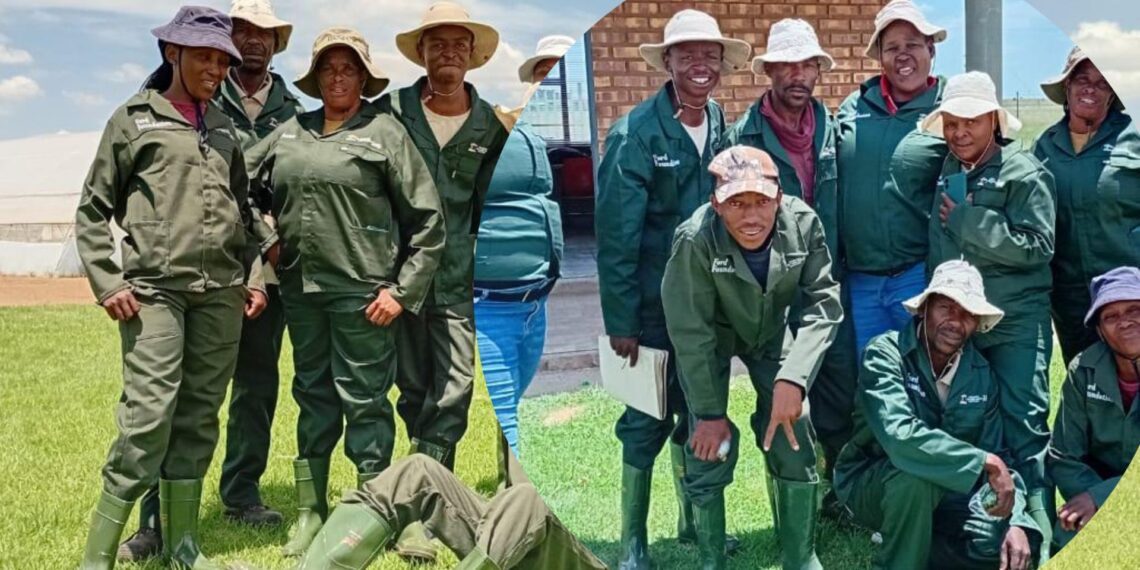
Public employment can transform rural economies – Deelpan is living proof. With the Social Employment Fund and Seriti Institute’s support, hundreds of work opportunities were created, sparking food security, self-employment, and resilience.
As South Africa prepares for the State of the Nation Address (Sona), one question should sit at the centre of our national debate: why do we continue to under-invest in public employment when the evidence of its impact is so clear?
Public employment programmes are often framed as temporary relief. In reality, they are among the most effective economic tools available to a country facing structural unemployment, deep inequality, and fragile local economies. When designed well, public employment does not drain the fiscus. It activates it.
Across the country, public employment has unlocked opportunity and enabled self-employment, allowing people to build livelihoods through meaningful work. Deelpan, a rural community in the North West, stands as a powerful example of what this investment can achieve.
Before the Social Employment Fund (SEF), Deelpan was not a place of opportunity. It was a place of survival. Income options were nonexistent. Food insecurity was high. Local markets were weak. What changed was not luck or charity. It was deliberate public investment.
Through the SEF, public employment funding enabled sustained work and income for local residents, while private-sector support helped establish the Deelpan Multi-Functional Agri-Node (MFAN). Implemented by Seriti Institute in partnership with the Bakolobeng Traditional Council, this was not a one-off project, but a system designed to unlock local capability, drive production, and build long-term resilience.
Measurable outcomes of community growth
Between 2023 and 2025, public employment funding created more than 750 work opportunities, primarily for women and young people. These were not idle jobs. Participants produced food, built skills, strengthened cooperatives, and stabilised household incomes. The result was the emergence of an active local economy where none had existed before.
The social return on investment provides an even clearer signal to policymakers. For every rand invested, over R3 of social and economic value was generated. Few public interventions deliver returns of this magnitude with outcomes that are both measurable and locally embedded.
Independent evaluation shows that 83% of households improved dietary diversity and access to nutritious food, while 74% now earn income from surplus produce sales. This is not dependency. It is economic participation.
And yet, public employment budgets remain vulnerable.
Related stories
- Sona 2026: Illicit trade and tariffs push farmers to breaking point
- Seriti’s community-led farming model delivers real rural change
- Seriti leads grassroots movement for clean air in Jozi
The uncomfortable fiscal reality is this: the cost of adequately funding public employment is a fraction of what South Africa loses each year to corruption, waste, and inefficiency. Redirecting even a small portion of this leakage into structured, monitored, community-based employment would activate thousands of local economies like Deelpan.
Public employment is also among the fastest and most effective tools government has to respond to the jobs crisis. Climate shocks, food insecurity, and youth unemployment cannot be addressed through long-term reform alone. They require immediate interventions that stabilise households while building skills and future opportunity. Public employment programmes have demonstrated that this dual objective is achievable.
Investing in people: The case for public employment
Crucially, Deelpan shows that opportunity does not simply “exist” in rural areas – it is created. The land was there. The people were there. What was missing was catalytic capital to activate both. Public employment filled that gap.
Evidence from Deelpan also shows that public employment does more than create jobs; it builds systems. Sustained work, skills development, and collective production strengthened the local economy, improved food security, and enhanced resilience.
Public employment further strengthened local governance, building trust, shared ownership, and accountability through partnerships with the Bakolobeng Traditional Council. These institutional gains are rarely visible in budget lines, yet they are essential foundations for long-term development success and state legitimacy.
Deelpan is not unique. It is indicative of what becomes possible when public employment is treated as economic infrastructure rather than short-term relief.
So why should the government allocate more funding to public employment?
- Because it works.
- Because it creates dignity, not dependency.
- Because it stabilises households while building skills and markets.
- Because it delivers measurable returns on public investment.
- And because the alternative — continued exclusion — carries far higher long-term costs.
Public employment should not sit at the margins of economic policy. It must be a central pillar of South Africa’s development strategy, alongside industrialisation, infrastructure, and education.
As Sona charts the path ahead, the message from Deelpan is clear: when government invests directly in people, communities respond with productivity, innovation, and resilience.
Public employment is not a safety net; it is economic infrastructure; it is a springboard. And South Africa can no longer afford to treat it as anything less.
READ NEXT: Zero-tariff China deal offers lifeline to SA agri exporters