Tuesday, August 25, 2026
SUBSCRIBE
22 GLOBAL MEDIA AWARDS
Food For Mzansi
  • News
  • Changemakers
  • Lifestyle
  • Farmer’s Inside Track
  • Food for Thought
No Result
View All Result
  • News
  • Changemakers
  • Lifestyle
  • Farmer’s Inside Track
  • Food for Thought
No Result
View All Result
Food For Mzansi
No Result
View All Result
in News

Rare dwarf Nguni calf at Vergelegen steals hearts

Nature is thriving at Somerset West’s Vergelegen estate. Beyond its world-class vineyards, the farm recently welcomed 133 Nguni calves, seven bontebok lambs, and two eland calves. Among the new arrivals is a rare dwarf Nguni

by Staff Reporter
3rd February 2026
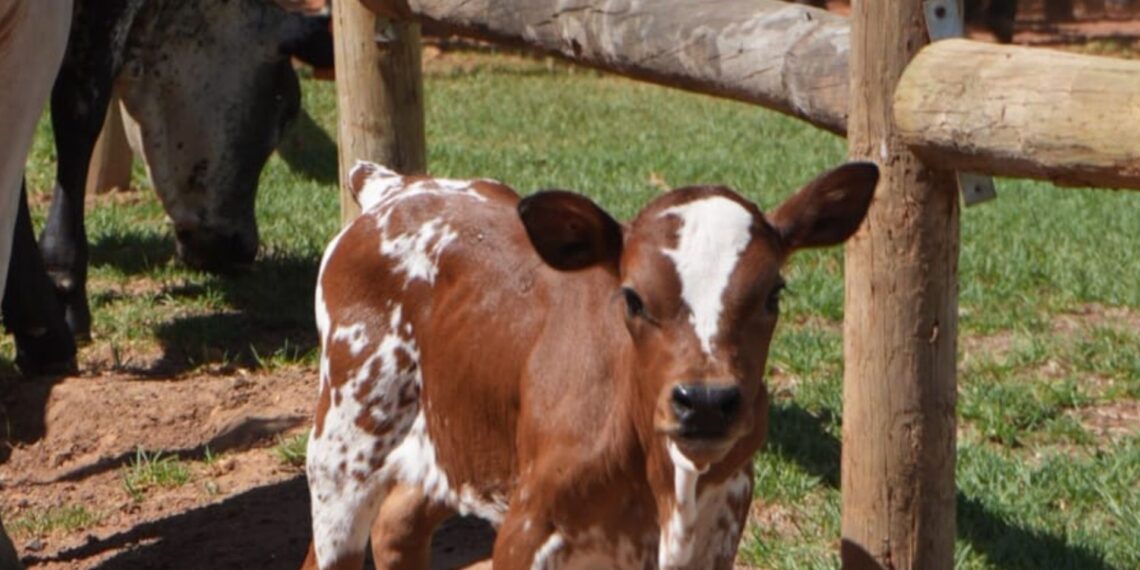
The rare dwarf calf born at Vergelegen in Somerset West. Photo: Vergelegen Wine Estate

The rare dwarf calf born at Vergelegen in Somerset West. Photo: Vergelegen Wine Estate

Share on FacebookShare on TwitterShare on WhatsApp

Vergelegen in Somerset West is celebrating a remarkable season of new life at its 3 000-hectare wine estate, which includes a 400-hectare game camp located within a 1 980-hectare nature reserve.

The most unusual newcomer is a dwarf Nguni calf, born in December. With short, stocky legs and a distinctive brown-and-white spotted hide, he is expected to grow no taller than between knee-and-waist height when fully grown.

“Dwarf Nguni cattle have a much shorter lifespan than standard Nguni, usually around four years, compared to up to 20 years for a normal Nguni,” says Vergelegen’s environmental manager, Eben Olderwagen.

“His mother is very protective and closely monitors anyone who approaches.”

Baby boom expands population

According to Olderwagen, the calf, who is yet to be named, joins another young Nguni, Henry, who is mostly white in colour and something of a celebrity on the estate. Bottle-fed and tame, Henry has formed a close bond with hospitality and events manager Sue Steenkamp and enjoys spending time in her garden.

Henry, the tame, bottle-fed calf at Vergelegen, Somerset West. Photo: Vergelegen Wine Estate

“Both calves were late arrivals. Vergelegen welcomed an impressive 133 Nguni calves between July and September last year, bringing the total Nguni herd to around 450 animals. The baby boom has extended beyond cattle. Two eland calves were born in mid-December 2025, boosting the estate’s eland population to 11. 


Related stories
  • Cattle vs. wildlife: How farming can help with solutions
  • Innovation is the new vintage for SA wine amid climate crisis
  • SA and Netherlands celebrate milestone in agri e-certification
  • Tariffs bite, but SA wine exports show resilience

“The original five eland, three cows and two bulls, were introduced in July 2020 from Elandsberg near Wellington as part of a long-term project to monitor their grazing impact on fynbos species and grasses,” Olderwagen stated.

Seven bontebok lambs were born in October 2025, bringing the total bontebok population at Vergelegen to approximately 90. While this is slightly below the usual 12 to 15 lambs born annually, Olderwagen says there is a natural explanation.

“Young females are reaching breeding age, and new breeding groups are forming as young males establish their territories,” Olderwagen said.

Bontebok were introduced to Vergelegen in 2008, when 13 animals were relocated from the nearby Helderberg Nature Reserve. Since then, the population has flourished.

Vergelegen is home to several spotted eagle owls, and a pair breeds every year in oak trees near the management offices. In November last year, two owlets were discovered out of their nest at the base of the tree, where their parents continued to feed them until they could fly.

READ NEXT: Agri outlook: SA’s farmers face a year of reckoning and renewal

Sign-up for the latest agricultural news delivered straight to your inbox every day with Mzansi Today!

Staff Reporter

Researched and written by our team of writers and editors.

Tags: Inform meNguni CattleWestern Cape
Food for Thought

How AI and intelligence can shield African farms from El Niño

by Zoë Karl-Waithaka
22nd August 2026

As a strengthening El Niño threatens Africa’s agricultural sector, traditional planning is no longer enough. An expert explains how AI-driven...

Read moreDetails
Fresh FMD outbreaks threaten South Africa’s beef trade just as exports rebound, with Agbiz chief economist Wandile Sihlobo calling for urgent action on biosecurity and vaccine production. Photo: Supplied/Food For Mzansi

Western Cape reaches 82% herd vaccination against FMD

22nd August 2026
Industry role players welcome the handover of the Vrede Dairy Farm but not without reservation. Photo: Supplied

Practical management tips every SA livestock farmer must follow

21st August 2026
Former nurse drives EC agroecology revolution in Ncera Village

Former nurse drives EC agroecology revolution in Ncera Village

21st August 2026
15 000 jobs shed: Why the SA agri sector is feeling the pinch

15 000 jobs shed: Why the SA agri sector is feeling the pinch

21st August 2026

Western Cape reaches 82% herd vaccination against FMD

SA food inflation hits 16-year low driven by bumper harvests

Chemistry meets creativity in Neo Mokhomo’s soya candle brand

Closing SA’s gender gap in commercial farming success

Cook once, eat twice: Smart kitchen habits for budget winter meals

Join Food For Mzansi's WhatsApp channel for the latest updates!

JOIN NOW!
Next Post

An FMD-free future: Pipe dream or reality?

THE NEW FACE OF SOUTH AFRICAN AGRICULTURE

With 21 global awards in the first six years of its existence, Food For Mzansi is much more than an agriculture publication. It is a movement, unashamedly saluting the unsung heroes of South African agriculture. We believe in the power of agriculture to promote nation building and social cohesion by telling stories that are often overlooked by broader society.

Beyond maize: Why neglected crops are SA’s climate-smart future

NW agri empowers 110 graduates to fight unemployment

Unstoppable: Double-amputee farmer sets sights on commercial success

How South Africa can stop relying on imported tomato paste

This week’s agri events: 24 – 28 August

Cook once, eat twice: Smart kitchen habits for budget winter meals

  • Awards & Global Impact
  • Our Story
  • Contact Us
  • Cookie Policy
  • Privacy Policy
  • Copyright

Contact us
Office: +27 21 879 1824
News: info@foodformzansi.co.za
Advertising: sales@foodformzansi.co.za

Contact us
Office: +27 21 879 1824
News: info@foodformzansi.co.za
Advertising: sales@foodformzansi.co.za

  • Awards & Global Impact
  • Our Story
  • Contact Us
  • Cookie Policy
  • Privacy Policy
  • Copyright

Chat Options

I'm Lerato, your AI assistant!
No Result
View All Result
  • News
  • Changemakers
  • Lifestyle
  • Farmer’s Inside Track
  • Food for Thought

Copyright © 2024 Food for Mzansi

This website uses cookies. By continuing to use this website you are giving consent to cookies being used. Visit our Privacy and Cookie Policy.