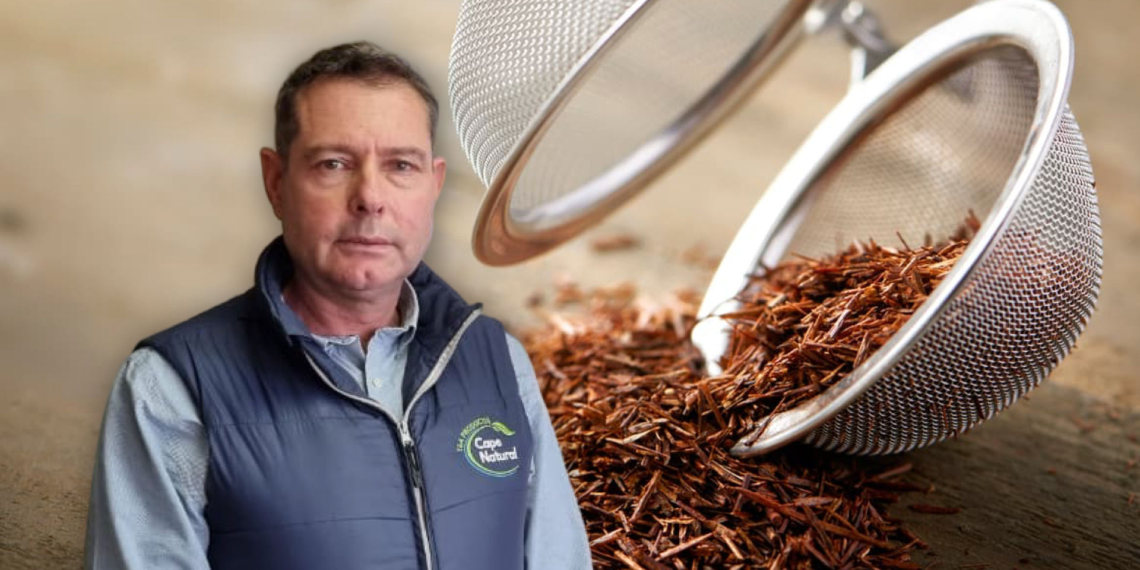
The South African rooibos industry is poised for an unprecedented global expansion after securing zero-tariff market access into China, the world’s largest tea-consuming nation.
Coming into effect earlier this year, this landmark trade development slashes the remaining 6% duty down to zero, completing a turnaround from over 30% tariffs local exporters faced just over two years ago.
The South African Rooibos Council (SARC) has hailed the breakthrough as a game-changer for the sector’s long-term global competitiveness. By removing final price barriers, the agreement makes South Africa’s iconic, health-focused tea far more attractive on physical shelves and digital retail platforms across China.
The SARC believes it will drive future export volumes, stimulate jobs along the value chain, and further secure funding for indigenous benefit-sharing initiatives in the Western Cape.
Food For Mzansi sat down with SARC director, Dawie de Villiers, to unpack what this trade milestone means for market prices, how the industry is navigating recent infrastructural and geopolitical supply chain bottlenecks, and how global success translates directly to empowerment for the country’s rightful knowledge holders.
Related stories
- Rooibos cosmetics offer growth path for agripreneurs
- Rooibos industry holds its ground amid climate uncertainty
- Rooibos powers wellness trend among Gen Z and Millennials
- Rooibos: The heart-healthy tea that’s backed by science
Lisakanya Venna: The rooibos industry has seen significant growth over the past decade. What have been the main drivers behind this expansion, both locally and internationally?
Dawie de Villiers: The rooibos industry’s growth over the past decade has been driven by a combination of consumer trends, product innovation and expanding market awareness, both locally and internationally.
Globally, there has been a strong shift toward health and wellness, with consumers increasingly seeking natural, functional and caffeine-free beverage options. Rooibos is well-positioned in this space due to its unique attributes, including its naturally caffeine-free profile, versatility and association with well-being.
At the same time, greater international awareness and education around rooibos have contributed to increased demand in established and emerging markets.
Locally, rooibos remains deeply rooted in South African culture and consumption patterns, while international demand continues to expand as consumers look for distinctive, origin-based products with strong sustainability and heritage value. The industry has also benefited from improved market access and stronger collaboration across the value chain to position rooibos competitively on the global stage.
South Africa recently secured a zero-tariff agreement for rooibos exports to China. What does this development mean for the industry, and how do you expect it to influence export growth?
The move toward a zero-tariff environment for rooibos exports to China is a significant and very positive development for the industry. China is the world’s largest tea-consuming country, and improved market access enhances rooibos’ competitiveness while unlocking substantial long-term growth opportunities.
Previously, tooibos exports to China were subject to tariffs of more than 30%, which were reduced to 6% in January 2024. The move to a 0% tariff environment in March 2026 creates a more favourable trading landscape and should help improve price competitiveness at shelf level and across online retail platforms.
In the short term, we do not expect an immediate surge in demand, as importers are still working through stock purchased under previous tariff structures. However, over time, reduced import costs are typically passed on to consumers, making rooibos more accessible and attractive to a broader market.
In the longer term, we believe this development will support stronger export growth, deepen market penetration and create new opportunities to introduce Chinese consumers to rooibos as a premium, naturally caffeine-free beverage aligned with growing health and wellness trends.
Rooibos is often highlighted as a uniquely South African product with strong heritage value. How is the industry ensuring that emerging farmers and empowerment initiatives benefit from its growth?
In 2019, the rooibos industry formally recognised the traditional knowledge that the indigenous Khoikhoi and San people hold on the rooibos plant and entered into an industry-wide benefit-sharing agreement with the National Khoi and San Council and the South African San Council as the representatives of the Khoikhoi and the San.
The industry has honoured this agreement through the payment of annual benefits. The benefits are generated through a traditional knowledge levy paid at farm-gate level on every kilogram of rooibos sold. The funds generated are managed by the South African San Council and the National Khoi and San Council and are distributed to support development initiatives within these communities.
While the rooibos industry works alongside these councils to facilitate the collection and disbursement of the funds, the implementation and oversight of specific projects rest with the councils themselves. Over the years, thousands of individuals within these communities have benefited through access to educational opportunities, entrepreneurship support and broader development programmes.
A meaningful focus of these initiatives has also been cultural awareness and heritage preservation, ensuring that the origins of rooibos are acknowledged and respected. This remains a tangible example of how the industry’s global growth translates into long-term benefits for the rightful knowledge holders.
The recent storms have caused widespread flooding and damage to infrastructure, including roads and bridges. Were rooibos producers impacted, and what broader risks does climate change pose to the industry’s sustainability and supply chains?
Fortunately, heavy rainfall in other parts of the country was not as severe in our primary rooibos production regions. The areas affected by excess water were relatively limited and localised. From what we understand, the impact has been mostly confined to infrastructure, such as roads and buildings. The plantations themselves are generally unaffected. We are also pleased to report minimal impact on nurseries, which is important for maintaining seasonal continuity.
Localised weather events are a reality of agriculture and have occurred over many years without causing long-term disruption to our operations. However, the key concern for the industry lies in international shipping and supply chain continuity. Ensuring smooth logistics from the Port of Cape Town to destination markets is where the greatest challenge sits.
We are currently seeing maritime disruption linked to geopolitical tensions in the Middle East. This remains a significant risk factor. In a prolonged conflict scenario, consumption patterns can shift, and consumer behaviour may change, requiring us to adapt our product offering both in South Africa and through our partners in international markets.
Looking ahead, what opportunities and challenges do you foresee for the rooibos industry over the next five to ten years?
The opportunity lies in introducing rooibos to a broader global audience, positioning it alongside established tea categories and highlighting its unique flavour profile and natural, caffeine-free and health benefits. China, as the world’s largest tea-consuming market, represents significant untapped potential.
At the same time, we must remain highly competitive, particularly when measured against other herbal teas and beverages that compete in the same health and wellness space.
It is important to recognise the role rooibos plays as an iconic South African product. We are fortunate to be the custodians of something unique in both its characteristics, its health benefits, and the specific geographical region in which it grows.
READ MORE: Standard Bank, Orizon launch first bank-backed carbon crop programme