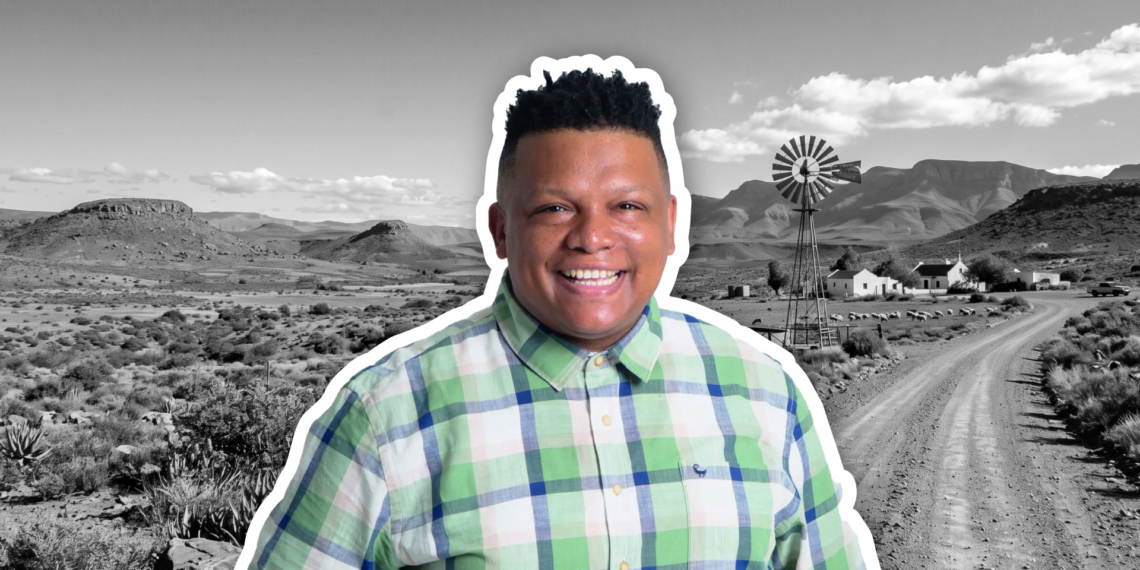
After a thought-provoking panel at the Karoo Winter Wool Festival, Food For Mzansi co-founder Ivor Price reflects on what agriculture, journalism and the Karoo landscape can teach South Africa about stewardship, trust and the voices we too often fail to hear.
There are places in this country where the noise cannot reach you.
The Karoo is one of them.
Driving home from the Karoo Winter Wool Festival in Middelburg, Eastern Cape, after participating in the National Wool Growers’ Association’s programme, I found myself thinking less about what had been said on stage than about what the landscape itself had been saying all weekend.
The Karoo has never been interested in spectacle.
It is a place that demands patience. It rewards consistency. It has no tolerance for shortcuts, slogans or performative outrage. It simply asks whether you have the character to endure another season.
That, I suspect, is exactly what South Africa is asking of us now.
Our panel covered familiar territory: politics, media, trust, misinformation and the future of organised agriculture. There were robust disagreements. Honest reflections. Difficult questions. That is healthy. Democracies depend on disagreement. But I left convinced that we are arguing about the wrong things.

The people we overlook
For years, I have travelled this country telling the stories of farmers who rarely make headlines. Young livestock producers in the Eastern Cape. Women growing vegetables in rural KwaZulu-Natal. Emerging commercial farmers in Limpopo.
Wool growers in the Karoo. Families who measure success not in social media followers but in rainfall, lambing percentages and whether there will be enough money to keep the next generation on the farm.
They are not asking to be rescued. They are asking to be seen. That is not the same thing.
One of the greatest failures of modern journalism is not simply what we cover. It is who we fail to notice.
The loudest voices almost always belong to those with the biggest platforms, the strongest lobbying machines or the greatest appetite for conflict. Meanwhile, the people quietly holding communities together disappear beneath the noise.
Food For Mzansi was founded to challenge precisely that.
We have spent years trying to decolonise the image of the South African farmer. Too many people still imagine agriculture through narrow political lenses, as though farming belongs to one language, one race or one version of history.
The truth is infinitely richer.
The future of South African agriculture is multilingual. It is multiracial. It is deeply entrepreneurial. It is filled with young people who are building businesses where previous generations saw only survival.
Some of them farm five hectares. Some farm five thousand. All deserve to be part of the national conversation. That conversation cannot be built on fear.
Fear is easy to manufacture. Every day our timelines are flooded with outrage carefully designed to provoke an emotional response before a rational one. Algorithms have discovered that anger travels faster than hope.
Related stories
- SA shearers honoured as wool sector rides global resurgence
- EC farmers receive 300 sheep to boost wool industry
- KZN agriculture shines at Premier’s Excellence Awards
- Parliament finds farm equity scheme failures run nationwide
Hope, unfortunately, requires work.
Trust requires even more.

Beyond the noise
One of the more striking moments during our discussion came when we reflected on the growing influence of social media over public opinion. Too often we behave as though whatever trends online represent the country.
It does not.
South Africa is not Twitter. It is not Facebook. It certainly is not the comment section.
South Africa is found in the places cameras seldom visit. It is found in shearing sheds where generations still work side by side. It is found in classrooms where agricultural science opens doors that poverty tried to close.
It is found in informal markets, family farms, cooperatives and livestock auctions where people continue building despite every reason to surrender.
Those South Africans are not interested in winning ideological arguments. They are interested in producing food. Creating jobs. Building businesses. Leaving something better for their children.
There is a profound wisdom in agriculture that politics would do well to recover.
Farmers understand stewardship. You never truly own the land beneath your feet. You borrow it from the future. Every decision you make either enriches it or diminishes it.
The same is true of democracy. The same is true of journalism. The same is true of leadership.
Our responsibility is not simply to win today’s argument. It is to leave stronger institutions for those who come after us.
That means resisting the temptation to reduce every disagreement to betrayal. It means remembering that people with whom we disagree remain fellow South Africans. It means recognising that criticism is not disloyalty and that accountability is not hostility.
Above all, it means refusing to surrender truth to whichever side shouts the loudest.
Trust grows slowly
As journalists, our first loyalty cannot be to governments, political parties, commodity organisations or lobby groups. Neither can it be to popularity. It must remain with the public.
Not the public that lives online, but the public that rises before sunrise to milk cows, shear sheep, inspect orchards, harvest maize, pack fruit and somehow still believes tomorrow can be better than today.
Those are the people I think about whenever someone asks why agricultural journalism matters. Because agriculture has never merely been about food. It is about dignity. It is about belonging. It is about giving South Africans permission to see one another again.
Driving through the Karoo, surrounded by landscapes that have outlived governments, ideologies and generations of politicians, I was reminded of something that journalism too easily forgets.
Countries are not ultimately held together by outrage. They are held together by trust. And trust, like good soil, is built slowly, protected fiercely and handed carefully to the next generation.
Perhaps that is the real work before all of us. Not simply to tell better stories. But to become a country worthy of believing them.
- The views and opinions expressed in this article are those of the author and do not necessarily reflect the views or positions of Food For Mzansi.
READ NEXT: Is your farm’s data safe? The hidden cyber risks in agriculture