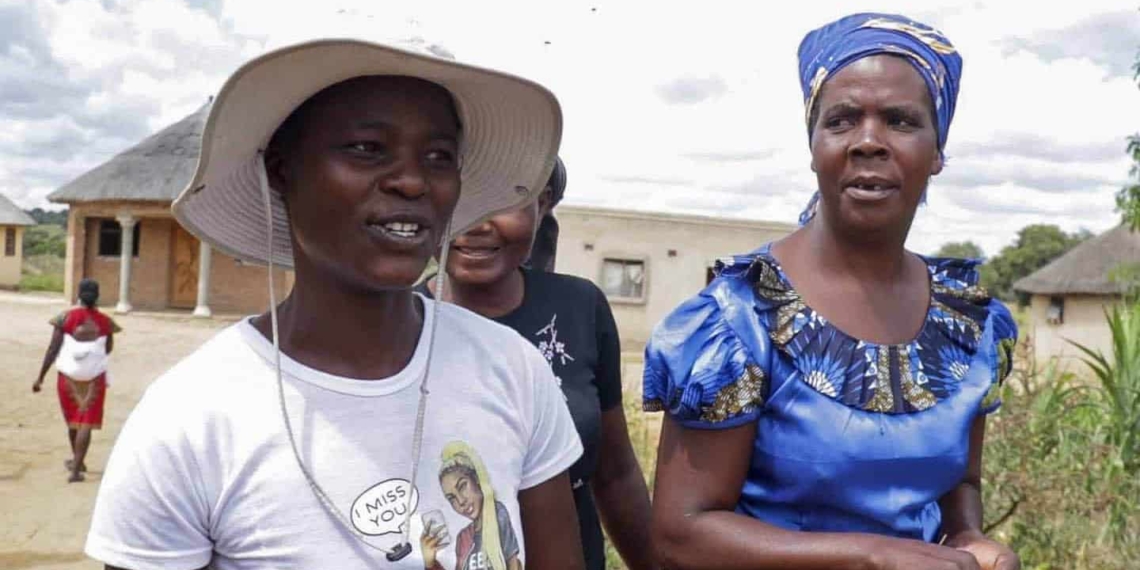

Miriam Sibanda (32) dips her left hand into a heap of greyish matter lying in a makeshift pond and lifts out a handful of the mushy muck. With the index finger of her right hand, she softly prods the sludge, spreading it over her palm to reveal some slimy maggots that wriggle as they are exposed to the light
The thought of doing this could make some people feel ill, but for Sibanda breeding maggots has become a part of her life. The mother of three young children, all in primary school, is part of the Combine Group, a ten-member women’s group in Tanyanyiwa village, which is in Nyaje, a ward in the Gokwe South communal lands in the Midlands province of Zimbabwe.
Here and in the districts of Kwekwe and Shurugwi, several groups of mostly women are producing the larvae of the black soldier fly, Hermetia illucens, and using them to augment chicken feed. They are involved in a programme to teach communal farmers better farming methods, including how to produce feed for their livestock. Known as the Extended Training for Rural Agriculture programme, it is being implemented as part of the Livelihoods and Food Security programme supervised by the United Nations Food and Agriculture Organization.
Most of the women had been raising broiler chickens to sell, but the ever-increasing costs of commercially produced chicken feed meant it was no longer profitable. The fly larvae, which the villagers started producing in the last quarter of 2020, has enabled them to revive their chicken-rearing and they now raise free-range chickens on a large scale.

Sibanda’s group is one of six that were involved in a pilot project to produce black soldier fly larvae after receiving training from agriculture extension workers. “They taught us that we can produce larvae, or maggots, by using waste like leftover food from our kitchens, rotting maize meal, or any other rotting crop such as cowpeas and the like, as well as vegetables. Such waste, which we store in a purpose-built pond that has to be closed at the top, forms the substrate or the material in which the maggots can grow,” explained Sibanda.
“We have some traps made of small pieces of wood and the black soldier fly lays its eggs on the traps. The eggs can be seen after four to five days and they hatch after 14 days, producing the maggots. Other types of fly, like the common house fly, may also hatch their own eggs in the substrate, but these die and those of the black soldier fly survive.”
Sibanda and her colleagues harvest an average of 10kg of maggots every three days, drying them then mixing them with other components to make chicken feed.
ALSO READ: World’s first ever dairy alternative made with insect larvae
Smell of success
She readily admits that the idea of producing maggots was odd at first. “In the initial stages, when we would open the pond to harvest the maggots, a sickening smell would engulf the whole homestead and we would use gloves to harvest the maggots as the substrate was grimy,” Sibanda said.
“It was tough and others easily gave up, but we soldiered on because the idea of producing our own chicken feed from readily available resources was very attractive. With time, we were able to produce better substrate which is not smelly and also produces more maggots.”

Sibanda and her colleagues keep an average of 100 free-range chickens at any given time. Apart from their income from chicken sales, she and her partners also make money by selling their chicken feed to others. She says she is now better able to take care of her family as a result of the income she earns.
Senzeni Govere, another member of the Combine Group, is a 35-year-old mother of five and the proud owner of one of the most beautiful homesteads in the area. Govere says she is pleased that through the money she earns from chicken-rearing and feed sales, she has been able to help her husband build a home made of brick and mortar instead of poles and mud, which is more common in rural localities like hers.
“My husband concentrates on the cropping side of our farming while I focus on chicken-rearing and chicken feed production. We support each other in what we do. We have two children in secondary school and one in primary school. We are able to pay for their education through the money that we get from farming,” Govere said.
Thriving through innovation
Benhilda Nkomo, an agriculture extension worker, helps the farmers with larvae production. Nkomo praised the women for their enthusiasm and said they have been able to create better substrates that don’t smell as much and produce more and bigger larvae through experimentation.
“We have imparted some basic knowledge to the farmers on how to produce larvae, but we are also learning from them as they have been able to improve several things through their continuous experimenting. The beauty of the black soldier fly is that it carries no pathogens or micro-organisms that can cause disease,” Nkomo said.
“The black soldier fly completes the whole notion of a circular economy by utilising waste from agriculture and creating value in the form of manure and proteins.”
Commercial chicken feed is made mainly from soya bean, a rich source of the protein that chickens need to grow. But soya beans do not thrive in Gokwe because the area is dry. The black soldier fly larvae also have a high protein content and are relatively easier to produce, which make them the perfect solution.
Irvin Mpofu, a specialist in stockfeed production and a lecturer at Chinhoyi University of Technology, also works with the villagers on the larvae project. He said it is still in its infancy in Zimbabwe compared with similar projects in Kenya and South Africa, where small-scale farmers are producing up to a tonne of dried larvae each month and some private producers get an average of 10 tonnes in the same period.
“Black soldier fly larvae production is sustainable in the Zimbabwe context for both smallholder farmers and private growers. The main enabling factors are the warm climate suitable for breeding of the fly, then comes the fact that [it] thrives on organic waste streams, which are generated at farm level and agro-processing factories,” he said.
Creating value
“The black soldier fly completes the whole notion of a circular economy by utilising waste from agriculture and creating value in the form of manure and proteins. The main pull factors for the smallholder farmers is the availability of waste streams from livestock and crops, including those from gardens. The need to support indigenous poultry production is an attractive incentive,” Mpofu said.
Gokwe is one of Zimbabwe’s driest areas and has traditionally been known as the country’s cotton-growing region. A combination of factors, including poor prices and increasing production costs, has led to a decline in cotton farming, which has left many farmers impoverished as they have been struggling to diversify. The production of the black soldier fly larvae has the potential to enable these farmers to transform their farming and not rely on a particular crop.
The farmers taking part in the project have also been taught to produce feed for other livestock, which offsets losses from the deaths of their animals, which tend to occur during the dry months. Communal farmers are taught basic finance skills, including how to establish savings and lending schemes and savings and credit cooperatives, and they learn about gender equality.
Although statistics are not readily available, the testimonies of some of the participants show that the project has helped improve the lives of many.

This article was first published by New Frame.