Following the release of the latest official crime statistics, reports of stock theft and farm crime continue to emerge weekly across South Africa, leaving agricultural communities with little choice but to invest heavily in private security to safeguard their livelihoods.
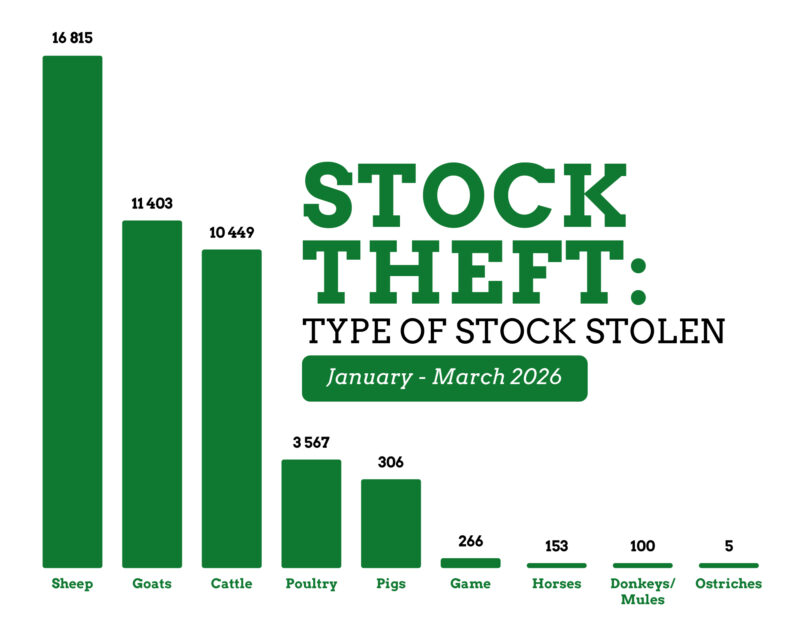
While the continuous incidents unfold on the ground, the official figures highlight the massive volume of the ongoing challenge. More than 43 000 livestock animals were reported stolen across South Africa between January and March 2026, according to the fourth-quarter crime statistics released by the South African Police Service (SAPS).
During that three-month reporting period, police recorded the theft of 16 816 sheep, making sheep the most targeted livestock category in the country.
This was followed by 11 403 goats and 10 449 cattle. Other reported livestock theft cases included 3 567 poultry, 306 pigs, 266 game animals, 153 horses, 120 donkeys or mules, and five ostriches.
These numbers only tell part of the story. A lot of farm theft goes unrecorded for several reasons, including the fact that rural police stations are hard to reach. Even for the crimes that are officially reported, the crisis is far from uniform, with a station-by-station breakdown highlighting how heavily certain localised hotspots are bearing the brunt of the problem.
“The figures are not just numbers. They are a stark mirror held up to our society. Behind every statistic is a traumatised victim, a distraught family, a community living in fear.
“The police can do little to address these factors as [they] are primarily responsible for enforcing the law and holding those who commit crime accountable.
“The less crime there is, the better the police can focus on those who commit it. Effective crime prevention therefore requires enhanced support from all government departments and from community-based, civil society and private sectors,” said police minister Firoz Cachalia.
Related stories
- Stock theft, fighting FMD high on NW and WC priority list
- Protect your herd: Tips for preventing livestock theft
- New RMIS research targets FMD, stock theft & market growth
- Farmers and brewers call for budget that builds, not breaks
Escalating farm crimes
Since the quarterly statistics were released, each week there seems to be a new report of theft hitting rural areas.
These ongoing cases demonstrate how sophisticated syndicate operations extend beyond standard livestock raids into other forms of high-value agricultural theft.
In the Eastern Cape, the SAPS Stock Theft and Endangered Species Unit (Stes) in Kariega intercepted a vehicle on the R75 outside the town, arresting a 38-year-old foreign national and recovering 151 poached protected cycads valued at approximately R1.5 million.
Police were tipped off by a local farmer who immediately reported the crime after spotting several suspects digging the protected plants directly out of a farm.
Despite these specialised anti-poaching busts, standard stock theft syndicates remain aggressively active every week, striking farms with zero warning. In Lebowakgomo, Limpopo, police opened an investigation after thieves forcefully breached a kraal at Makotse Newstands during the night, escaping with 16 sheep and 11 goats valued at R63 600.
This relentless cycle of theft has left rural communities across provinces like Limpopo fending for themselves against rampant criminality.
“Limpopo farming communities are under siege from rampant and unchecked criminality, leaving farmers increasingly forced to secure themselves and their livelihoods,
“In Tzaneen, avocado farmers have reported operating at a loss as theft syndicates target orchards, forcing some to spend hundreds of thousands of rand annually on private security.
“Livestock farmers in Ga-Mashashane, Molemole and Blouberg have similarly reported escalating stock theft, with animals stolen or slaughtered and farmers left to absorb the losses,” said Marie Helm, provincial spokesperson for the Limpopo department of agriculture and rural development.
Joint operations hit back
Despite these vulnerabilities, some targeted joint operations between local farmers and the police are proving effective at striking back against these syndicates.
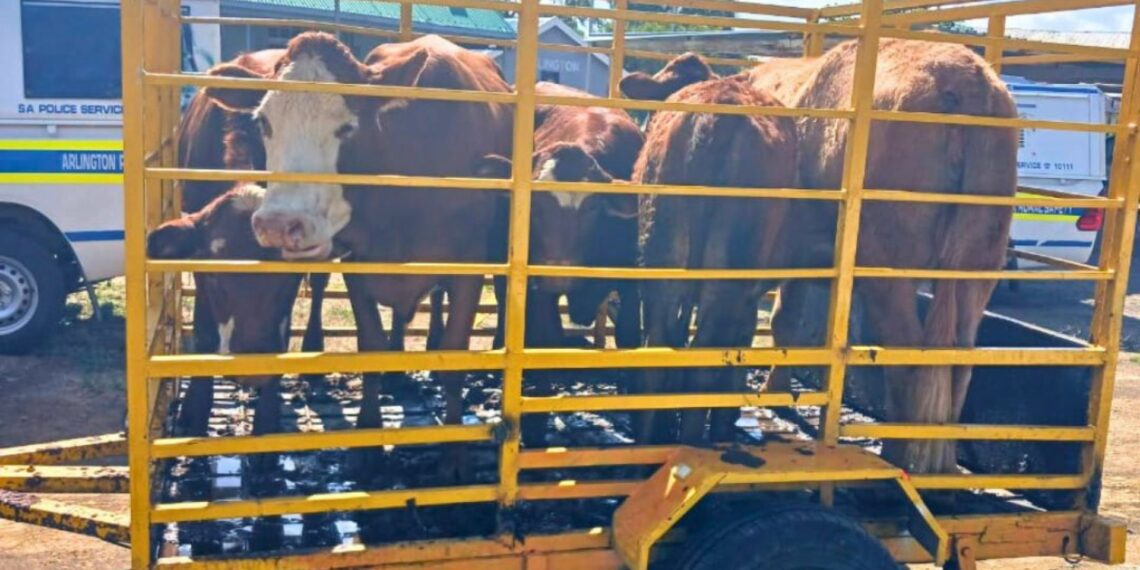
In North West, a multidisciplinary operation involving the Potchefstroom Stock Theft Unit, Flying Squad, and local farmers successfully tracked down and arrested three suspects along the N12 Road, recovering 16 stolen cattle that were promptly returned to their owner.
SAPS acting provincial commissioner of the North West, Major General Ryno Naidoo, commended the swift breakthrough, emphasising that “rural safety remains a priority, as it contributes directly to the country’s economy.”
To avoid stock theft and secure legal recourse, SAPS advises farmers to implement the following measures:
- Maintain livestock registers: Implement and maintain a comprehensive livestock register.
- Immediate reporting: Report all stock theft incidents immediately to the nearest police station.
- Brand marking: Brand mark your livestock according to the Animal Identification Act to prevent identification disputes in court.
- Stakeholder cooperation: Cooperate and work together with local SAPS and stock theft units.
READ NEXT: More than dirt: Seven ways to reverse land degradation