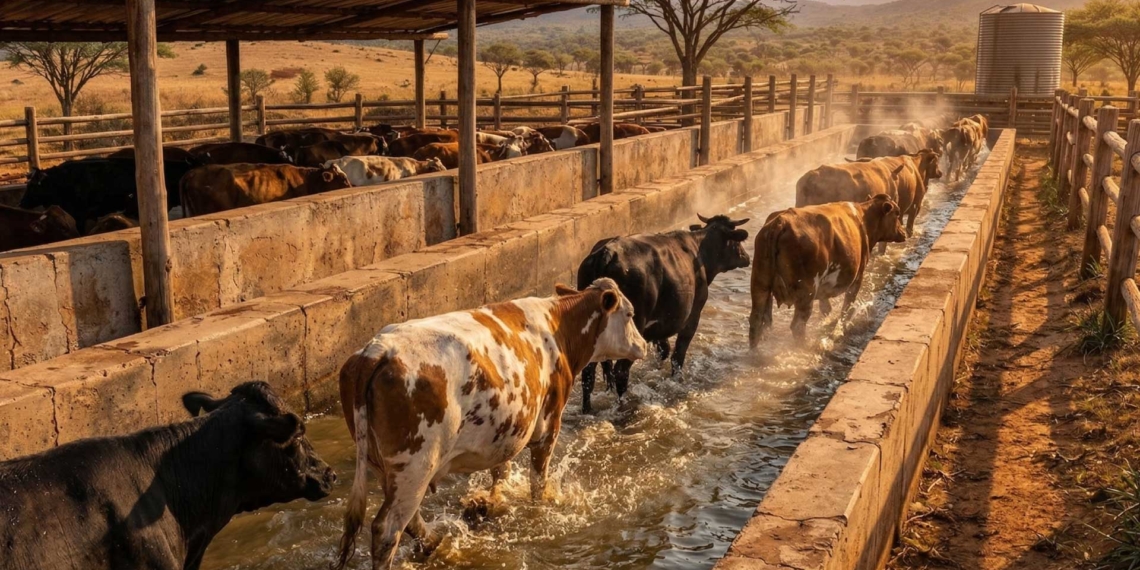
At a dusty communal dip tank outside Senwabarwana in the Blouberg Local Municipality in northern Limpopo, cattle move slowly through a narrow crush while veterinary officials prepare their syringes.
For one communal cattle farmer, the moment is both hopeful and heavy. He asks that his name not be used, fearing stigma and unwanted attention in his tight-knit village. In recent months, he has already buried animals that died of the disease.
Others in his community have watched their herds weaken, milk production drop, and livestock markets close overnight. In communal farming systems, where cattle are often a family’s savings account, the losses cut deep.
“We’ve suffered already,” he says softly. “Some people lost animals. Others couldn’t sell when they needed the money. When you see the vaccination team arrive, you feel relief, but you also know what we’ve been through.”
Across South Africa, scenes like this are becoming more common as the country ramps up its vaccination drive to contain the devastating foot-and-mouth disease (FMD) outbreak that has swept through the livestock sector.
A national vaccination push
Agriculture minister John Steenhuisen recently led a vaccination campaign in Limpopo, confirming that progress is being made as vaccines begin reaching farms across the country. The government’s goal is to vaccinate more than 80% of South Africa’s national cattle herd by the end of the year.
According to Steenhuisen, the rollout has already made important progress in areas where vaccination campaigns are underway. Around 60% of communal cattle and roughly 40% of commercial herds in targeted FMD-positive zones have already received vaccines.
Vaccination drives have also been launched in Gauteng, the Free State, KwaZulu-Natal, and the Western Cape, while the other provinces are also rolling out vaccines as authorities and the private sector race to contain the spread of the disease.
So far, South Africa has imported 2.5 million FMD vaccine doses in 2026, with more on the way. The first million came from Argentina’s Biogénesis Bagó, followed by 1.5 million from Türkiye’s Dollvet. The Agricultural Research Council has also restarted local production for the first time in 20 years, but at very limited quantities. Vaccines are being distributed nationwide, prioritising hotspots, and the government is covering all costs, ensuring free access for farmers.
For farmers who have spent months living under strict movement restrictions and market uncertainty, these numbers represent the first real signs of a coordinated fightback. The vaccines form part of a broader strategy aimed at stabilising the livestock industry and helping the country regain access to valuable red meat export markets.
Related stories
Farmers are under pressure but holding the line
The FMD outbreak has placed an enormous strain on the red meat industry, affecting both communal and commercial farmers. Movement restrictions have disrupted auctions, delayed sales, and restricted cattle movement between farms and provinces.
Yet farmers have adapted, tightening farm biosecurity and working closely with veterinary authorities to limit the spread of the disease. For communal livestock farmers, vaccination is particularly critical.
“Communal systems often have large, shared grazing areas and dip tanks,” explains a veterinary official involved in the campaign. “If vaccination reaches these communities, it can dramatically reduce the risk of the virus spreading further.”
Veterinary teams comprising animal health technicians, state veterinarians, and extension officers are now vaccinating thousands of cattle each day in affected areas.
The science behind the response
Experts say vaccination is one of the most effective tools available to slow the spread of FMD, but it must be supported by strong disease management measures.
Renowned veterinary epidemiologist, Dr Gideon Brückner, says coordinated national oversight remains essential. “Vaccination reduces the viral load in affected areas and helps protect neighbouring farms,” he explains. “But it must go hand in hand with surveillance, movement control, and proper monitoring.”
Traceability of vaccinated animals has also emerged as a key concern. Angus Williamson, Kwanalu vice president and the RPO’s chairperson in KwaZulu-Natal, says properly identifying vaccinated cattle will be critical for managing the outbreak and rebuilding export confidence.
Providing an update on the situation in parts of southern KwaZulu-Natal, Williamson says some members in the Ugu and Harry Gwala district municipalities have begun receiving vaccines, including several dairies.
“Although they’re not tagging communal cattle at the moment, they have told us that tagging will happen during the second round at the dip tanks,” Williamson says. “We hope that this will happen because traceability is very important.
“The number of vaccines coming into the country is still slow. KwaZulu-Natal only had around 200 000 doses of the Argentinian vaccine, yet the province has roughly 1.4 million cattle. We need at least three million doses just for that province.”
For that reason, he says, the vaccination campaign still has a long road ahead.
Industry steps in to help
Agricultural organisations are stepping forward to support the national response. The Milk Producers’ Organisation (MPO), which represents about 880 dairy farmers nationwide, has played a key role in coordinating vaccination efforts in KwaZulu-Natal.
CEO Fanie Ferreira says the organisation worked closely with provincial authorities to distribute vaccines where they were most urgently needed. “In KwaZulu-Natal, 200 000 doses were allocated and around 90,000 of those were distributed through the MPO,” he explains.
The organisation, together with sponsors, also provided vehicles with cooling boxes to transport vaccines from the Allerton laboratory to veterinary practices serving the Harry Gwala Municipality. In one coordinated effort, approximately 50 000 doses were administered in just six hours.
Ferreira says the cooperation between government, veterinarians, and industry organisations has been critical. Minister Steenhuisen has publicly thanked veterinary teams and industry partners, such as the MPO, for supporting the vaccination campaign and helping safeguard the country’s livestock sector.
The Red Meat Producers Organisation (RPO), through one of its partner sponsors, Tal-Tec, made a mobile cattle handling facility available to administer vaccines in some regions of the Eastern Cape, where there are no cattle handling facilities available. The RPO is also involved in vaccine distribution and, through its members, even arranged a private plane to deliver vaccines to a rural area to quicken the response time.
Despite the progress, experts agree that significantly more vaccines will be needed. South Africa has roughly 14 million cattle, and if each animal requires two doses, the country would ultimately need around 28 million vaccines.
The consequences of FMD have been devastating. Many large-scale commercial farms have been brought to a standstill, with operations frozen as cattle fall ill or movement restrictions bite.
Communal farmers often suffer in silence too, watching their herds wither before their eyes. In one reported case, a dairy farmer lost nearly 400 cattle, wiping out years of milk production and leaving a community reeling from the financial and emotional toll.
Back at the Limpopo dip tank, the vaccination team finishes the final animals before packing up their equipment and heading to the next village. The communal farmer watches his herd walk slowly back toward the grazing lands.
“There’s still a lot of work ahead,” he says. “But today feels different.”
For farmers across South Africa, those small injections represent more than a medical intervention. They mark the beginning of recovery for a red meat industry that has endured months of hardship but remains firm.
Industry calls for closer collaboration
Earlier, Red Meat Producers Organisation (RPO) chief executive Dr Frikkie Maré noted the sector’s commitment to working with government and industry to end the FMD crisis.
“The national RPO remains willing to collaborate on solutions and implement actions to bring an end to FMD,” Maré said. “But we again urge government to open up communication, not just through occasional press releases or monthly briefings, but on a weekly or bi-weekly basis, providing clear, factual information on our current status, the challenges we face, and the anticipated timelines.”
He stressed the importance of practical engagement.
“We need to review and discuss proposed regulations together, ensuring they are implementable while achieving their intended purpose. Producers must be involved directly through their representative organisations, not only through veterinarians. Market access for affected red meat producers must be prioritised because no one can survive without it.”
Maré also highlighted the need for targeted support for farmers already struggling.
“We need to determine the needs of those who have been without income for long periods and work together to identify options to bridge the gap. During the Covid-19 pandemic, the government and the private sector provided relief funds to support small businesses. We need to ask how we are going to do the same to protect our producers now.”
This story is part of a special series in partnership with the Red Meat Producers’ Organisation (RPO) – a tribute to the farmers feeding our nation, one meal at a time.

READ NEXT: Agrolimo Farms: Tebogo turns schoolyards into Soweto’s pantry