With support from the Seriti Institute and the Citi Foundation, smallholder farmers across four provinces are demonstrating that climate-smart agriculture and digital innovation can transform rural livelihoods.
Across four provinces of South Africa, smallholder farmers are proving that with the right support, farming can be both sustainable and profitable. Through a partnership between the Seriti Institute and the Citi Foundation Global Innovation Challenge, 312 farmers from KwaZulu-Natal, Limpopo, North West, and Mpumalanga have transitioned from subsistence farming to thriving agri-enterprises.
The two-year project, implemented between 2023 and 2025, funded by the Citi Foundation Innovation Challenge, resulted in the establishment of 50 new farming enterprises. It is supported with training, inputs, tools and infrastructure such as irrigation systems, shade nets, poultry houses, and storage facilities.
This project forms part of Seriti’s Multifunctional Agri-Nodes model, which is designed to build fair food systems through local capacity building and climate-smart farming.
“When farmers are equipped with proper farming support, they become agents of change,” said Dr Siphesihle Qange, programme lead. “This initiative has improved livelihoods while strengthening South Africa’s local food systems.”
Connecting smallholders to markets
The 312 farmers received a range of training covering permaculture, food safety, and financial and business management. Moreover, across all project sites, over half a million seedlings were produced and distributed to smallholder farmers, which encouraged them to produce not just for household consumption but also for local markets.
To help strengthen market linkages, Seriti hosted five value chain dialogues in partnership with the national fresh produce markets in Gauteng, North-West, and KwaZulu-Natal. These events directly linked farmers with retailers, agents, buyers and policymakers, helping them understand pricing, quality standards, and supply consistency.
The results are tangible in Deelpan, farmers now supply Sannieshof Spar supermarket with lettuce, spinach and cabbage. Lesiba Daniels from Mokopane supplies spinach to eight Boxer stores, Roots and Spar, while in Standerton, farmers supply Astral Foods’ canteen with various vegetables.

Lesiba Daniels from Mokopane supplies fresh spinach to eight Boxer stores, Roots, and Spar. Photo: Supplied/ Food For Mzansi
To digitalise the local farming trade, Seriti launched the Community Fresh App, a marketplace connecting smallholder farmers directly with consumers and retailers. The app, available on the Google Play Store, promotes fair pricing and reduces postharvest losses by linking farmers with real-time demand. It is part of Seriti’s effort to integrate technology into agriculture while empowering communities to “buy local.”
Related stories
- Agriculture meets innovation at Seriti’s 3rd Annual Farmers’ Day
- Land Bank back on track, boosting support for farmers
- Podcast: Land Bank’s asset insurance is the lifeline you need
Empowering women and youth in farming
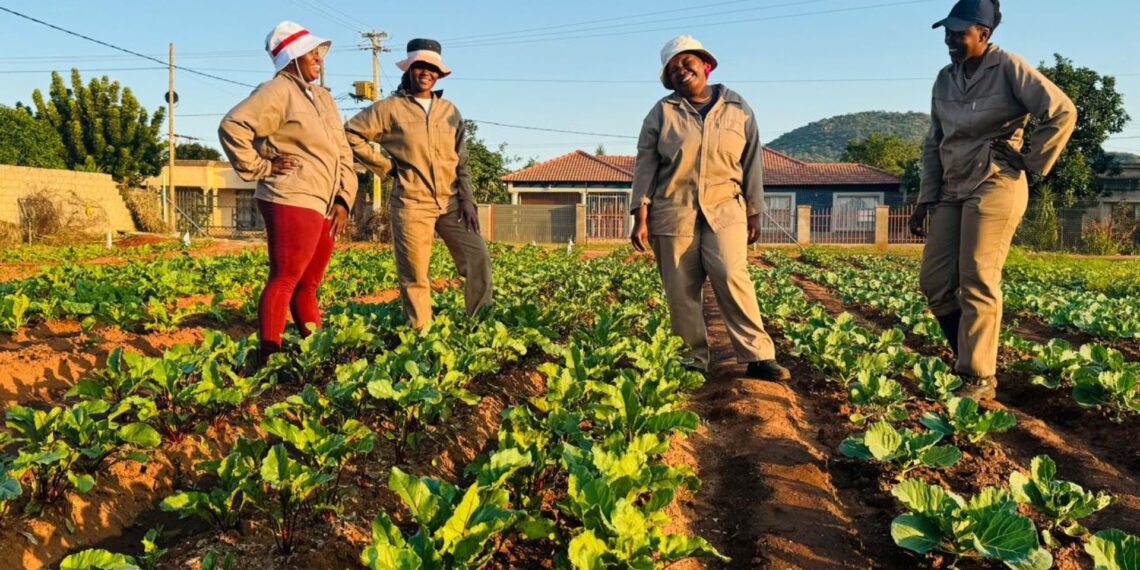
More than 60% of project beneficiaries were women and youth, many of whom gained access to land for the first time through partnerships with traditional leaders. Women-led cooperatives, such as Ladies First in Agriculture in Deelpan, received infrastructure support to refurbish their poultry houses and expand their production.
Across all nodes, over 30 agri-enterprises were formally registered, and more than 24 are in the process of registration. This indicates a growing appetite for entrepreneurship in rural farming communities.
“We are not just growing vegetables; we are growing independence,” said Caroline Molokela, chairperson of Ladies First Cooperative from Deelpan.
The project’s impact goes beyond improved production. Through agroecological training, composting, and waste reduction practices, Seriti has encouraged environmentally sustainable farming and reduced reliance on synthetic inputs.
The initiative has also strengthened tri-sectoral partnerships with government departments, NGOs, and the private sector, ensuring long-term sustainability. Deelpan traditional authority allocated 15ha of land, Afgri in Standerton provided mentorship, and WD Seedlings donated over 21 000 seedlings to boost production.
“This initiative has changed how communities perceive farming; it is now seen as a business and a livelihood,” added project manager Elizabeth Ralefatane.
Support drives innovation
Seriti’s Agri-Nodes initiative demonstrates that through strategic partnerships, smallholder farmers can drive local food security and create employment opportunities. Furthermore, co-created projects with the communities foster a sense of ownership.
As a result of the above impact, Seriti has been selected for the Citi Foundation 2025 Global Innovation Challenge for the second time! This recognition places them among 50 global non-profit organisations accelerating youth employability through innovation.
With Citi Foundation’s support, they will continue to scale AgriFuture Pathways Initiative, equipping young people in South Africa with skills in the green economy, mechanisation, and agribusiness – opening pathways for business and employment opportunities.
Moreover, this support will help them drive meaningful innovation that connects young people to dignified work and empowers them to shape their own futures.
READ NEXT: Safe pesticide storage: Protect your farm, people and planet