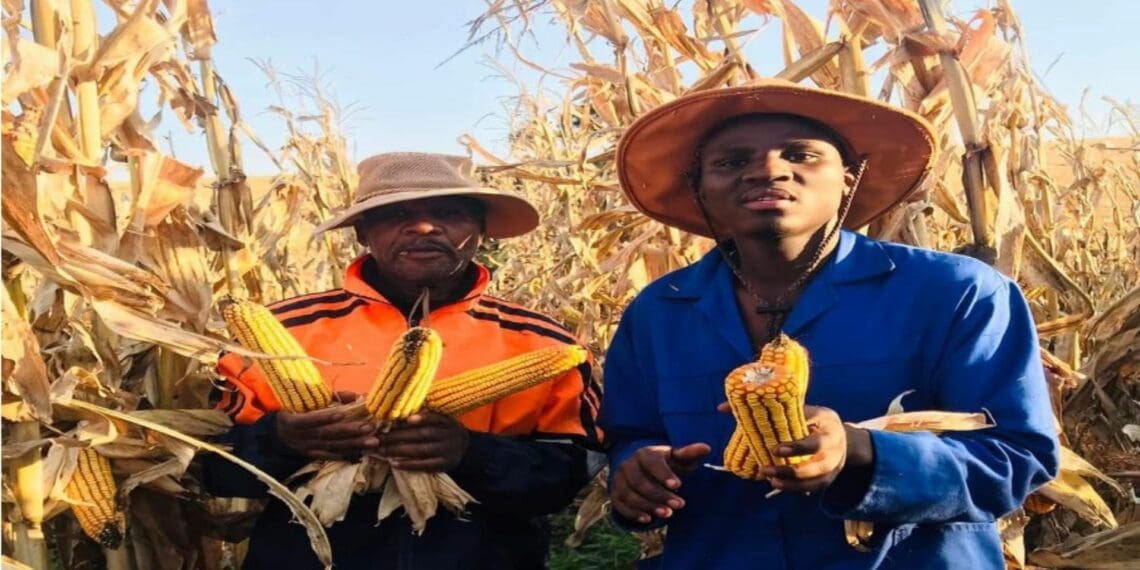
Named one of the Eastern Cape’s trailblazers of 2021, Nkosinathi Makamela defied the odds and found success with his farming business venture. The 22-year-old animal science student from the University of Fort Hare has been recognised as one of South Africa’s youngest agripreneurs.
Makamela started a small-scale farm, Lolo Mixed Farming, with his father at the age of 19, with as little as R1500 from his monthly NSFAS allowance.
His hard work has led him to win a number of prestigious awards and judging from the amount of work he shares on his social media platform, he has all the right qualities to be an entrepreneur.
Food For Mzansi got upclose and personal with this talented young agripreneur.
You were named one of Eastern Cape’s trailblazers by the National Youth Developmental Agency (NYDA) in 2021. What did this moment mean to you?
Just thinking of that moment still gives me butterflies in my stomach because I never thought that a young person like me, who comes from a very small town like Idutywa, would become the face of the NYDA trailblazers. It is unbelievable and shocking at the same time, but I am very honoured to be one of the inspiring youth of Mzansi.
You share a close bond with your father. He must have been so proud.
I am what I am today because of him. Receiving the award meant that he reaped the fruit that he planted 20 years ago. It also meant that his work with me finally got recognised. He was very excited and proud at the same time.
Take us back to where it all began…
It all started in 2020 during the Covid-19 lockdown. I am a University of Fort Hare student, so we were asked to go home for safety precautions. [Studying remote meant that] we took online learning as a form of studying. Being at home did not stop the NSFAS bursary from providing, so I used my April allowance to start the business. I bought seeds at a local market and took them from there to where they are now.
Your mother used to farm. Did she spark your farming interests?
I’d say both my mother and father [inspired me]. Even though she is no longer with us, her death left a huge void in the family. I remember when I would come home from school to find out that everything she worked for is dying, including the pigs and the crops. I was very concerned as to how would we survive because all the crops that were meant to provide for us were dying, so I decided to become a farmer as soon as I got the chance.

How did you acquire the land?
I’m actually using my family’s land. There was once a shop in our community that was owned by a white person. When he went out of business, he gave my father the authority to acquire the land he used for his shop, which resulted in my family owning a very large amount of land. My community also gave me a piece of land, however I haven’t used it yet.
What kind of crops do you grow and how do you market your products?
Spinach, carrot, beetroot, butternut, cabbage and some soya beans. I use mostly Facebook as you can see. Whenever I have new stock available, I post pictures on Facebook, then people place their orders.
Farming is not without challenges. What’s been your biggest headaches as a farmer?
I would say the presence of water for my crops and livestock has been one of those challenges. Secondly, is the presence of capital. Since I am a still at an entry level I do not have enough capital to invest on equipment for the business. Remember, I started this business with my allowance, which barely covers anything because I also need it to maintain myself at school.
Thirdly, is the challenge of selling my products. There are times where I do not sell anything, but I am working on that. And also the presence of pesticides, insects and worms are a huge challenge. I remember they ate my spinach some time ago.
Do you have a partnership with retail stores?
I haven’t formed any partnership with retail stores, however I do have partnerships with my community’s vendors. I supply to them to sell in town as a form of free market.
How much money do you make on average with your farming business?
I can’t really provide a figure. All I can say is that it depends on what I’m selling at that time. For example, since my farming business is mixed, selling livestock does sometimes get me a lot of money, but it is not constant because people don’t always buy these types of products. It comes and goes. But on holidays when there are “imigidi” (coming of age celebrations) – it does make kind of a lot (laughs).
Starting a business is no small feat. What have you enjoyed most about starting yours?
I’d say the independence that comes with it, but also the quality time I share with my father to build something that is not only my empire, but my family’s too. And also, I enjoy the support coming from my community. They are very supportive, so this business has brought people together in a sense.
And also It makes me happy to see something that was a dream three years ago, is growing in front of my eyes. It’s the smallest things that I enjoy, like feeding the chickens, cleaning the kraal, there’s just a warm feeling about it that makes me proud.

Has it been hard to balance your personal life and your work?
Sometimes I am very strict when it comes to time management. During the semester I focus on my school work, and during recess I work my ass off at that farm to help my father out. But in terms of my personal life, my girlfriend understands what I have to do, so I wouldn’t say it’s really hard, but it does require a lot of effort and sacrifice.
What are your future plans?
I’m such a dreamer, I have so many plans for the future. I plan on becoming a commercial farmer and growing my business by doing both crop and livestock farming. In addition, because this land belongs to my parents, I intend to have my own land, maybe build myself a cottage next to my farm and live my life with my business.
I just want to live with my dream; own a fruit and veg shop where I sell my products. And I also want to own an agri-school where I get to offer short agri-business courses to people who want to know more about this industry.
What advice would you give to other aspiring agripreneurs?
Don’t be afraid to start small. That small thing you have, use it and who knows, it may grow into something far better than you anticipated. Starting a business is not an easy task. It needs a lot of time, work, and energy. You will need to sacrifice a lot, so do that, and then you will succeed. Everything is possible, if you have it in your mind then it will come true. You just have to prepare yourself to work.
ALSO READ: Persistence pays off for Northern Cape farmer
Sign up for Mzansi Today: Your daily take on the news and happenings from the agriculture value chain.