Food For Mzansi journalist Duncan Masiwa travelled to Switzerland, where he met Andreas Scheurer, a fourth-generation farmer known for his sustainable, organic farming practices. On Scheurer’s 19.5-hectare farm in Kallnach, he focuses on stress-free cattle farming and selling whole animals directly to consumers, noting a zero-waste approach to meat production.
You might expect the air near a slaughterhouse to be thick with the scent of livestock and meat processing, but on Andreas Scheurer’s organic farm, it’s anything but. Instead, the air is crisp and refreshing, offering a stark contrast to what you’d imagine in such close proximity to a slaughterhouse.
In Kallnach, a village in the Bernese Seeland region of Switzerland, I met Scheurer, owner of Bio Scheurer. The purpose of my visit was to find out how this fourth-generation farmer and agronomist practices on-farm slaughtering, a practice that only gained official approval in Switzerland in 2020.
“Our cattle breed is Aubrac. It’s a French breed,” Scheurer shares proudly. “Right now, we have three heifers and eight calves.”
He adds that his herd of Aubrac suckler cows usually consists of 10 to 12 suckler cows and their calves. With these animals, he can manage his farm in a closed cycle.
Stress-free living for cattle
On his 19.5-hectare farm, the animals stay in a comfortable, familiar place until the end of their lives, and they’re never separated from the rest of the herd. This is part of his strategy to make sure animals live in a stress-free environment.
“Feeding is only grass for our cows. We like to have them outside the whole year, eating the grass on pasture, but it’s not possible in wintertime. We have to feed dry grass (hay).”
They also don’t milk the cows. The milk is for the calves. When the calves are weaned, they are slaughtered within ten months.
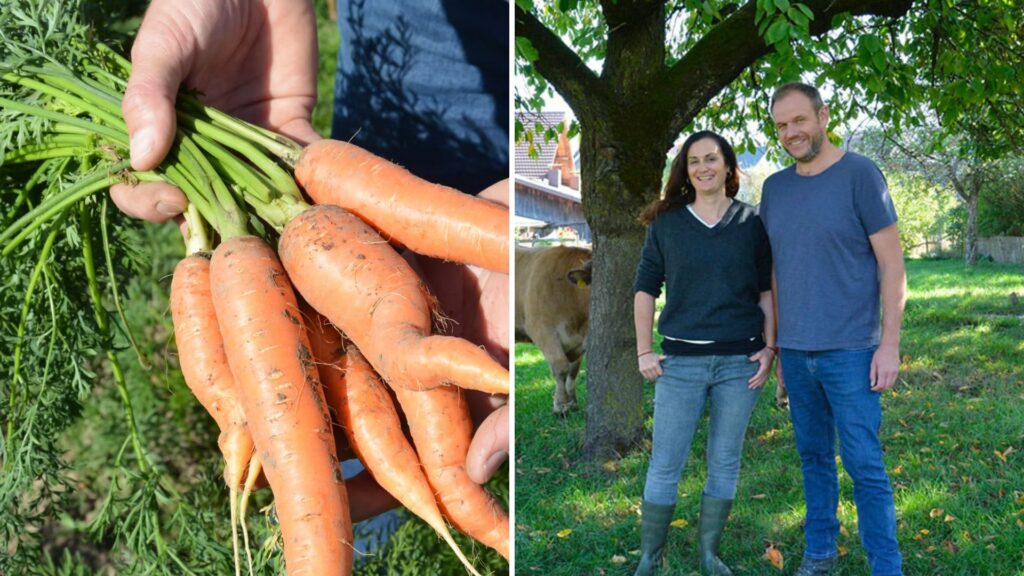
The farm is also home to grass grown in a rotation cycle. The crop rotation consists of temporary seeded pasture, wheat, soya, spelt, carrots, and golden millet.
This benefits the soil and also provides food for the cows. In addition to meat, the cows also produce manure and slurry, which can be used as fertiliser in arable and vegetable farming.

Selling every last bit
Scheurer, who also works full-time as an agronomist at the School of Agricultural, Forest and Food Sciences HAFL in Zollikofen, says they sell their beef directly to consumers.
Their goal, he explains, is to sell the whole animal without wasting any part of the animal.
Scheurer, who also dedicates most of his time as an agronomist at the School of Agricultural, Forest and Food Sciences HAFL in Zollikofen, shares that they take a direct approach to selling their beef.
They sell straight to consumers, ensuring that each cut is appreciated for its value. What really struck me was his thoughtful approach: their goal is to sell the entire animal, making sure that nothing goes to waste.
“We have around 120 customers, so we can sell all the meat we have to the consumers.
“We make packages of 10 kilograms of beef and we sell it like that. Our calves are around 12 months old when we slaughter them.”
Related stories
- Pascal’s pride: Farm innovates with sustainable practices
- Michaela helps Austrian farmers find their voice
Since 1 July 2020, farm and pasture slaughter has been officially allowed under the Ordinance on Slaughter and Meat Inspection (VSFK). However, farmers must first obtain a licence from the cantonal veterinary office. One key requirement is that there needs to be a slaughterhouse within a 20-minute drive, ready to accept the animals once they’ve passed.
A trained person, for example, a butcher or a farmer with appropriate training, must carry out the stunning and bleeding.
“I was a little bit afraid to slaughter cows because Swiss consumers are not used to eating cow beef because it’s not so tender, but it’s tastier, more intensive in taste, but Swiss consumers are not so used to it.
“We don’t have a store; when we slaughter an animal, after slaughtering, we wait for three weeks, and then we call the customers and they come here. And take their package like that.”
Transparency in practice
When asked about the role of branding and packaging, Scheurer answers: “We package by ourselves in the slaughterhouse. There is a brand with our name and address, but not exactly like a brand.”
They also market via their website.
Customers also form a unique connection with the farm. In the beginning, he made the mistake of telling customers the names of the cows, which he says was a mistake.
“Customers, they don’t want to know that. They do want to know that the cows are well taken care of.
“When they come to pick up their beef, they want to see the cows, the furniture in the barn… and where they are. It’s important for the consumers that they know our cows are fed only by grass.”
- [Editor’s note: Duncan Masiwa’s visit to Switzerland was sparked by his recognition as one of the International Federation of Agricultural Journalists (IFAJ’s) top 10 young leaders for 2024. This prestigious honour took him to IFAJ Global Congress, where he had the opportunity to explore innovative farming practices and connect with global agricultural experts.]
READ NEXT: Dairy dynasty: Family, innovation fuel Foundation Farm success
Get Stories of Change: Inspirational stories from the people that feed Mzansi