Despite decades of arrests and high-tech sea patrols, South Africa’s abalone poaching crisis remains a permanent fixture of the coastal landscape.
Driven by a deadly combination of Far Eastern demand, gang-controlled drug pipelines, and a local economy that leaves fishers with few choices, the illicit trade has become an entrenched survival mechanism that law enforcement is struggling to break.
The scale of the problem was highlighted when eleven suspects were arrested following the discovery of abalone with an estimated value of over R10 million in Alberton, Gauteng.
The persistent nature of this crime raises a critical question: What is the government and the police doing to combat this never-ending problem?
The answer lies in a complex web of high-stakes money and social desperation. According to the department of forestry, fisheries and the environment (DFFE), the trade is primarily driven by the huge prices abalone fetches in the Far East. These high returns act as a magnet for organised criminal syndicates who have turned the harvesting of wild stocks into a sophisticated international operation.
A cycle of syndicates and survival
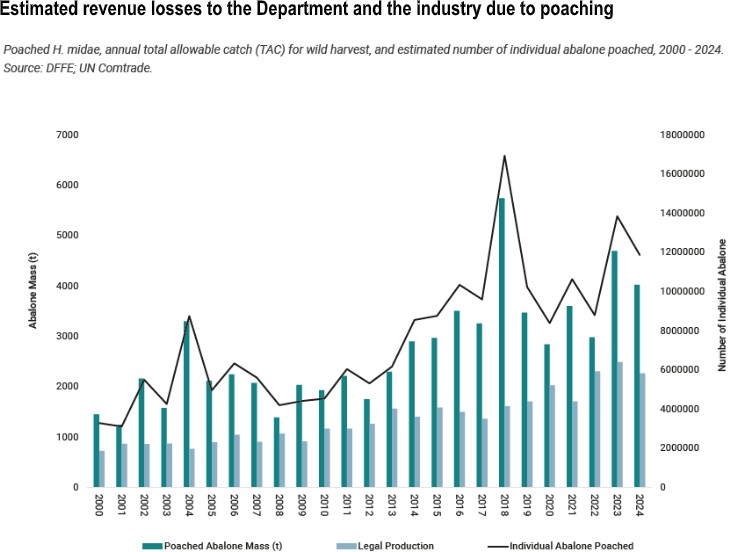
The scale of this problem is captured in the department’s data, which shows poached mass consistently outstripping legal production for over two decades.
Director of communication and advocacy at the department of forestry, fisheries and environment, Zolile Nqayi, said, “The illegal harvesting of abalone is mainly driven by the high values which abalone reaches in the Far East, and these high returns attract the involvement of criminal syndicates.
“Illegal harvesting has resulted in severe declines in abalone populations, and the resource is currently considered to be heavily depleted. The current levels of illegal harvesting remain higher than can be sustained by the resource, leading to continued declines in the abundance of abalone across its range, and jeopardising the legal fishery.”
Related stories
- Quota fears rise as abalone stocks dwindle
- West Coast abalone farm is a beacon of hope
- Aquaculture poised for growth with support to small-scale farmers
- Farmer 101: Mariculture is flooded with opportunities
According to the International Collective in Support of Fishworkers (ICSF), this lucrative industry is allegedly controlled by gangs who trade abalone with criminals from Asian countries in exchange for drugs.
Local fishermen say they, too, have been forced into illegal fishing. Though many involved are associated with gangs, former poacher Dimitri Williams explained, “You must do it because when you are out at sea and don’t catch anything, you don’t have any money. The children must go to school, you must live as a human being, you must eat, there are lots of stuff you need.”
Enforcement measures in place
To combat this entrenched crisis, the DFFE said it enforces the Marine Living Resources Act through daily inspections, coastal patrols, sea patrols, anti-poaching operations, verifications, and investigations in cooperation with enforcement partners.
The department also shared that it intensified efforts under Operation Phakisa’s Marine Protection Services and Governance initiative, specifically Initiative 5: the Enhanced Coordinated Enforcement Programme.
“This unites departments and role players to tackle illegal activities like abalone poaching with joint resources, while pursuing administrative actions against commercial permit holders, including fines and cancellations for violations alongside collaborations with the South African Police Service (SAPS) and other agencies,” Nqayi said.
Lieutenant Colonel Christopher Singo of the Priority Crime Investigation (DPCI) unit emphasised ongoing collaboration with government institutions, private sectors, communities, and law enforcement agencies like the Hawks to trace and dismantle these networks.
“These joint efforts delivered the recent Alberton bust with multiple arrests, signalling potential progress in the fight,” Singo said.
READ NEXT: Sona 2026: Illicit trade and tariffs push farmers to breaking point