Saturday, September 5, 2026
SUBSCRIBE
22 GLOBAL MEDIA AWARDS
Food For Mzansi
  • News
  • Changemakers
  • Lifestyle
  • Farmer’s Inside Track
  • Food for Thought
No Result
View All Result
  • News
  • Changemakers
  • Lifestyle
  • Farmer’s Inside Track
  • Food for Thought
No Result
View All Result
Food For Mzansi
No Result
View All Result
in It Takes a Village

West Coast abalone farm is a beacon of hope

A small group of abalone farmers is helping the Doring Bay Abalone farm mature into a great one with South Africa the biggest abalone producer outside of Asia. This rural project is doing big things, not only for the country, but for the lives of impoverished fishing community members

by Liezl Human
1st February 2023
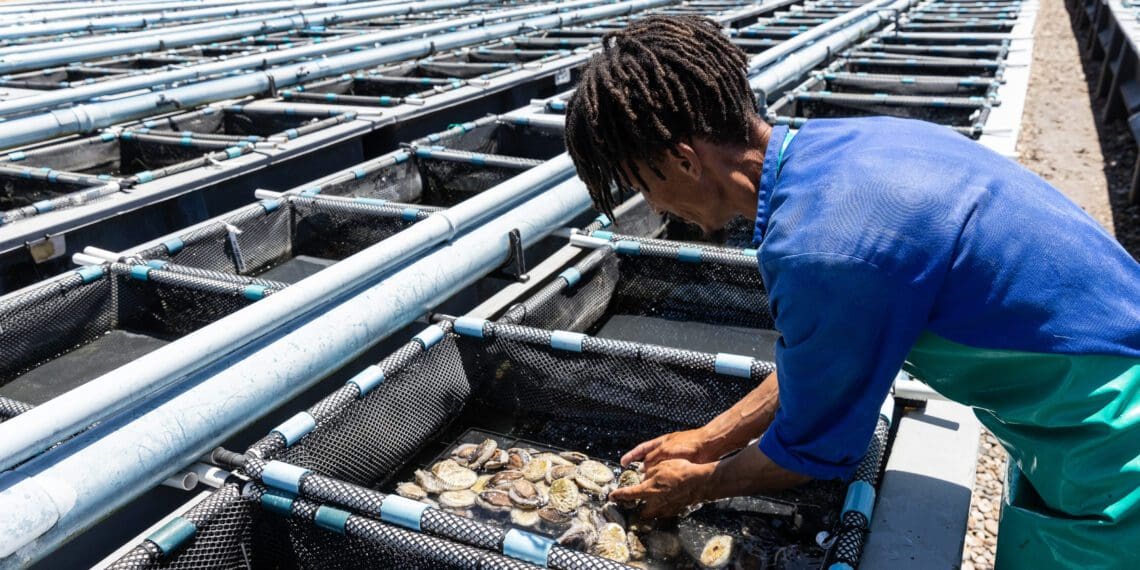
General worker Roderick Coetzee placing the abalone into tubs to be weighed and graded. Photo: Supplied/Ashraf Hendricks

General worker Roderick Coetzee placing the abalone into tubs to be weighed and graded. Photo: Supplied/Ashraf Hendricks

Share on FacebookShare on TwitterShare on WhatsApp

“If we protect what we have, eventually generations to come will benefit from it,” says Ruben Saul, chairperson of the Doringbaai Development Trust. Speaking from the Doring Bay Abalone farm based in the small West Coast fishing village, 40 kilometres north of Lambert’s Bay, he is excited about what’s in the pipeline.

The land-based farm extends along the harbour. The abalone, also known as “perlemoen”, are hatched and spawned in several old factory buildings. When GroundUp arrived, rows of tubs filled with more mature abalone were outside in the sun.

Nearly all the abalone hatched, spawned, and grown on the farm are exported to Hong Kong, China where it is highly valued and regarded as a delicacy.

Doring Bay Abalone is one of a few companies in South Africa that provide abalone to the Asian market legally. The species of abalone grown on the farm, Haliotis midae, is currently a critically endangered species due to rampant poaching.

A 2018 report from TRAFFIC, a United Kingdom-based conservation non-governmental organisation, estimated that between 2000 and 2016, almost 100 million abalone were illegally harvested from South African seas. The report noted that two-thirds of abalone imported from South Africa came via the illegal market.

Photo: Supplied/Ashraf Hendricks
Doring Bay Abalone is an equity project that belongs to the emerging farmers. Photo: Supplied/Ashraf Hendricks

Small fishing community

A 2022 report by the Global Initiative, a Switzerland-based civil-society organisation, estimated that illegal harvesting currently exceeds 3 000 tonnes per year. The report notes that there is a “fast-growing abalone aquaculture sector, producing close to 2 000 tonnes of abalone annually”, much smaller than the illicit market.

While the Doring Bay Abalone fosters sustainability of the critically endangered species, the production of 60 tonnes of abalone per year is just a drop in the ocean.

When the farm opened in 2013, it had eight workers. Now it employs over 50 local people.

Unlike other commercial aquaculture farms, the community has a 37% shareholding stake in the Doring Bay farm, held in the Doringbaai Development Trust. The rest is privately owned.

The trust was established after the old Oceana crayfish factory closed down in 2006 after about 75 years of operation. This was devastating for the community as it left many people without jobs, says Saul. The trust was set up in 2007 to help the community cope with the closure.

Saul said that hundreds of people from the small fishing community have benefitted from the opportunities created since this project’s inception.

At the 2011 census, the town’s population stood at about 1 200 people.

Ruben Saul, chairperson of the Doringbaai Development Trust, says there are plans to expand the farm and create more job opportunities for locals. Photo:Supplied/Liezl Human

Living on abalone

According to Anchen Frisley, a supervisor and worker at the farm for almost five years, most people in Doringbaai make a living as fishers, in the abalone industry or at mines nearby.

Though Frisley spends most of the day grading it by size and the quality of its shell, she has never tasted it. “I haven’t eaten [abalone] and I don’t want to because I work with it every day,” she says jokingly.

Frisley explains that the market size of abalone ranges between 100 and 250 grams. Dried abalone is the preferred method of preserving it for export, but it can also be frozen, canned, or exported live.

Saul says there are plans to expand the farm to produce an additional 30 tonnes. This, he estimates, will create 20 more permanent jobs. Saul says that this expansion will cost about R8 million.

This article was written by Liezl Human and first appeared on GroundUp.

ALSO READ: ICYMI: Potato industry value chain under attack

Get Stories of Change: Inspirational stories from the people that feed Mzansi.
Liezl Human

Tags: AbaloneperlemoenWestern Cape
News

Aucamp outlines strategy for biosecurity, trade, and infrastructure

by Tiisetso Manoko
2nd September 2026

In an exclusive interview with Food For Mzansi, agriculture minister Willie Aucamp outlines his vision to accelerate the AAMP, tackle...

Read moreDetails
Tobias Doyer, CEO of Grain SA. Photo: Supplied/Grain SA Facebook

Rising costs, climate risk push Swartland wheat farmers to the brink

2nd September 2026
Sick spuds: No need to panic as SA’s potatoes are banned in Zim

Potato turning point ahead as onions double in price year-on-year

1st September 2026
Early calf care: Key growth targets every cattle farmer must track

Early calf care: Key growth targets every cattle farmer must track

1st September 2026

How to align your farming cycles with long-term financial success

1st September 2026

Mamelodi farmers learn how to test soil with just a bottle and spade

How Tebogo beat post-harvest losses with smart agro-processing

Former electrical engineer builds farming powerhouse on tribal land

This week’s agri events: 31 August – 03 September

Tough times, hardy cattle: Why Mzansi farmers are choosing Nguni

Join Food For Mzansi's WhatsApp channel for the latest updates!

JOIN NOW!
Next Post
Podcast: 'Let's separate land from all the issues'

Podcast: 'Let's separate land from all the issues'

THE NEW FACE OF SOUTH AFRICAN AGRICULTURE

With 21 global awards in the first six years of its existence, Food For Mzansi is much more than an agriculture publication. It is a movement, unashamedly saluting the unsung heroes of South African agriculture. We believe in the power of agriculture to promote nation building and social cohesion by telling stories that are often overlooked by broader society.

Honoured roots: A father’s legacy, a daughter’s farming dream

Gauteng farmers urged to harness massive urban market

Foot-and-mouth crisis hits SA dairy industry with R1-billion loss

Tough times, hardy cattle: Why Mzansi farmers are choosing Nguni

Dragon fruit thrives in KZN valley despite tough national season

Government hikes sugar import price, but industry warns of gap

  • Awards & Global Impact
  • Our Story
  • Contact Us
  • Cookie Policy
  • Privacy Policy
  • Copyright

Contact us
Office: +27 21 879 1824
News: info@foodformzansi.co.za
Advertising: sales@foodformzansi.co.za

Contact us
Office: +27 21 879 1824
News: info@foodformzansi.co.za
Advertising: sales@foodformzansi.co.za

  • Awards & Global Impact
  • Our Story
  • Contact Us
  • Cookie Policy
  • Privacy Policy
  • Copyright

Chat Options

I'm Lerato, your AI assistant!
No Result
View All Result
  • News
  • Changemakers
  • Lifestyle
  • Farmer’s Inside Track
  • Food for Thought

Copyright © 2024 Food for Mzansi

This website uses cookies. By continuing to use this website you are giving consent to cookies being used. Visit our Privacy and Cookie Policy.