Monday, September 7, 2026
SUBSCRIBE
22 GLOBAL MEDIA AWARDS
Food For Mzansi
  • News
  • Changemakers
  • Lifestyle
  • Farmer’s Inside Track
  • Food for Thought
No Result
View All Result
  • News
  • Changemakers
  • Lifestyle
  • Farmer’s Inside Track
  • Food for Thought
No Result
View All Result
Food For Mzansi
No Result
View All Result
in News

‘Young people of Africa, step up to feed the continent!’

by Zolani Sinxo
18th November 2021
Agriculture, land reform and rural development minister Thoko Didiza and Grace Obeda from the African Development Bank are among the A-list of speakers participating in the Pan-African Summit on Youth in Sustainable Agriculture. Photos: Supplied/Food For Mzansi

Agriculture, land reform and rural development minister Thoko Didiza and Grace Obeda from the African Development Bank are among the A-list of speakers participating in the Pan-African Summit on Youth in Sustainable Agriculture. Photos: Supplied/Food For Mzansi

Share on FacebookShare on TwitterShare on WhatsApp

Young people of Africa, you need to engage and grow a vibrant agricultural sector – for the sake of sustainable food security on our continent.

A strong call to action came from South African agriculture, land reform and rural development minister Thoko Didiza today. She was joined by Grace Obeda, principal youth employment officer at the African Development Bank, in opening Food For Mzansi’s Pan-African Summit on Youth in Sustainable Agriculture.

The summit marks three years since the award-winning Food For Mzansi was established, and is currently underway in Pretoria and virtually. Guests and speakers from at least 15 countries across Africa are attending.

As keynote speaker, Obeda said that agriculture remains the backbone of Africa’s economic development. “The best way to transform it, is through raising productivity.”

She talked about the need for Africa to up its game in creating job opportunities for young people. Africa’s most valuable asset and sustainable competitive advantage is not its oil, gas and minerals, she said, but its demographically dominant youth.

“70% of Africans are under 35. This is according to statistics, in 2019, of the African Development Bank. They are projected to reach 850 million by 2050 and will constitute half of the 2 billion working-age population by 2063.” said Obeda.

Before the arrival of Covid-19, Africa’s employment has been lagging and African countries needed to create an average of 1.7 million jobs per month from 2013 to 2063 just to meet the current employment bids. And about 54 million African youth are not in employment, education or training. “Where are these young people?” asked Obeda.

The effects of Covid-19 in youth employment  

Feeding Africa: Grace Obeda of the African Development Bank, keynote speaker at the Pan-African Summit on Youth in Sustainable Agriculture. Photo: Supplied/Food For Mzansi
Grace Obeda of the African Development Bank. Photo: Supplied/Food For Mzansi

In just about a year and a half now, the pandemic has devastated the livelihoods of millions of young people globally, said Obeda.  

“This increase in unemployment… is expected to exceed the employment rates from the 2009 global financial crisis.”  Most skills training opportunities for youth have also been interrupted, creating long-term implications for post-Covid recovery.  

Adding to the challenges, Africa’s private sector, which provides most of the employment, is not growing fast enough. Africa must therefore harness its young demographic by equipping it with skills and tools to create jobs.  

“Fortunately, even with this [being] vulnerable, opportunities for youth are presenting themselves so much more prominently in the digital space. “Why? Because young people have a competitive advantage over their older counterparts when it comes to the application of technology. In fact, centres with a high level of digitalisation seem to have weathered the storm.”

Obeda added, “We know that agriculture remains the backbone of Africa’s economic development and the best way to transform it is through raising productivity. And this could be productivity from farm level all the way to the market.”

Supporting young people, especially in agriculture, will be one of Africa’s winning strategies to creating sustainable jobs. “So, I guess that’s why we are here today, talking about the role that you can play in transforming Africa’s food systems. Because agriculture is a sector with endless possibilities if properly diversified.”

Reigniting the spirit of Pan-Africanism

Didiza congratulated Food For Mzansi on what she called the wonderful work that the publication was doing in the agricultural sector.

“Food For Mzansi, in its three years, has done so much to profile the agricultural sector in our country. It has ensured that diverse and critical views are heard. At the height of the Covid-19 pandemic, it has fed the sector with information and regulations that impacted our agriculture and agribusiness.”

Didiza also touched on the issue of climate change that has affected rural smallholders in agriculture, saying more needs to be done to fight the effects of climate change and save jobs.  

“We have come together as young people where we are reigniting the spirit of Pan Africanism. This is important as we seek to uplift our engagement and collaboration for the future.”
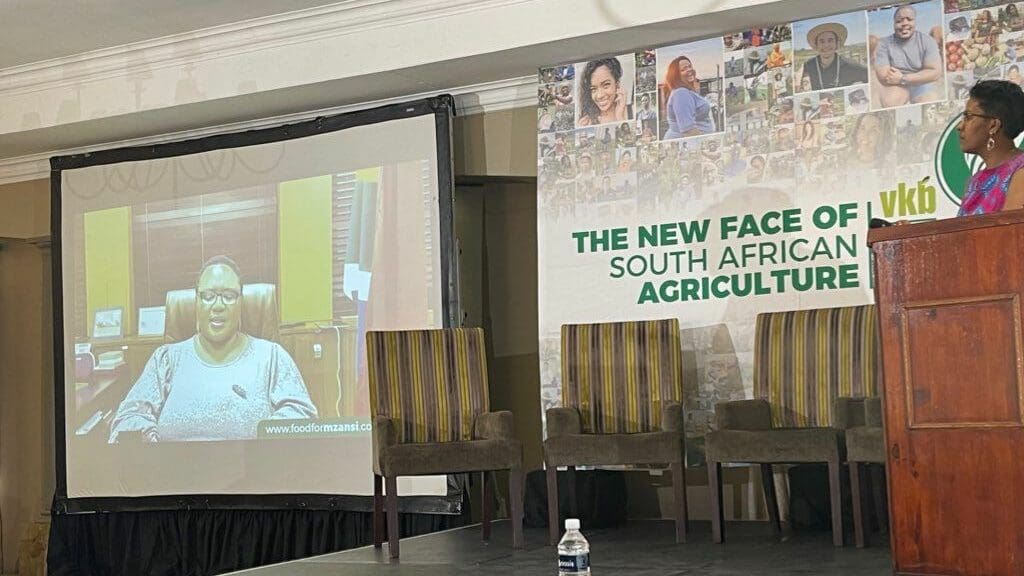
Summit on sustainable agriculture in Africa: Minister Thoko Didiza addresses the summit remotely, with Dawn Noemdoe, Food For Mzansi's editor for audience engagement hosting the event. Photo: Food For Mzansi
Minister Thoko Didiza addresses the summit remotely, with Dawn Noemdoe, Food For Mzansi’s editor for audience engagement hosting the event. Photo: Food For Mzansi

Coverage on the summit is ongoing.

ALSO READ: Jozi agripreneur brings African foods to global markets

Sign up for Farmer’s Inside Track: Join our exclusive platform for new entrants into farming and agri-business, with newsletters and and podcasts.

Zolani Sinxo

Zolani is an award-winning journalist and holds a National Diploma and a B Tech in journalism, he is a journalist at heart with a particular interest in developmental journalism, politics, African development stories, environment, and global and national current affairs. He started to develop an interest in writing and storytelling at a young age after he co-authored a folk tales children’s book in 2005 titled Our Stories, Amabali Ethu. After graduating, Zolani worked at various government institutions where he worked in the marketing and communication departments specialising in media liaison and editorial management. His passion for developmental journalism saw him being a co-founder of a community newspaper in Stellenbosch, Umlambo News. He has also worked for the Group Editors as a journalist for the George Herald and is also the editor of Idinga community newspaper. Zolani loves books, especially on Africa’s politics, history, stories, and biographies of African leaders who have made a significate contribution to the continent’s socio-economic wellbeing.

Tags: Food For MzansiPan-African Summit on Youth in Sustainable AgricultureThoko Didiza
Tough times, hardy cattle: Why Mzansi farmers are choosing Nguni
News

Tough times, hardy cattle: Why Mzansi farmers are choosing Nguni

by Vateka Halile
3rd September 2026

Nguni cattle are known for their hardiness and low-maintenance needs, making them ideal for Mzansi's harsh conditions. However, market prejudice...

Read moreDetails
Dragon fruit thrives in KZN valley despite tough national season

Dragon fruit thrives in KZN valley despite tough national season

3rd September 2026
The future of Mzansi's sugar industry hangs in the balance

Government hikes sugar import price, but industry warns of gap

3rd September 2026

Chicken is booming, but the real money is in the supply chain

2nd September 2026
How Tebogo beat post-harvest losses with smart agro-processing

How Tebogo beat post-harvest losses with smart agro-processing

2nd September 2026

Honoured roots: A father’s legacy, a daughter’s farming dream

This week’s agri events: 31 August – 03 September

Dragon fruit thrives in KZN valley despite tough national season

Beyond finance: Making women-led farms bankable

RSVP now: Emerging farmers’ programme at Nampo Cape

Join Food For Mzansi's WhatsApp channel for the latest updates!

JOIN NOW!
Next Post
Prof. Karen is bowing out of the horticulture industry after a long and successful career. Photo: Supplied/Food For Mzansi

Horticulture guru and mentor bows out

THE NEW FACE OF SOUTH AFRICAN AGRICULTURE

With 21 global awards in the first six years of its existence, Food For Mzansi is much more than an agriculture publication. It is a movement, unashamedly saluting the unsung heroes of South African agriculture. We believe in the power of agriculture to promote nation building and social cohesion by telling stories that are often overlooked by broader society.

Tiger Brands CEO calls for stronger food value chain

Plant, pick, protect: The rising potential of urban foraging in SA

RSVP now: Emerging farmers’ programme at Nampo Cape

Community-led farms boost food security and incomes in Limpopo

Farmers rethink water use as shortages threaten food production

Honoured roots: A father’s legacy, a daughter’s farming dream

  • Awards & Global Impact
  • Our Story
  • Contact Us
  • Cookie Policy
  • Privacy Policy
  • Copyright

Contact us
Office: +27 21 879 1824
News: info@foodformzansi.co.za
Advertising: sales@foodformzansi.co.za

Contact us
Office: +27 21 879 1824
News: info@foodformzansi.co.za
Advertising: sales@foodformzansi.co.za

  • Awards & Global Impact
  • Our Story
  • Contact Us
  • Cookie Policy
  • Privacy Policy
  • Copyright

Chat Options

I'm Lerato, your AI assistant!
No Result
View All Result
  • News
  • Changemakers
  • Lifestyle
  • Farmer’s Inside Track
  • Food for Thought

Copyright © 2024 Food for Mzansi

This website uses cookies. By continuing to use this website you are giving consent to cookies being used. Visit our Privacy and Cookie Policy.