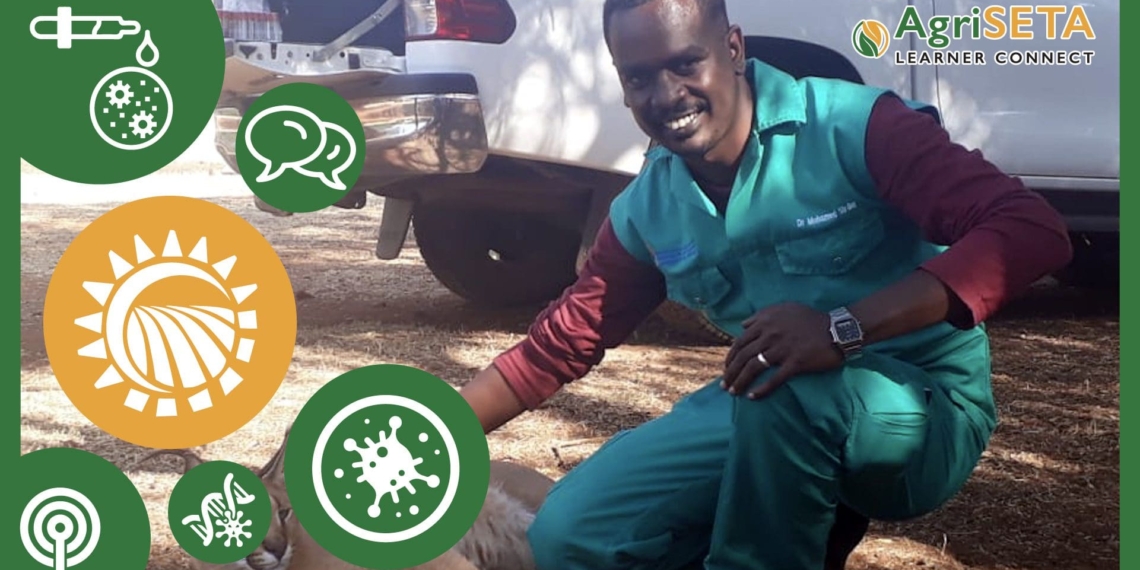
North Africa’s loss was South Africa’s gain. And just as well because we have a critical shortage of veterinary epidemiologists, and the nation is looking at you to perhaps, one day, walk in the shoes of the likes of Dr Mohamed Sirdar.
Growing up in a small town in the embattled Sudan, Sirdar received a scholarship at the University of Pretoria while studying veterinary science at a university in his home country. The rest is history. Almost two decades of studying and doing research between Sudan and South Africa later, he has recently completed his PhD degree in veterinary epidemiology.
Today, he works as a senior veterinary researcher at the Agricultural Research Council at the Onderstepoort Veterinary Research Institute. He is happy to call Mzansi his second home, and we’re grateful that he’s brave enough to choose a career for which we have a critical shortage of skills in the country.
Stepping into his role takes patience, perseverance and hard work. Veterinary epidemiologists are specialised veterinarians who focus on disease outbreaks in animal populations. Sirdar’s day-to-day work involves coordinating and offering training programmes on animal health issues for smallholder farmers across the country. He is also conducting disease surveillance activities.
If you are interested in this career or field of study follow the links below to learn how get involved. Through our AgriSETA Learner Connect campaign we will feature many more careers to choose from in the agricultural sector, right here on Food for Mzansi, as well as 19 radio stations all over the country.
Now over to Dr Mohamed Sirdar, senior veterinary researcher at the Agricultural Research Council’s Onderstepoort Veterinary Research Institute. He will tell you how to possibly land this job through very, very hard work…
1Could you sum up your job for us? I’m a senior veterinary researcher and also the manager of our training unit. My team and I strive to deliver world-class veterinary research in providing scientific support. Research activities focus on the development and improvement of vaccines and diagnostic tests, applying the latest molecular biological techniques.
2So, what does the day-to-day of your job entail? I coordinate and deliver training programmes on animal health issues for smallholder farmers across the country. We host and go to farmers’ days, training days and farmers’ technical veterinary support activities.
We also organise professional training for the national veterinary services and regional or international partners. These training activities are performed at our state of the art veterinary laboratories.
In addition, I’m engaging in research activities mainly focusing on transboundary-animal diseases and food safety such as developing proposals, designing research studies, analysing data, preparing reports and writing scientific manuscripts for publication. We also conduct disease surveillance activities that involve animal sampling animals, surveys and monitoring animal diseases.
3
What qualification do you need for this career? A Bachelor’s degree in veterinary science is required to perform veterinary duties. However, becoming a researcher requires further studies and I completed a Master’s degree and doctoral studies.
4What are the character traits you need to be great at your job? Team spirit, excellent communication skills, patience and perseverance, good observation and attention to minor details as well as analytical thinking.

5What subjects do I need to become a veterinary epidemiologist Firstly, you will need to have a degree in veterinary science or veterinary medicine. Then you need at an MSc qualification in the following subjects: basic veterinary epidemiology and population medicine, biostatistics in veterinary science, analytical veterinary epidemiology, animal health information management, scientific reasoning in veterinary epidemiology and advanced topics in veterinary epidemiology. These subjects are based on the University of Pretoria’s syllabus.
6What do you love about agriculture as a space to work in? I love that the agricultural space provides a wide view to all other professions. It interlinks with other disciplines. For example, working at a poultry farm, exposes you to different fields and disciplines like engineering such as operating the ventilation, cooling systems, management, biology pest control, veterinary medicines, including vaccination, environmental factors in term of biosecurity, and economics like sales and finance.
7Don’t be modest, tell us about your proudest career moments? I believe that we have proud moments of ourselves at each stage of our career development. The motivation and energy we gain and gasp during that moment, paves the path for us to the next level of our career. Completing my PhD degree in veterinary epidemiology from the University of Pretoria and the upcoming graduation ceremony at the end of September is certainly one of those moments.
8What do you do when you’re not at work? I enjoy being with family, playing volleyball and watching soccer.
9Any advice for young people who are inspired by your career story here on AgriSETA Learner Connect? They should always believe in themselves. Nothing is impossible to achieve. Just keep motivated, study and work hard, connect with others and always learn something new.
10Where can I study to become a veterinary epidemiologist? Remember, currently the faculty of veterinary science at the University of Pretoria is the only veterinary school in the country. In other words, there’s only one place in South Africa where you can become a veterinarian.
How to listen to AgriSETA Learner Connect:
Option 1: Click here to listen on Spotify (all mobile and other devices).
Option 2: Click here to listen on any Apple device.
Option 3: Click here to listen on Google Podcasts.
Option 4: Click here listen using this player. Just click “play”.
Catch AgriSETA Learner Connect on these radio stations:
-
Waterberg Stereo: Bela Bela, Brits, Naboomspruit, Pietersburg, Pretoria, Thabazimbi, Tzaneen – 104.9 FM
-
Waterberg Stereo: Thabazimbi, Naboomspruit – 104.9 FM
-
Laeveld Stereo: Nelspruit – 100.5 FM
-
Lichvaal Stereo: Lichtenburg – 92.6 FM
-
Overvaal Stereo: Viljoenskroon, Parys – 96.1 FM
-
Maluti FM: Bethlehem – 97.1 FM
-
Rosestad FM: Bloemfontein – 100.6 FM
-
Wild Coast FM: East London – 98.6 FM
-
Gamka FM: Oudtshoorn – 87.6 FM
-
Kouga FM: Humansdorp – 97.8 FM
-
Eden FM: Hessequa, Kannaland, Karoo, Oudtshoorn, Plettenbergbaai, Riversdale, Uniondale – 93.8 FM
-
Radio Overberg: Bredasdorp – 98.4 FM
-
Caledon FM: Caledon – 89.3 FM
-
Whale Coast FM: Hermanus – 96.0 FM
-
West Coast FM: Vredenburg – 92.3 FM
-
Lara FM: Springbok – 91.6 FM
-
NFM: Okiep – 98.1 FM