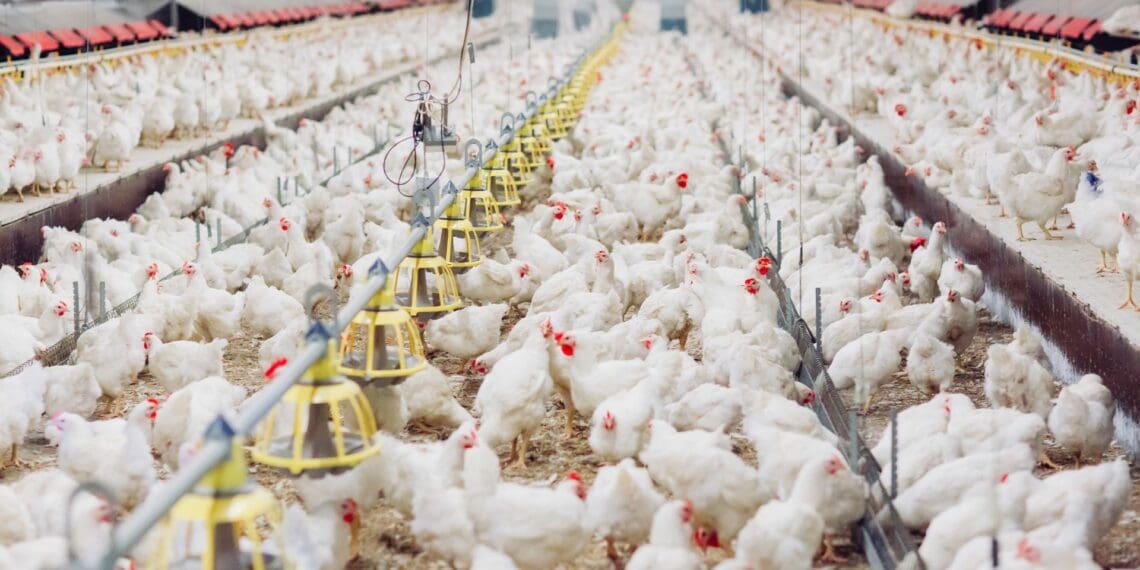
An outbreak of avian flu – a highly contagious viral infection that affects wild birds as well as poultry – has hit poultry farms in South Africa. Two different strains are causing bird flu outbreaks in the country – A(H5N1) and influenza A(H7N6). A specialist in poultry health, Shahn Bisschop, answers some questions put to him by The Conversation Africa.
What strain has broken out in South Africa?
The outbreak caused by a highly pathogenic (HPAI) strain of H7N6 avian influenza is causing the most concern at present. The strain was first confirmed in chickens near Delmas north of Johannesburg at the beginning of June 2023.
This virus is a novel mutation of a strain which originated from wild birds at or near the location of the original outbreak.
The strain is well-adapted to chickens – it infects them easily and replicates effectively in them, in preference to other avian species – and spreads very easily between birds and farms. An estimated 10 million have become infected while six million died from the H7N6. A further 1.7 million died from H5N1 earlier in the year.
The conventional control measures (collectively known as biosecurity) have been less effective than usual in limiting the spread of the disease. The main measures taken on poultry farms include strictly limiting human and vehicle movement. People entering farms will typically take further measures to limit disease transmission such as showering, changing clothes and disinfecting footwear when moving between different parts of the farm.
Because wild birds are associated with the spread of avian flu, measures are taken to ensure they are completely excluded from all chicken sheds.
ALSO READ: Bird flu: It’s safe for consumers to eat chicken, eggs
What’s new this time?
For at least the past nine years, HPAI H5 viruses of the 2.3.4.4 clade have been spread across the globe principally by wild bird migrations and infect a range of avian and mammalian species. The first recorded cases caused by viruses belonging to this clade were reported in South Africa in 2017. A second outbreak occurred in 2020. It was anticipated that the next outbreak would probably also be caused by these viruses and indeed the first reported cases of HPAI in 2023 in the coastal regions were associated with H5 strains.
Local experts are working on the theory that the present outbreak of H7N6 HPAI was created when a low pathogenicity AI (LPAI) virus circulating without causing disease in wild birds, underwent a mutation to become an HPAI strain adapted to cause serious disease in chickens. This mutation occurred locally.
Mutation from LPAI to HPAI has been described in poultry in various parts of the world but was considered less likely than the return of the H5 clade 2.3.4.4 viruses previously encountered.
LISTEN TO: Podcast: A farmer’s guide to protecting chickens against bird flu
What’s in place and what’s missing
Avian influenza is a “controlled disease”. That means it’s placed under strict government control with the aim of eradication as quickly as possible when outbreaks are detected. All outbreaks on farms are immediately reported to the state veterinary service, which takes responsibility for the disease.
The protocol for HPAI control is that all affected farms are placed under strict quarantine and all surviving birds are destroyed and disposed of as quickly as possible in order to limit the further spread of the disease.
However, there are weaknesses in the system.
Resources and compensation
The biggest is that the state veterinary services don’t have sufficient resources to manage the outbreaks effectively.
Secondly, because the state doesn’t compensate farmers for their losses, they have difficulty getting farmers to comply with orders to cull. This has meant that outbreaks have spread out of control. Infected birds have been moved off infected farms for sale – taking the disease with them.
Farmers in the EU and US are compensated when culling happens. This used to be the case in South Africa but it no longer happens.
As a result, South Africa has struggled to contain HPAI outbreaks. In 2017 and 2020/21 the outbreaks gradually slowed and eventually stopped.
HPAI outbreaks tend to be seasonal. In Europe, they occur principally in winter months. In South Africa, there is a similar but less clear trend of more cases in the winter and fewer in the summer. This may be related to reduced viral survival in hotter summer weather.
READ NEXT: Bird flu outbreak reveals opportunities for SA agriculture
Are there new approaches to consider?
New and innovative thinking is needed to deal with the reality on the ground in South Africa.
One possible solution is the introduction of appropriate vaccines. This would reduce the losses associated with outbreaks and would slow the spread of the disease between farms. Like all vaccines, they can’t prevent birds from becoming infected but they can manage the level of infection and spread. But they can’t eradicate the disease.
However, there are limited options in terms of available vaccines. South Africa would need to ensure that the vaccines registered for use in the country were effective against the local strain. If vaccines are poorly matched to outbreak strains, they won’t be effective.
All of this will take time, even with the best efforts of government and industry.
Does the strain pose a risk to people? What should consumers should be aware of?
The South African Poultry Association has made it clear that poultry products are safe for consumption. It has been collaborating with the University of Pretoria to make sure poultry products are indeed safe. Together with leading scientists, they have sequenced the current field strain of the H7 avian influenza virus. In a recent paper, scientists reported that none of the amino acid markers were present that afford the virus the ability to bind to mammalian cells.
This shows that infection of humans with the current virus is highly unlikely.
The story first appeared on The Conversation.
ALSO READ: Do-or-die: Protect your chickens from bird flu
Sign up for Mzansi Today: Your daily take on the news and happenings from the agriculture value chain.