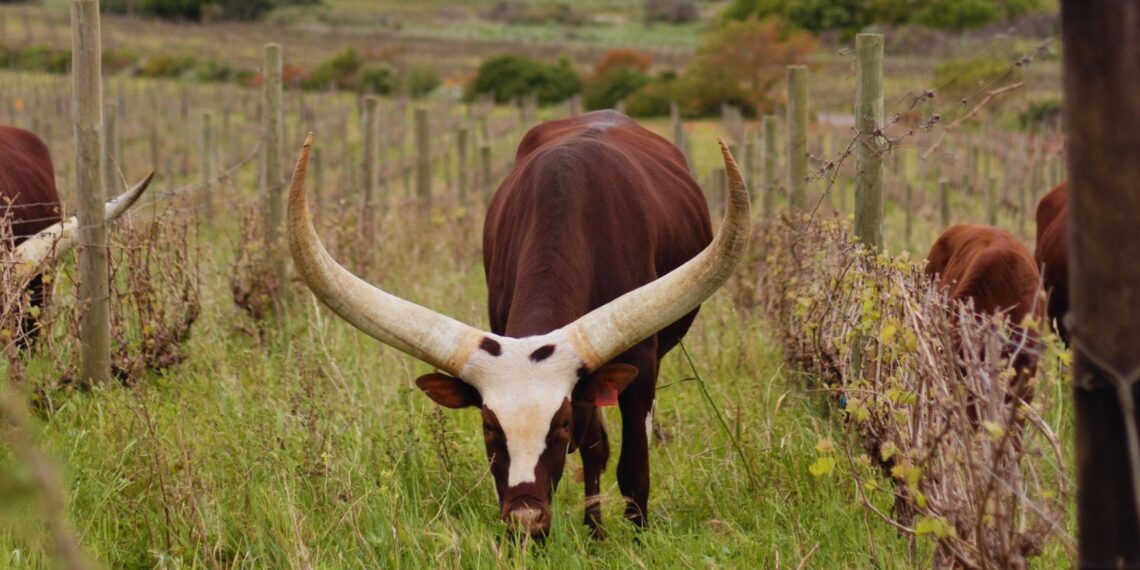
As climate change intensifies, vineyards in South Africa face rising temperatures, water scarcity, and soil degradation. In response, the ReGenWine project offers a compelling local solution grounded in regenerative agriculture.
The ReGenWine study, led by Stellenbosch University and funded by South Africa Wine, examines how regenerative farming, including the use of cattle, can help wine farmers cope with the growing challenges of climate change, rising costs, and sustainability demands.
The study runs over three years, with Hartenberg Wine Estate near Stellenbosch as the main trial site.
According to Gerard Martin, executive manager for research, development and innovation at South Africa Wine, there is a need for data-driven decision-making in the wine industry. “If we want to build a wine industry that’s fit for the future, we have to rethink how we farm – and we need solid data to back it up,” he says.
That’s why they have partnered with Stellenbosch University on this project. “Regenerative farming shows promise, but we want to understand exactly how it works in a real vineyard setting, and what it could mean for South African wine,” Martin said.
Professor Melané Vivier, who leads the project, explains that their mission is to find out if working more closely with nature can help farmers in practical, measurable ways.
Vivier is also the director of the South African Grape and Wine Research Institute at Stellenbosch University.

Related stories
- Sustainable agriculture: Empower small farms for lasting change
- How conservation agriculture reshaped the Overberg region
Hartenberg’s regenerative journey
While Hartenberg is known for its eye-catching Ankole cattle, the project uses a smaller breed – Dexter cattle – that fits more easily between vineyard rows.
The idea is to combine cattle, cover crops, and composting into a system that improves soil health, reduces chemical use, and keeps the vineyards productive.
This is one of the first studies in South Africa to test regenerative farming in vineyards in such a detailed, scientific way. The researchers measure everything from soil microbes and carbon levels to vine growth, grape quality, and farm costs.
“There’s a lot of interest in regenerative farming at the moment,” Martin says. “But most of the knowledge is based on experience, not hard data. This study will help us learn what works – and where.”
Hartenberg has been on a regenerative journey for years, using cover crops, composting, and fewer chemicals. Since 2017, the farm has also brought livestock into the vineyards, following a holistic grazing model.
Earlier this year, Hartenberg became the first wine estate in South Africa – and only the second in the world – to be verified under the Ecological Outcome Verification (EOV) system, which tracks real results in soil and land health.
“We’ve seen big changes since the animals arrived,” says Hartenberg viticulturist Wilhelm Joubert. “The soil is healthier, the pests are more balanced, and we use fewer inputs. Plus, we can use the cattle for meat in our restaurant, which brings in extra income.”

Five workstreams, one vision
The ReGenWine project not only looks at the vineyards and the grapes, it also takes a whole-farm view, comprising five research workstreams:
- Soil health – tracking carbon, microbes, and soil structure.
- Vine and wine – measuring vine growth and grape quality.
- Cover crops and livestock – studying how the animals move, eat, and return nutrients.
- Costs and impact – comparing inputs, outputs, and farm profits.
- Sharing the knowledge – making sure findings reach farmers and the broader industry.
Although it’s early days, the researchers hope their findings will help build a stronger, more resilient wine industry.
“We’re not saying this is the only way to farm,” says Vivier. “But we believe it’s a good place to start asking the right questions, and looking for answers based on science and experience.”
Martin adds that this is also about South Africa taking the lead.
“We’re not just catching up with global trends; we’re doing serious work, right here, that could help shape the future of wine.”
READ NEXT: Banking on seeds: Fowler’s bold plan for food security
Sign up for Mzansi Today: Your daily take on the news and happenings from the agriculture value chain.