Citrus Research International (CRI) has launched a new handbook designed to help citrus growers make informed irrigation decisions and improve water-use efficiency amid growing pressure on agricultural water resources.
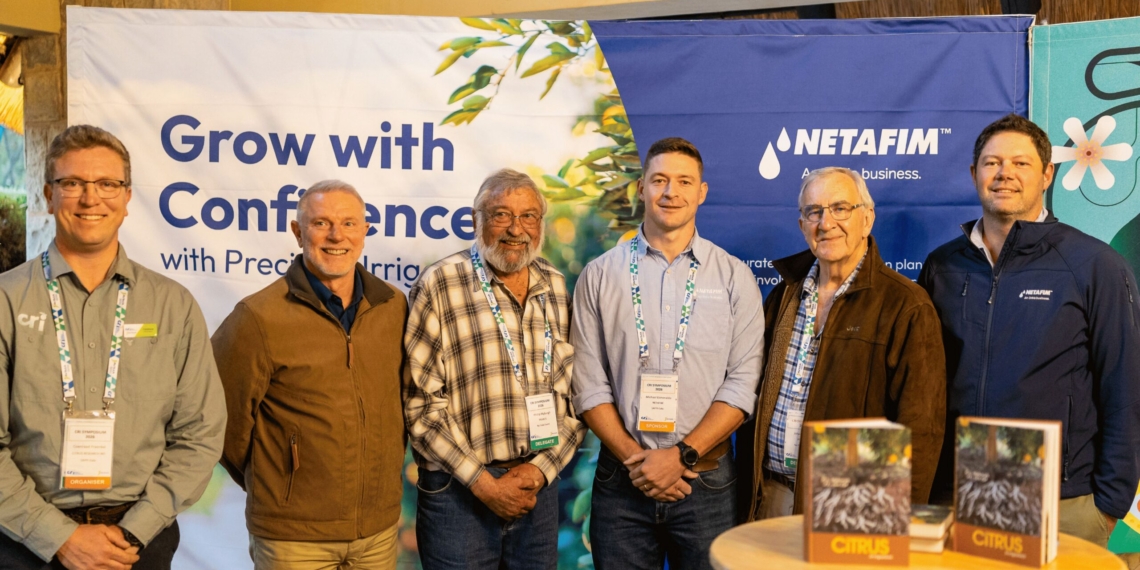
The publication, Citrus Irrigation, was launched on 24 August 2026 during the 13th CRI Citrus Research Symposium at Champagne Sports Resort in the Drakensberg, KwaZulu-Natal.
Written by Dr Phillip Myburgh and Dr Johan van Zyl, the handbook was developed through a CRI-led project, with Netafim as its sole sponsor. It combines scientific research with practical field experience to provide growers with guidance that can be applied under different production conditions.
The need for the publication emerged through irrigation training sessions conducted by CRI’s extension team in collaboration with Netafim. These sessions highlighted the importance of helping growers understand irrigation principles and apply them consistently in their orchards.
CRI’s Coenraad Fraenkel said, “We wanted to put together a handbook that is practical for the industry, while retaining the scientific depth to serve as a reference in academic settings. Different terminology and gaps in understanding can make irrigation unnecessarily confusing. The aim was to bring the information together in a form that growers can use.”
Related stories
- Netafim’s precision irrigation helps farmers grow more with less
- Every drop counts: Managing precision irrigation for export citrus
- SADC experts urge smarter, more inclusive climate-smart tech
- Know your water and soil: Practical tips for smarter drip irrigation
Combining research with field experience
The authors drew on both South African and international research, supported by visits to citrus-producing regions across the country. Citrus growers contributed practical knowledge and assisted with orchard investigations, including soil profile examinations and root studies.
Technical specialists also reviewed chapters and provided feedback during the development process. This helped shape a publication that combines scientific explanations with practical guidance on irrigation strategies, the effects of poor irrigation and over-irrigation, and water-quality considerations.
The handbook also addresses the use of treated wastewater, providing information relevant to growers navigating increasingly complex water-management decisions.
With water scarcity and pressure to improve water-use efficiency placing greater demands on producers, the publication aims to help growers better understand the consequences of different irrigation practices.
“We used international and South African literature, and we went to growers for practical information to make the contents applicable in the field,” said Myburgh. “Developing guidance on irrigation strategies was a particularly demanding task because published results are not always consistent.”
The project also represents a significant milestone for the two authors, who began working together in August 1976. The completion of the handbook 50 years later brings decades of shared experience to a resource intended for both industry and academic use.
Industry support and partnerships crucial
Citrus grower Jaco Lindeque of Group 91 in Letsitele attended the launch and said the handbook could make an important contribution to the industry after reading several chapters.
“Irrigation is the foundation of what we do,” Lindelique said, commending the quality of the publication and the dedication of the team behind it.
Michael Esmeraldo of Netafim said the company’s sponsorship reflected its longstanding relationship with citrus growers and CRI.
“Supporting the handbook was an easy decision. It is a token of our gratitude to the citrus industry and reflects the relationship we have with CRI,” said Esmeraldo. “We hope there will be many more projects of this kind.”
At the launch, copies of the publication were also presented to Prof. Vaughan Hattingh, CEO of CRI, and Dr Boitshoko Nshabele, CEO of the Citrus Growers’ Association of Southern Africa (CGA).
Citrus Irrigation is available through the CRI online resource centre at R350 per copy.
READ NEXT: Farmers forced to cut jobs as operational costs skyrocket