Drip irrigation success requires high-quality equipment and much more. Netafim’s Byron La Trobe explains how important planning, operation and maintenance actions are when striving for better yields.
For farmers investing in drip irrigation, choosing the right equipment is an important part of the equation, but it is only one part. Understanding water quality, soil conditions, irrigation uniformity and system maintenance is essential to getting the best return for your investment.
That was the key message from Byron La Trobe, technical advisor at Netafim Southern and East Africa, who shared practical insights from his work with farmers across the Southern Cape, Eastern Cape and parts of the Free State.
Start with water and soil
Before installing a drip irrigation system, farmers should understand the conditions on their farms.
“Know the water quality and know the soil,” La Trobe advises.
Water analyses can help determine the filtration requirements and suitable drip delivery rates, while soil characteristics influence dripper spacing and irrigation scheduling.
La Trobe says these analyses are a relatively small investment compared with the potential cost of designing an irrigation system incorrectly.
Related stories
- Smart irrigation key to getting more value from every bag of fertiliser
- How to choose the right drip irrigation system for seasonal crops
- How to choose the right drip irrigation system for seasonal crops
Uniform water supports uniform crops
Irrigation uniformity plays a major role in crop growth and productivity, particularly in crops with shallow root systems.
Closer dripper spacing can help wetting patterns overlap more effectively, reducing dry areas between emitters and ensuring more even water distribution along plant rows.

When plants receive uniform amounts of water, root development and nutrient uptake are more consistent. Poor uniformity, however, can result in some parts of the field being overwatered while others receive too little, leading to uneven plant growth and potentially lower yields.
Consistent water and nutrient availability also promotes more uniform stalk, flower or fruit development.
Protect pollination with precision irrigation
Drip irrigation can offer an important advantage during flowering by keeping water focused around the root zone while maintaining a relatively dry canopy and flower environment.
This is particularly important when pollination is essential for achieving good yields.
La Trobe says overhead irrigation during flowering can create an unfavourable environment for bees.
“We can do everything right, but at the end of the day, if the bees don’t work, we are not going to achieve the yields that we want,” he says.
Creating favourable conditions for pollinators should therefore be part of the irrigation strategy.
Monitor salinity carefully
Water quality can significantly affect irrigation management. Farmers should monitor electrical conductivity (EC) in their water and soils and involve an agronomist when salinity becomes a concern.
Different crops tolerate salinity differently, meaning the amount of additional water needed to manage salts in the root zone will vary.
Extra irrigation can also increase pumping costs and raise the risk of fertiliser being leached beyond the crop’s roots. Regular soil and water analyses can help farmers make better decisions about crop selection and irrigation management.
Make every kilogram of fertiliser count
With fertiliser prices under pressure, La Trobe believes precision fertigation offers significant potential for farmers.
Instead of applying fertiliser in large quantities at once, nutrients can be dosed over a longer period, making them more consistently available to the crop.
Better fertigation management can also reduce the risk of nutrients being leached below the root zone.
“Each drop of fertiliser basically leaching beyond the root zone is money wasted,” La Trobe says.
Thin-wall drip offers practical benefits
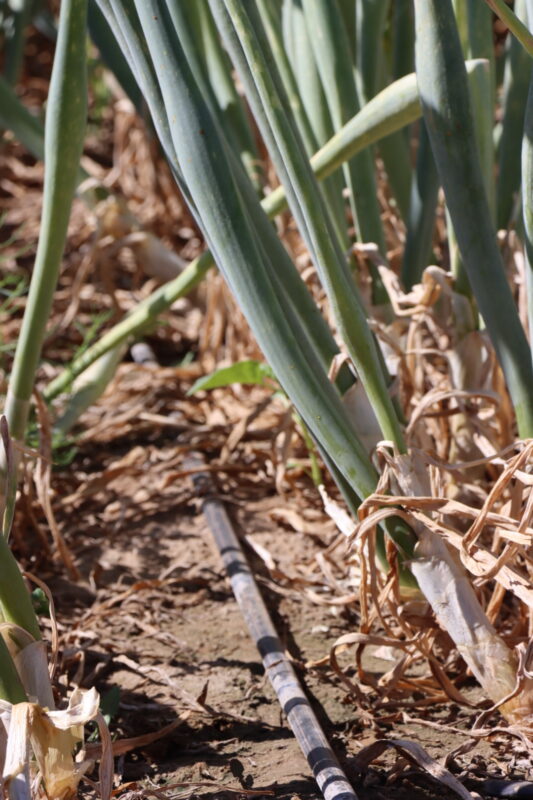
For suitable crops, thin-wall drip lines can provide a practical seasonal alternative to reusable heavy-wall systems.
Thin-wall lines can be replaced each season, allowing farmers to start with new drip lines rather than managing accumulated build-up from previous seasons. However, proper field preparation remains essential.
Farmers should remove thorny weeds, sharp rocks and debris that could puncture the drip lines during installation or throughout the season.
La Trobe also recommends considering mechanised installation and retrieval equipment to reduce labour costs and prepare fields more quickly for the next crop.
Don’t forget the filter
One of the biggest mistakes farmers can make is underestimating the importance of filtration.
“Never forget about the filter,” La Trobe warns.
Poor filtration can lead to blocked emitters, uneven water distribution and ultimately reduced crop performance. Investing in the correct filtration system from the beginning can prevent costly problems later.
La Trobe concludes that successful irrigation comes down to one simple principle: understand your water, understand your soil and design your system accordingly.
READ NEXT: Smart vineyard irrigation starts below the ground