Saturday, October 3, 2026
SUBSCRIBE
22 GLOBAL MEDIA AWARDS
Food For Mzansi
  • News
  • Changemakers
  • Lifestyle
  • Farmer’s Inside Track
  • Food for Thought
No Result
View All Result
  • News
  • Changemakers
  • Lifestyle
  • Farmer’s Inside Track
  • Food for Thought
No Result
View All Result
Food For Mzansi
No Result
View All Result
in News

SADC experts urge smarter, more inclusive climate-smart tech

Climate-smart agriculture requires practical, farmer-first solutions, according to experts at Kagiso Trust’s session during the High-Level SADC Food Systems Transformation Policy Dialogue. They highlighted blended finance, accessible digital tools and adaptable practices as key to building climate resilience

by Vateka Halile
15th August 2026
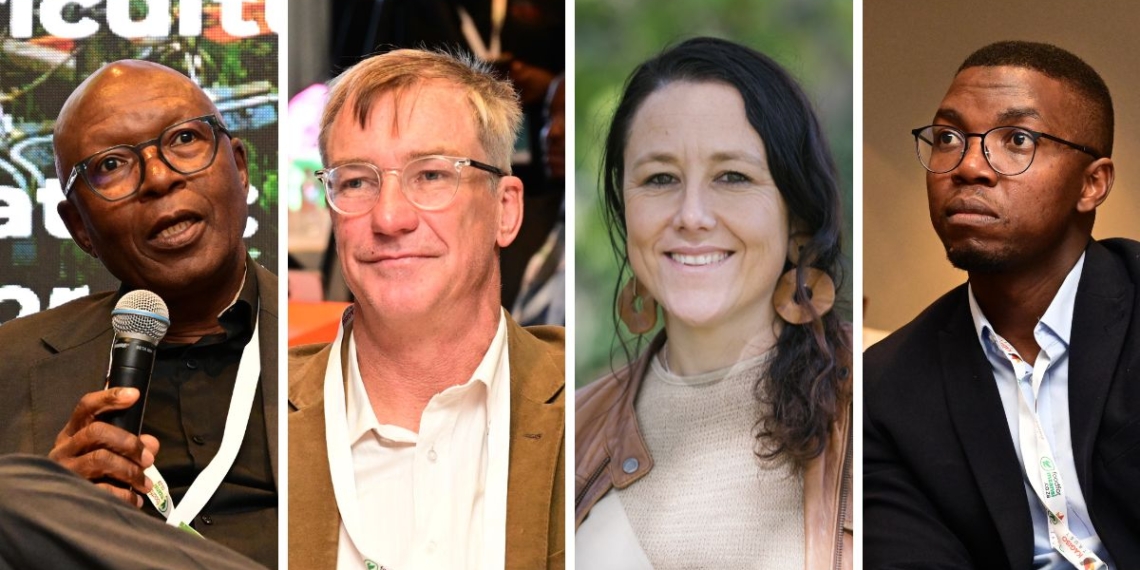
Some of the finest experts participated in the Kagiso Trust session at the High-Level SADC Food Systems Transformation Policy Dialogue in Durban. From left: Ishmael Sunga (SACAU); Prof. Naudé Malan (Holistic Economic Revolution Research and Development); Dr Tara Southey (TerraClim); and Desry Lesele (Nedbank Commercial Banking). Photos: Food For Mzansi

Some of the finest experts participated in the Kagiso Trust session at the High-Level SADC Food Systems Transformation Policy Dialogue in Durban. From left: Ishmael Sunga (SACAU); Prof. Naudé Malan (Holistic Economic Revolution Research and Development); Dr Tara Southey (TerraClim); and Desry Lesele (Nedbank Commercial Banking). Photos: Food For Mzansi

Share on FacebookShare on TwitterShare on WhatsApp

For farmers looking to adapt to changing conditions, the move toward climate-smart agriculture is bringing together new technologies, data, financing models, and farming practices. However, the success of these approaches depends on whether they fit the practical realities of farmers and the environments in which they operate.

This was the view of speakers at the high-level SADC Food Systems Transformation Policy Dialogue, an official side event of the 2026 SADC Summit in Durban, discussing the future of agriculture in South Africa and the wider Southern African Development Community (SADC) region.

Kagiso Trust was a key partner at the High-Level SADC Food Systems Transformation Policy Dialogue in Durban. Pictured from the left are representatives Thabane Ndlela, Luvuyo Sandi, Nomkhosi Khumalo, Itumeleng Maboa, Boichoko Ditlhale and Zukhanye Mangesana. Photo: Food For Mzansi

Financing regenerative agriculture

Speaking at a special session convened by Kagiso Trust, Desry Lesele, senior manager for agriculture client value proposition at Nedbank Commercial Banking, said one of the biggest challenges in scaling regenerative agriculture is the financing model used to support producers.

Lesele said his engagements with farmers have shown that many understand the importance of soil health and resilience and are not resisting regenerative agriculture. The difficulty, he noted, is that the costs of making the transition are immediate, while the returns can take several years to materialise.

“The real question is not whether regenerative agriculture works. The question is whether our financing, and I say ‘our’ because I’m in the banking sector, is designed to support this transition,” Lesele said.

Delegates who attended the SADC Food System Transformation Policy Dialogue. Photo: Supplied/Food For Mzansi

He explained that farmers need what is known as “patient capital” because agricultural systems operate according to biological cycles, whereas financial institutions typically operate on shorter reporting and repayment schedules. 

This mismatch, he said, often results in farmers using short-term financing to fund transitions that take five years or longer.

Lesele also called for greater use of blended finance and risk-sharing mechanisms, emphasising that commercial finance alone is insufficient. Climate-smart funds, development finance institutions, and governments could help de-risk investments and encourage greater private-sector participation.


Related stories
  • Farmers lead with agroecology to build greener food systems
  • From data to dinner: AI reshaping global food systems
  • Khula! & Kagiso Trust launch programme to empower 500 farmers

A gathering of influential voices at the Kagiso Trust session during the High-Level SADC Food Systems Transformation Policy Dialogue in Durban, bringing together leaders and experts from across agriculture, food systems, finance, policy and development. Among those in attendance was Cuthbert Kambanje, Agrifood Systems Investment Specialist at the FAO. Photo: Food For Mzansi

Putting farmers at the centre of tech development

Meanwhile, Dr Tara Southey, founder and CEO of TerraClim, which uses climate and agricultural data to help farmers make better-informed decisions, said agricultural technology should support farmers’ knowledge, not replace it.

“No one knows your land better than the farmers themselves,” Southey said.

She described initiatives to integrate diverse agricultural datasets, including agro-climate information, crop suitability, soil data, and remote-sensing analytics. She highlighted a project in the Eastern Cape that brought together information from institutions such as the Agricultural Research Council (ARC) and the Council for Scientific and Industrial Research (CSIR) into a single platform accessible to farmers and agricultural advisers.

The platform was field-tested with farmers in Mthatha in the Eastern Cape, whose feedback helped developers simplify the tool and identify the exact information advisers needed. Southey said the project subsequently focused on training agricultural advisers in this province, with more than 40 users now accessing the system daily.

She noted that this tailored approach is crucial across the SADC because farming conditions vary considerably between countries, regions, and even districts. “One size doesn’t fit all,” Southey said.

Ishmael Sunga, CEO of the Southern African Confederation of Agricultural Unions (SACAU), noted that the issue extends beyond climate-smart technologies to agricultural innovation more broadly.

He observed that researchers sometimes develop technologies that appear impressive but are ultimately not adopted because they fail to address the specific problems farmers face. “It’s perfected, but it’s rejected,” Sunga said.

He argued that farmers should be involved in developing innovations from the outset, and that research and development must be rethought around farmers’ varying needs, scales, and ambitions.

Sunga added that climate-smart agriculture must also encompass basic infrastructure, such as electricity, water systems, roads, and bridges.

“These are climate-smart solutions,” he said, asserting that farmers require an integrated approach involving government, researchers, and policymakers.

Michael Lilje, CEO and founder of Orizon Agriculture, shared insights on making precision agriculture more accessible and practical for farmers during a special Kagiso Trust session at the High-Level SADC Food Systems Transformation Policy Dialogue in Durban. Photo: Food For Mzansi

Technology farmers can understand and implement 

Michael Lilje, the CEO and founder of Orizon Agriculture, highlighted precision agriculture as another area where the focus can easily shift from core farming principles to the technology itself.

He stressed that precision agriculture is fundamentally about applying the right input in the right place at the right time. While large commercial farms might deploy expensive machinery across thousands of hectares to achieve this, smaller farmers can apply the same principles without owning specialised equipment.

“Precision agriculture, at its core, is just putting the right input in the right place at the right time,” Lilje said.

He advocated for prioritising education before technology investments, enabling farmers to understand core principles and evaluate whether a specific machine or system will yield a sufficient return on investment.

Professor Naude Malan, a sustainable food systems expert from Holistic Economic Revolution Research and Development, cautioned that an overemphasis on high technology can create severe hurdles for smaller farmers.

He explained that expensive machinery often only makes financial sense when deployed in large operations capable of maintaining high productivity.

“If you adopt high technology, the biggest systems around that machine must be absolutely optimised for highest production,” Malan said.

He pointed to simpler, lower-cost technologies that can be adapted to varied farming environments, arguing that farmers should have the opportunity to move through progressive stages of technology adoption.

Malan further said that sustainable food systems must reflect ecological differences between individual farms rather than relying on a uniform model.

“We have to have a diversity of approach. The policy cannot be singular; it has to be diverse,” he said.

He noted that the financial viability of individual farming enterprises should remain central to decisions regarding technology, finance, and policy, allowing farmers to adopt tailored solutions at a manageable pace.

READ NEXT: FANRPAN unveils decade strategy for Africa’s food systems

Sign-up for the latest agricultural news delivered straight to your inbox every day with Mzansi Today!

Vateka Halile

Vateka Halile grew up in rural areas of Cofimvaba in the Eastern Cape. She was raised in a traditional family setting and found writing to be a source of comfort and escape. Vateka participated in an online citizen journalism course through Food For Mzansi, and her passion for health and medicine-related stories was born. Her dedication to community work and love for social justice and solidarity spaces is evident in her quality time with the community when she isn't working.

Tags: Agricultural financeAgritechClimate-smart agricultureFood SystemSADC
Feed relief brings hope to drought-stricken Loeriesfontein farmers
News

Feed relief brings hope to drought-stricken Loeriesfontein farmers

by Staff Reporter
1st October 2026

Drought conditions in the Northern Cape continue to devastate local grazing. To help sustain livelihoods, 104 small-scale livestock farmers in...

Read moreDetails

Tomatoes surge, potatoes tighten as fresh produce prices shift

30th September 2026
Master farming first: Jotham’s formula for multi-stream income

Master farming first: Jotham’s formula for multi-stream income

30th September 2026
SADC symposium brings plant nutrition research closer to the farm

SADC symposium brings plant nutrition research closer to the farm

30th September 2026
High input costs drive SA grain farmers to rethink crop mix

High input costs drive SA grain farmers to rethink crop mix

30th September 2026

SA Pink Lady apples see strong growth across European markets

Master farming first: Jotham’s formula for multi-stream income

Beyond tradition: Mbatha takes SA goat meat to retail and the world

Feed relief brings hope to drought-stricken Loeriesfontein farmers

‘Citrus Irrigation’ guide empowers growers amid water scarcity

Join Food For Mzansi's WhatsApp channel for the latest updates!

JOIN NOW!
Next Post

Protecting crops and farmers: Inside ARC’s plant virology bank

THE NEW FACE OF SOUTH AFRICAN AGRICULTURE

With 21 global awards in the first six years of its existence, Food For Mzansi is much more than an agriculture publication. It is a movement, unashamedly saluting the unsung heroes of South African agriculture. We believe in the power of agriculture to promote nation building and social cohesion by telling stories that are often overlooked by broader society.

SA Pink Lady apples see strong growth across European markets

Beyond tradition: Mbatha takes SA goat meat to retail and the world

Royal Show: FNB brings farmers together to talk collaboration

Regulatory barriers and capital costs stall SA dragon fruit growth

‘Citrus Irrigation’ guide empowers growers amid water scarcity

Earth as a pharmacy: Dlamini builds backyard dandelion brand

  • Awards & Global Impact
  • Our Story
  • Contact Us
  • Cookie Policy
  • Privacy Policy
  • Copyright

Contact us
Office: +27 21 879 1824
News: info@foodformzansi.co.za
Advertising: sales@foodformzansi.co.za

Contact us
Office: +27 21 879 1824
News: info@foodformzansi.co.za
Advertising: sales@foodformzansi.co.za

  • Awards & Global Impact
  • Our Story
  • Contact Us
  • Cookie Policy
  • Privacy Policy
  • Copyright

Chat Options

I'm Lerato, your AI assistant!
No Result
View All Result
  • News
  • Changemakers
  • Lifestyle
  • Farmer’s Inside Track
  • Food for Thought

Copyright © 2024 Food for Mzansi