Global warming is exacerbating water scarcity across the globe. A likely reality for South Africa in particular is that by 2050, climate change will have an impact on water availability in most parts of the country.
A novel research study by the CSIR and Stellenbosch University to quantify water uses nationwide, shows that the agricultural sector is South Africa’s largest water user.
With that in mind, what can farmers do when it comes to water use management and slowing down the impact of climate change on Mzansi’s water sources?
According to the United Nations University World Institute for Development Economics Research (UNU-WIDER), come 2050, climate change would have likely impacted access to water in most of South Africa.
“Increased drying or flooding is expected, with the potential for strong localised effects. This is particularly true of regions with small water resource management systems.
“Climate change risks for run-off and irrigation demand vary significantly across South Africa, with some regions expected to experience increased drying and others flooding,” a study by UNU-WIDER revealed.
While UNU-WIDER projects measure impact only by 2050, South African farmers say their lives have already been shaped by inadequate access to water.
ALSO READ: Jozi’s water woes take its toll on agri
2050? Taps are already dry
Dineo Mphahlele, a vegetable farmer in Winterveld, Gauteng, said they only have running water at night. As a result, she only gets to water her produce at night if water is available.
“I am forced to store water in tanks and whenever the water arrives, it takes up to 30 minutes to fill up a 5-litre bucket. That is how slow the water comes out. It’s not sustainable to operate any farming business without reliable water,” she said.
Meanwhile, Pretty Seabela, a vegetable farmer in Limpopo, told Food For Mzansi that having no water has been a norm for years. In her area, nothing has changed.
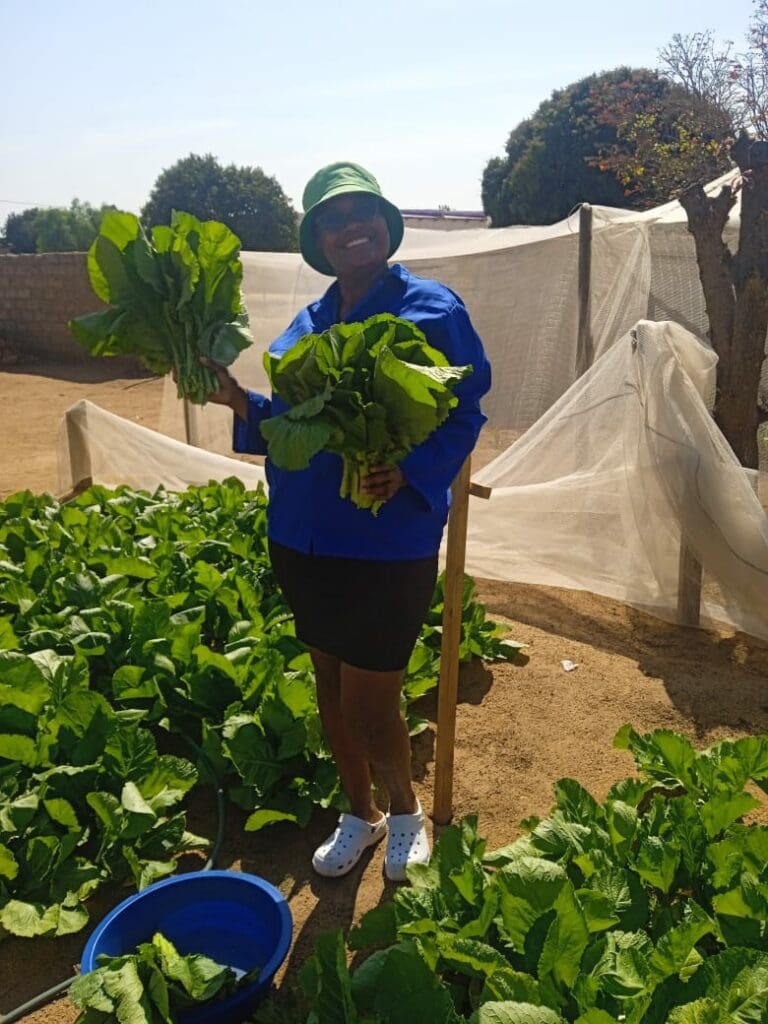
“Where I am from, the only way to have access to water is to buy water. Growing up we were struggling with water scarcity and now there is no water.
“Our rights are being violated. Water is a basic need that we all have to get, I have got a borehole at home but with load shedding, it is hard because without electricity there’s no water too,” she said.
Seabela explained that many cannot afford to install boreholes. “I do not know how others survive because I am from a rural area and a lot of people are going without.”
Takalane Nemangowe from Ga Maboi village in Limpopo, said homes with installed water taps remain dry.
“We have a system of rotational water supply where one section gets water for a week, followed by another section the week thereafter. Pupils are forced to carry water buckets in addition to their school bags because there is just no water available and children cannot stay away from school. A plan has to be made,” Nemangowe said.
What farmers can do
According to Dr Ferrial Adam, an environmental justice activist from WaterCan, there is not enough awareness for farmers in the country on the importance of preserving water.

“Given that the agricultural sector is one of the biggest water users, there needs to be more done to ensure the efficiency of water use,” she highlighted. “There must be a focus on improved agricultural practices that use less water and fewer pesticides and fertilisers.”
While policies on water use exist, a lack of enforcement and implementation is the key reason for Mzansi’s water woes, Adam believes.
In addition, the way government defines access is problematic, Adam said.
‘Govt needs to step up’
“About 46% of people in South Africa have a running tap in their home. The rest depend on communal taps which are often broken and on rivers and streams that are polluted. So, in my view, the government has to step up its game, water must be treated as a human right and people deserve better services,” she said.
Water pollution caused by fertilisers and pesticides is another issue exacerbating South Africa’s water troubles, Adams pointed out.
“There are two challenges with this: one is not enough testing is being done to keep track of what is flowing in our waterways. The second issue is the lack of enforcement and monitoring of polluting industries,’ she added.
Environmental health expert Bettina Genthe said farmers should embrace drip irrigation to give water in the country a fighting chance. She admits while there is still a lot more to do, more and more farmers are exploring drip irrigation methods as a means to save water and cut costs.
READ NEXT: Climate change overwhelms farmers in Ghana
Sign up for Mzansi Today: Your daily take on the news and happenings from the agriculture value chain.