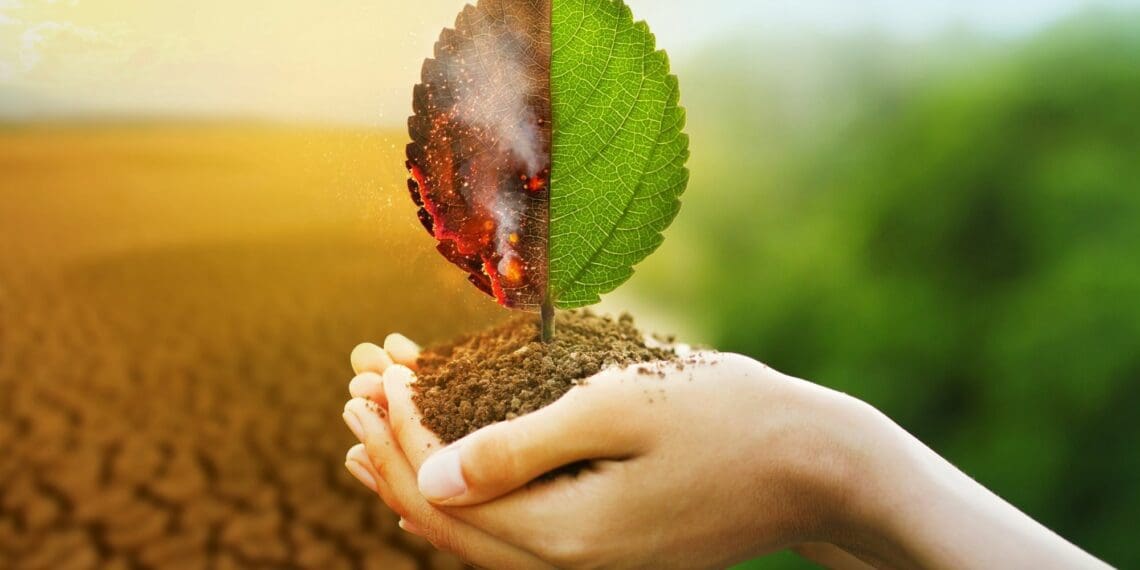
Can our planet recover from climate change? Commissioning editor Kofoworola Belo-Osagie asked scientists to share the reasons they believe there is hope.
Jennifer Fitchett, associate professor of Physical Geography, School of Geography, Archaeology and Environmental Studies, University of the Witwatersrand, South Africa
People are starting to notice the weather and climate, and to understand climate change better than ever before.

It is very difficult for humans to feel the 1.1℃ post-industrial warming. In Johannesburg, our diurnal temperature range is often more than 20℃. From day to day, our maximum temperatures can differ by over 10℃. This makes climate change seem intangible. However, over the last few years, the public has become far more aware of the weather and climate, and the impacts of climate change are becoming more tangible, more easily observed, and more measurable by the person on the street.
We are noticing, for example, that jacarandas are flowering earlier than they used to. We are aware that floods are evidence of extreme climates, and that extreme climate events are affecting southern Africa more frequently than they used to.
The tone of public discourse is starting to shift. Sometimes this leads to single events not-quite-correctly being attributed to climate change. But it shows that people are aware and concerned about their climate future. This public awareness is a crucial first step in addressing climate change.
While is it very important to recognise the immense value of young climate change activists like Greta Thunberg, we often don’t notice the many students across the world who are choosing to pursue degrees in fields relating to climate change.
The University of the Witwatersrand launched a short course that was offered to over 5 000 incoming first-year students in 2022, and which was taught by a PhD student in climate change. This large cohort of students passionate about understanding climate science, avenues for adaptation, and innovations for mitigation is our future!
Patrick Omeja, senior research fellow, College of Agriculture and Environment, Makerere University, Uganda
There is an urgent need for far-reaching change. Government action on climate change is slow as their hands are often tied by stringent bureaucracy, big business and the need to please all of the electorate.
However, I am optimistic that climate action will happen because communities, businesses and foundations around the world are seeing the need for action and doing their part.

For example, in Uganda, solar panels are appearing everywhere. Large companies like Coca-Cola Africa, Nile Breweries, Unilever and Nations Media Group are supporting efforts to restore natural ecosystems and putting the environment before profits. And, for example, the Ivey Foundation in Canada is liquidating its entire endowment to promote climate action now.
The funding from these companies is supporting many innovations and solutions, from refugee communities creating forests in the deserts to innovators turning plastics into boats and building materials. They are finding ways to save energy and reduce the footprints of carbon emissions.
Africa is just awash with new ideas and initiatives that are turning environmental challenges into new sources of livelihoods, and adapting to and mitigating the impacts of a changing climate. If many small groups take action, it will make a real difference.
Generally, if humans are the primary cause of a globally warming climate, that means we can also be the architects of its undoing. I think people know that action needs to urgently happen, so people from all walks of life will volunteer to help. I believe human nature “overall” is good and the degraded ecosystems are resilient to recovery, given time and support.
Desta Mebratu, professor, Centre for Sustainability Transitions, Stellenbosch University, South Africa; Fellow, African Academy of Science

The Paris Agreement on climate change, adopted in 2015, brought a new sense of optimism in terms of addressing the challenges associated with climate change. Unfortunately, the gap between pledges and commitments made by national governments and concrete actions on climate change continued to widen in the subsequent years. This has made the possibility of limiting the planetary temperature rise to 1.5℃ more remote.
Over the last couple of years, we have witnessed increased engagement and leadership of non-state actors, including businesses, civil societies and major groups such as youth groups and local communities. This has led to a plethora of initiatives and partnerships aimed at fast-tracking climate actions and has created a new sense of optimism.
This, coupled with the increasing motivation and creativity displayed by youth groups across the world around climate action, gives me a great sense of hope about our collective future.
Ultimately, however, it all depends on how fast national governments take concrete climate actions.
Yimere Abay, research fellow, Centre for International Environment and Resource Policy, Tufts University, United States
The sixth assessment report of the Intergovernmental Panel on Climate Change, published in 2022, described a gloomy future for life on planet Earth. The report detailed the irreversible impacts of change on ecosystems, human life and biodiversity, along with disproportionate impacts across regions, sectors and communities. It called for urgent decisions by world leaders to minimise the adverse consequences. Disappointingly, the 27th Conference of Parties (Cop27) of the United Nations Framework Convention on Climate Change didn’t agree to phase down all fossil fuels.
Yet there are still reasons to be hopeful for progress from Cop27.

First, the cost of wind and solar technologies is plummeting. Technologies for carbon capture, utilisation, storage and transmission are rapidly progressing to foster transformation into a low-carbon market. Africa has an opportunity to use its massive renewable energy resources, harness its minerals and metal resources to develop solar photovoltaic systems and wind turbines, and address the barriers in the way of clean energy development. The turning point will be when fossil fuels become less efficient and more expensive than renewables.
Cop27 called for reforms in multilateral development banks. Reforms could address Africa’s reputation of being “riskier” for climate investment by providing guarantees. Africa needs US$2.8 trillion from 2020 to 2030, whereas the yearly climate finance flow is only US$30 billion.
Cop27 also introduced a new holistic approach towards food and agriculture. The aim is to boost the finance for agricultural transformation and adaptation. This is another reason to be optimistic, since about 70% of the continent’s population depends on agriculture.
Finally, it’s encouraging to see social movements, particularly among the youth, taking action on climate change. These social movements, including indigenous peoples’ alliances, have self-organised across all regions without discrimination of faith, race, colour, age, gender, ideology, or education and have become the guardians of the future.
This article was first published in The Conversation.
ALSO READ: Climate change: Agroecology is Africa’s answer
Sign up for Mzansi Today: Your daily take on the news and happenings from the agriculture value chain.