Smallholder farmers in KwaZulu-Natal’s Harry Gwala District are gaining practical tools to improve the quality, productivity and market readiness of their livestock, thanks to the Agricultural Research Council’s (ARC) ongoing Kaonafatso ya Dikgomo (KyD) or Cattle Betterment Programme.
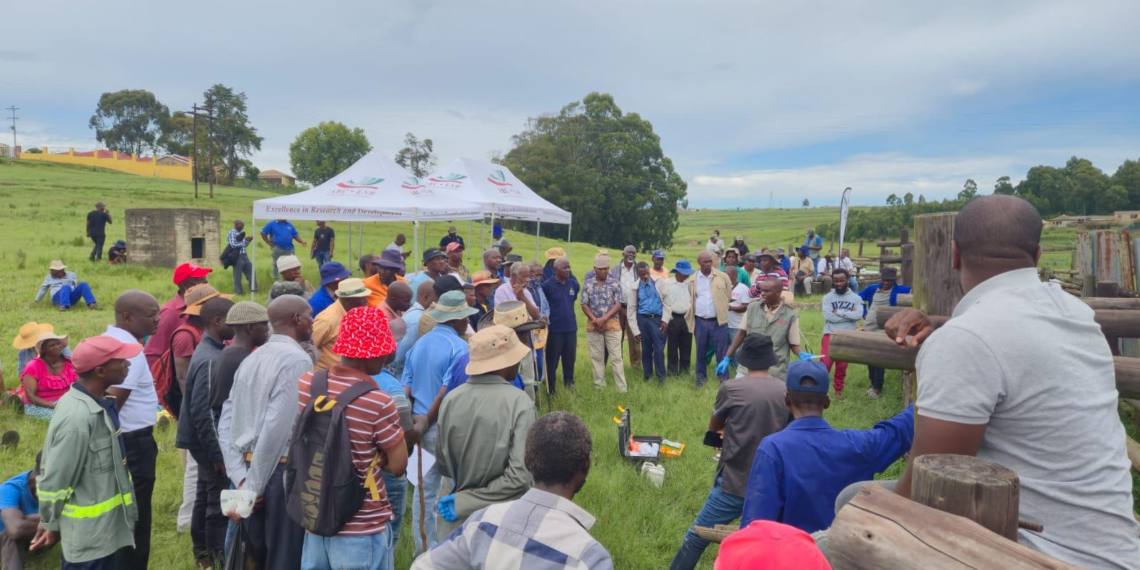
Implemented in terms of the Animal Improvement Act 62 of 1998, the KyD scheme aims to strengthen livestock genetics, management practices and traceability in communal and smallholder production systems. As part of this drive, the ARC hosted an information and demonstration Day in the JPP Local Municipality, drawing farmers, extension officers and animal health practitioners from across the region.
The event offered hands-on demonstrations that connected animal identification, breeding, health and value addition directly to improved incomes and long-term sustainability.
Ear tagging and LITS: The foundation of traceability
One of the first demonstrations of the day focused on the Livestock Identification and Traceability System (LITS) and the correct application of ear tags for individual animal identification. Led by Ayanda Mchunu, the session highlighted how proper identification forms the backbone of modern livestock management.
Farmers were shown how to insert ear tags correctly to avoid injury and infection, while ensuring that each animal carries a unique identification number. This number links the animal to records covering birth date, parentage, vaccinations, treatments and production performance.
Beyond farm management, LITS plays a growing role in national biosecurity and market access. Traceability helps authorities respond quickly to disease outbreaks and gives buyers confidence about the origin and history of animals. For smallholder farmers aiming to enter formal markets, proper identification is becoming non-negotiable.
Related stories
- GPS ear tags offer hope against livestock theft
- Pneumonia in livestock: Spot the signs before it’s too late
- Protect your herd: Tips for preventing livestock theft
- Meet the EC duo changing the game in livestock care
Choosing the right bull: Genetics matter
Improving herd quality starts with selecting the right breeding animals. In a practical session led by Thokozani Ndonga, farmers learned how to assess a breeding bull beyond just size and appearance.
Participants were guided through key selection criteria, including body conformation, structural soundness, temperament and signs of good fertility. Functional traits such as strong legs, a well-developed frame and overall health were emphasised, as these directly influence the bull’s ability to serve cows effectively and pass on desirable traits.
Farmers were reminded that one bull can sire many calves over several seasons, meaning a poor-quality bull can quickly lower herd performance. Conversely, a well-chosen bull can improve growth rates, fertility and overall productivity across the herd.
Artificial insemination and reproductive efficiency
Reproductive management was another key focus area, led by Albert Sithole, who demonstrated artificial insemination (AI), pregnancy diagnosis and oestrus synchronisation. AI was highlighted as a cost-effective way for smallholder farmers to access superior genetics without buying expensive bulls. By using semen from proven sires, farmers can steadily improve traits such as growth, milk production and carcass quality.
The session covered the essentials of heat detection, proper semen handling, and the timing of insemination, critical factors for successful conception. Pregnancy diagnosis was presented as an important tool for identifying pregnant and non-pregnant cows early, allowing farmers to rebreed open cows and manage feed resources more efficiently.
Farmers also learned how oestrus synchronisation brings groups of cows into heat simultaneously, making it easier to plan breeding and calving seasons. This results in more uniform calves, which simplifies management and strengthens marketing opportunities.
Technology in the fight against stock theft
A session led by Dr Yandisiwe Sanarana highlighted the importance of accurate pedigree recording. Farmers were encouraged to document parentage and performance data carefully, as this forms the backbone of long-term genetic improvement. Reliable pedigree records help prevent inbreeding, guide the selection of superior breeding animals and support the development of herds with predictable, efficient performance suited to local conditions.
Sanarana also introduced the expanding role of DNA technology in livestock management and crime prevention. DNA profiling can confirm parentage and is increasingly used in stock-theft investigations, enabling stolen animals to be genetically traced back to their rightful owners, thereby strengthening legal cases and acting as a strong deterrent. For farmers who lose animals to theft each year, this technology offers a valuable additional layer of protection.
Disease management: Protecting herd health
Healthy animals are productive animals, and Frans Seolwane addressed practical aspects of disease management in cattle. Farmers were reminded that prevention is always cheaper than treatment.

The session covered vaccination programmes, parasite control and the early detection of common diseases. Farmers were encouraged to work closely with animal health technicians and veterinarians, and to report unusual symptoms promptly.
Good biosecurity practices, such as isolating new animals before introducing them to the herd and controlling animal movements, were highlighted as essential steps to prevent the spread of infectious diseases. With outbreaks of transboundary diseases posing serious risks to trade and livelihoods, farm-level vigilance is more important than ever.
Small stock management adds resilience
While cattle dominated the day, small stock were not forgotten. Moses Komane presented on improved small stock management, highlighting the role of goats and sheep in diversifying income and improving household food security.
Topics included housing, nutrition, breeding management and disease control. Farmers were encouraged to keep basic production records, such as kidding or lambing dates and growth rates, to identify their most productive animals.
Small stock requires lower input costs than cattle and can reproduce quickly, making them an asset for smallholder farmers seeking to spread risk and generate more regular cash flow.
Adding value through dairy agro-processing
Looking beyond primary production, Tondani Neluvhalani introduced farmers to opportunities in dairy agro-processing. Rather than selling raw milk only, farmers can increase income by producing value-added products such as amasi, yoghurt and cheese.
The session outlined basic hygiene requirements, simple processing methods and the importance of quality control. Value addition can open new local market opportunities, especially in rural areas where demand for affordable dairy products remains strong.
By processing milk at the community level, farmers can reduce post-harvest losses and create employment along the value chain.
READ NEXT: Experts call for feed efficiency in dairy, meat industries
Market readiness: Linking farmers to opportunity
Closing the loop from production to profit, Dr Walter Shiba addressed market readiness and what buyers expect from smallholder livestock producers.
Farmers were urged to see their operations as businesses. This includes keeping proper records, ensuring animals are healthy and well-conditioned before sale, and complying with identification and movement regulations.

Different market channels, from informal sales to auctions and abattoirs, were discussed, along with the standards associated with each. Understanding these requirements helps farmers target the most suitable market and negotiate better prices.
Shiba emphasised that improving genetics and production means little if farmers cannot access reliable markets. Planning for the market from the start, including breed choice, feeding, and health management, is key to turning livestock into a sustainable source of income.
A step forward for smallholder livestock
The ARC’s Kaonafatso ya Dikgomo Information and Demonstration Day showed that livestock improvement is not about a single technology but about combining identification, genetics, health, management, and marketing into an integrated approach.
By bringing practical knowledge directly to farmers in the Harry Gwala District, the programme is helping to build more productive herds, stronger smallholder enterprises and more resilient rural livelihoods.
For many farmers, the day’s lessons reinforced a powerful message: better records, better animals and better market preparation can translate into better returns and a more secure future in livestock farming.
READ NEXT: Plan before you plant: Key insurance lessons for SA farmers