Sunday, September 6, 2026
SUBSCRIBE
22 GLOBAL MEDIA AWARDS
Food For Mzansi
  • News
  • Changemakers
  • Lifestyle
  • Farmer’s Inside Track
  • Food for Thought
No Result
View All Result
  • News
  • Changemakers
  • Lifestyle
  • Farmer’s Inside Track
  • Food for Thought
No Result
View All Result
Food For Mzansi
No Result
View All Result
in News

Davos boosts confidence in Mzansi’s agricultural trade

As the World Economic Forum ends in Davos, South Africa has emerged as a confident voice for trade and investment. Agbiz chief economist Wandile Sihlobo says agriculture remains one of the country’s strongest platforms for export growth in an uncertain global landscape

by Ivor Price
23rd January 2026
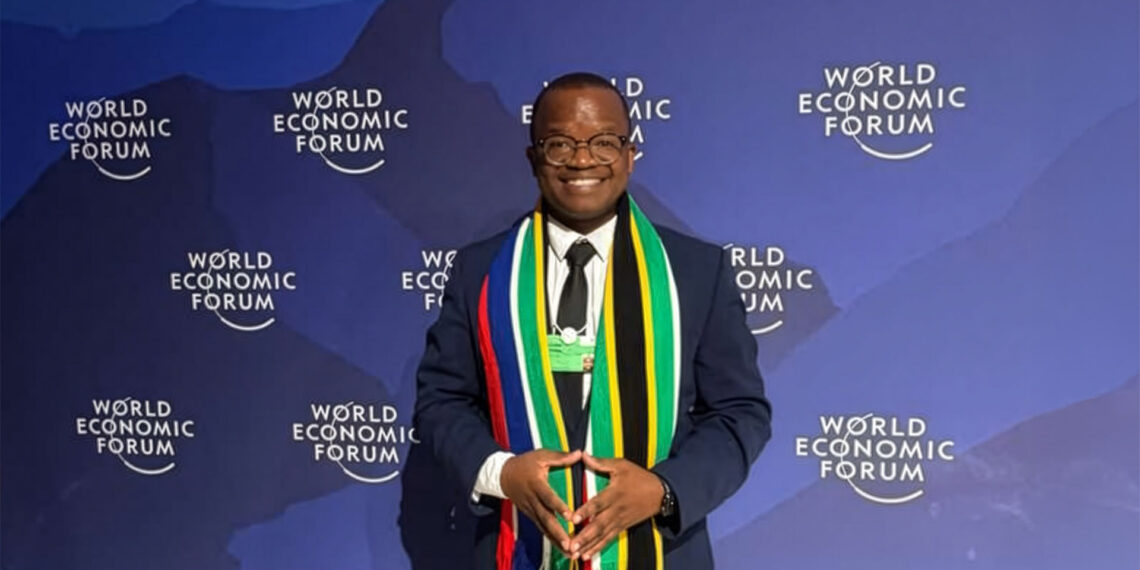
Wandile Sihlobo, Agbiz chief economist, at the World Economic Forum in Davos, Switzerland, highlighting South Africa’s agricultural trade opportunities. Photo: Supplied/Food For Mzansi

Wandile Sihlobo, Agbiz chief economist, at the World Economic Forum in Davos, Switzerland, highlighting South Africa’s agricultural trade opportunities. Photo: Supplied/Food For Mzansi

Share on FacebookShare on TwitterShare on WhatsApp

As the World Economic Forum annual meeting ends today in Davos, Switzerland, one message has come through clearly for South Africa. Despite rising global uncertainty, countries are actively looking to strengthen trade and investment ties. Agriculture remains central to those discussions.

Wandile Sihlobo, chief economist at Agbiz, attended the summit at the request of the South African government. He says geopolitics and trade dominated many conversations throughout the week.

“The central theme in many conversations I had, and in the various panel discussions, centred on geopolitics and trade,” Sihlobo says. “The presence of U.S. president Donald Trump and his focus on Greenland, among other aspects, made this a central theme, alongside the launch of the Board of Peace.”

Trade and partnerships in focus

While global political tensions shaped much of the public debate, Sihlobo says there were equally important discussions taking place around economic cooperation.

“Aside from these central themes, there were also fundamental conversations that are critical to us in South Africa,” he says. “Countries are talking of strengthening partnerships and exploring various avenues for investment and trade.”

South Africa’s government and business delegation used these engagements to position the country as a credible and reform-focused partner. This came at a time when the country has a positive economic story to tell.

“The economy is recovering, supported by reforms in the network industries, amongst other factors,” Sihlobo says.

Economic diplomacy was a strong focus. South Africa engaged with countries that offer potential for export growth. Asia and the Middle East featured prominently. At the same time, leadership continued to prioritise existing markets in Europe, the United Kingdom, the United States and across Africa.


Related stories
  • SA strikes major agri trade deal with Vietnam
  • Exports up, jobs down: Why agri-trade leaves rural workers behind
  • High-value exports navigate trade shocks
  • ARC sustains excellence with fourth top employer title

Agbiz chief economist Wandile Sihlobo with Minister Ronald Lamola, Minister of International Relations and Cooperation, at the World Economic Forum in Davos, discussing opportunities for South Africa’s agricultural sector. Photo: Supplied/Food For Mzansi

Why global trade rules matter

Another issue that came through strongly at the summit was the need to protect multilateral institutions such as the World Trade Organisation.

“A stable and fair global trading environment is essential for South Africa,” Sihlobo says, “particularly for the industry I spend most of my time studying, agriculture.”

South Africa’s agricultural sector has grown significantly since 1994. According to Sihlobo, the sector has more than doubled in size. Trade has been one of the key drivers of that growth.

Improved seed cultivars, better animal genetics and advanced machinery have all helped raise productivity. But Sihlobo stresses that production gains alone are not enough.

“Yield growth without key market uptake wouldn’t be sufficient,” he says. “What has always remained key is the opening of new export markets.”

Exports on track for a milestone

That export-led growth is now pushing South African agriculture towards a new milestone. When final figures for 2025 are released, Sihlobo expects agricultural exports to exceed US$14 billion for the first time.

This would build on the US$13.7 billion recorded in 2024. Last year’s top exports by value included citrus, grapes, maize, apples and pears, wine, nuts, fruit juices, sugar, berries, dates, pineapples, avocados, wool, apricots and peaches, ciders and beef.

South Africa’s agricultural exports are already spread across a wide range of markets. However, Sihlobo says further diversification is needed in today’s volatile global trade environment.

In 2024, Africa remained South Africa’s largest agricultural market. The continent accounted for 44% of the total export value. Asia and the Middle East followed with a combined 21%. The European Union accounted for 19%. The Americas made up 6%. The rest of the world, including the United Kingdom, accounted for 10%.

“This is a sound platform to build on,” Sihlobo says. “South Africa must continue to foster closer relations with various countries and promote exports.”

South Africa’s message in Davos was supported by progress at home. Improvements in logistics, better power supply and broader macroeconomic reforms featured strongly in discussions. “This spoke to the deliberate focus and landed well in several engagements,” Sihlobo says.

While global headlines may focus on high-profile geopolitical moments, Sihlobo believes South Africa made effective use of the summit.

“There were many other engagements underway,” he adds. “South Africa had a good story to tell, and I am glad to have been part of the team that delivered our positive message and our openness to deepening trade.”

READ NEXT: Stakeholders urge strict compliance as FMD battle continues

Sign-up for the latest agricultural news delivered straight to your inbox every day with Mzansi Today!

Ivor Price

Ivor Price is a multi-award-winning journalist and co-founder of Food For Mzansi.

Tags: Agricultural tradeInform meWandile SihloboWorld Economic Forum
Tough times, hardy cattle: Why Mzansi farmers are choosing Nguni
News

Tough times, hardy cattle: Why Mzansi farmers are choosing Nguni

by Vateka Halile
3rd September 2026

Nguni cattle are known for their hardiness and low-maintenance needs, making them ideal for Mzansi's harsh conditions. However, market prejudice...

Read moreDetails
Dragon fruit thrives in KZN valley despite tough national season

Dragon fruit thrives in KZN valley despite tough national season

3rd September 2026
The future of Mzansi's sugar industry hangs in the balance

Government hikes sugar import price, but industry warns of gap

3rd September 2026

Chicken is booming, but the real money is in the supply chain

2nd September 2026
How Tebogo beat post-harvest losses with smart agro-processing

How Tebogo beat post-harvest losses with smart agro-processing

2nd September 2026

Farmers rethink water use as shortages threaten food production

Plant, pick, protect: The rising potential of urban foraging in SA

Former electrical engineer builds farming powerhouse on tribal land

How to align your farming cycles with long-term financial success

How Tebogo beat post-harvest losses with smart agro-processing

Join Food For Mzansi's WhatsApp channel for the latest updates!

JOIN NOW!
Next Post
Bolu Farming: A partnership grounded in shared agricultural values

Bolu Farming: A partnership grounded in shared agricultural values

THE NEW FACE OF SOUTH AFRICAN AGRICULTURE

With 21 global awards in the first six years of its existence, Food For Mzansi is much more than an agriculture publication. It is a movement, unashamedly saluting the unsung heroes of South African agriculture. We believe in the power of agriculture to promote nation building and social cohesion by telling stories that are often overlooked by broader society.

Tiger Brands CEO calls for stronger food value chain

Plant, pick, protect: The rising potential of urban foraging in SA

RSVP now: Emerging farmers’ programme at Nampo Cape

Community-led farms boost food security and incomes in Limpopo

Farmers rethink water use as shortages threaten food production

Honoured roots: A father’s legacy, a daughter’s farming dream

  • Awards & Global Impact
  • Our Story
  • Contact Us
  • Cookie Policy
  • Privacy Policy
  • Copyright

Contact us
Office: +27 21 879 1824
News: info@foodformzansi.co.za
Advertising: sales@foodformzansi.co.za

Contact us
Office: +27 21 879 1824
News: info@foodformzansi.co.za
Advertising: sales@foodformzansi.co.za

  • Awards & Global Impact
  • Our Story
  • Contact Us
  • Cookie Policy
  • Privacy Policy
  • Copyright

Chat Options

I'm Lerato, your AI assistant!
No Result
View All Result
  • News
  • Changemakers
  • Lifestyle
  • Farmer’s Inside Track
  • Food for Thought

Copyright © 2024 Food for Mzansi

This website uses cookies. By continuing to use this website you are giving consent to cookies being used. Visit our Privacy and Cookie Policy.