Saturday, September 5, 2026
SUBSCRIBE
22 GLOBAL MEDIA AWARDS
Food For Mzansi
  • News
  • Changemakers
  • Lifestyle
  • Farmer’s Inside Track
  • Food for Thought
No Result
View All Result
  • News
  • Changemakers
  • Lifestyle
  • Farmer’s Inside Track
  • Food for Thought
No Result
View All Result
Food For Mzansi
No Result
View All Result
in News

Documentary sparks debate on SA’s broken food system

Activists and farmers are calling for urgent reform of South Africa’s food system following the screening of 'What Feeds Us' in Cape Town. The documentary highlights how industrial agriculture, corporate control, and weak market access are deepening food insecurity

by Marecia Damons
4th April 2026
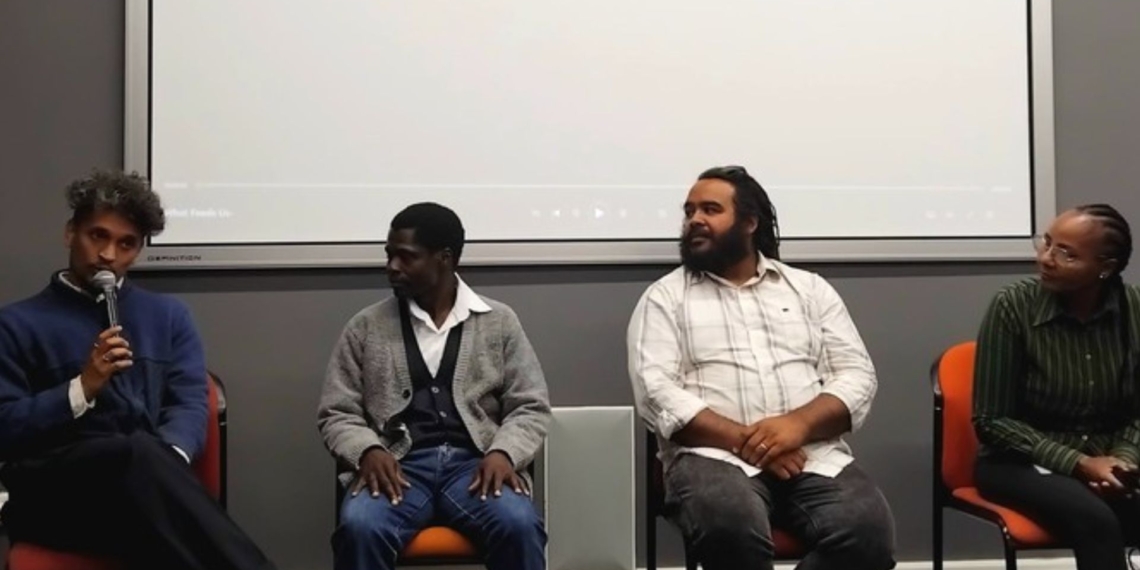
Director of 'What Feeds Us', Alex Hendricks, in a panel discussion with Method Gundidza, Marshall Rinquest and Busisiwe Mgangxela. Photo: Marecia Damons/GroundUp

Director of 'What Feeds Us', Alex Hendricks, in a panel discussion with Method Gundidza, Marshall Rinquest and Busisiwe Mgangxela. Photo: Marecia Damons/GroundUp

Share on FacebookShare on TwitterShare on WhatsApp

Activists attending the screening of a new documentary on the food system, What Feeds Us, have called for urgent action to solve food insecurity in South Africa.

The screening in Cape Town on Friday came days after the South African Human Rights Commission held hearings on how the structure of the food system contributes to food insecurity.

The documentary, directed by Alex Hendricks with cinematography by Jonathan Hendricks and editing by Mayur Vallabhjee, argues that industrialised agriculture is squeezing out smaller producers while contributing to environmental harm and food insecurity.

The film features the experiences of small-scale farmers, researchers and activists from Mpumalanga, the Eastern Cape and Western Cape.

Fixing the food system

According to StatsSA, nearly one in five households (19.7%) experienced moderate food insecurity in 2023. Severe food insecurity was experienced by 8% of households, meaning they regularly run out of food and go for a day or more without eating.

Despite the country producing a food surplus, many households cannot afford to eat. Agriculture minister John Steenhuisen told the SAHRC last week that food prices are determined by market forces, not the department, and that exports are necessary for job creation.

But Tony Gerrans, executive director of Humane World for Animals South Africa, told GroundUp at the film screening that the current system prioritises profit over fairness and sustainability.

“We seem to have got confused between the pursuit of profits and a food system that is just and sustainable, and those two things aren’t the same,” he said.


Related stories
  • Cutting post-harvest losses key to combat food insecurity
  • AAII unites leaders to address Africa’s food insecurity
  • Rising hunger: Stats SA sounds alarm on food insecurity
  • CGE: Women farmworkers still trapped in systemic exploitation

He called on the government to redirect subsidies and enforce existing regulations. “If we want to have a truly just food system that is premised on empowerment, we need to address the undue influence that these corporations have.”

“The system we have now favours the entrenchment of large oligopolies that command pricing power and control the supply chain,” he said. These dynamics make it nearly impossible for smaller farmers and beneficiaries of land reform to compete.

Method Gundidza, director of EarthLore Foundation, maintains that the heavy reliance on chemicals in food production is degrading the soil and ultimately human health.

“The soil loses its virility and then they need to pump in even more and more chemicals,” he said. “What we see playing out on the soil is exactly what will play out in the person when we consume the food that comes from there.”

Small-scale farmers struggle with market access

Busisiwe Mgangxela, an agroecology farmer in East London, said access to markets remains one of the biggest challenges for small-scale farmers.

She said government institutions represent an untapped opportunity.

“There are consumers like the Department of Education, Defence, Correctional Services and SASSA. These are the areas we should be selling to. There is a market available, but the issue is accessing it,” she said.

Marshall Rinquest, environmental educator and founder of Valley Food Gardens, said communities cannot afford to wait for intervention from above. He said communities need to “build something solid, consistent and sustainable”, because “we cannot depend on government”.

He said local municipalities are “often unaware” of what is already happening at grassroots level, and urged greater visibility and support for community-led initiatives.

“No one wants to see social instability when people are hungry,” Gerrans added. “A society can move very quickly from being socially stable to being unstable when people are desperate because they are hungry.”

  • This story was first published on GroundUp.

READ NEXT: New NAMC board set to drive agricultural transformation

Sign-up for the latest agricultural news delivered straight to your inbox every day with Mzansi Today!

Marecia Damons

Tags: Consumer interestFood SecurityFood systemsInform me
News

Aucamp outlines strategy for biosecurity, trade, and infrastructure

by Tiisetso Manoko
2nd September 2026

In an exclusive interview with Food For Mzansi, agriculture minister Willie Aucamp outlines his vision to accelerate the AAMP, tackle...

Read moreDetails
Tobias Doyer, CEO of Grain SA. Photo: Supplied/Grain SA Facebook

Rising costs, climate risk push Swartland wheat farmers to the brink

2nd September 2026
Sick spuds: No need to panic as SA’s potatoes are banned in Zim

Potato turning point ahead as onions double in price year-on-year

1st September 2026
Early calf care: Key growth targets every cattle farmer must track

Early calf care: Key growth targets every cattle farmer must track

1st September 2026

How to align your farming cycles with long-term financial success

1st September 2026

Rising costs, climate risk push Swartland wheat farmers to the brink

How to align your farming cycles with long-term financial success

How Tebogo beat post-harvest losses with smart agro-processing

Tough times, hardy cattle: Why Mzansi farmers are choosing Nguni

Beyond finance: Making women-led farms bankable

Join Food For Mzansi's WhatsApp channel for the latest updates!

JOIN NOW!
Next Post

Western Cape wheatlands threaten blue crane breeding success

THE NEW FACE OF SOUTH AFRICAN AGRICULTURE

With 21 global awards in the first six years of its existence, Food For Mzansi is much more than an agriculture publication. It is a movement, unashamedly saluting the unsung heroes of South African agriculture. We believe in the power of agriculture to promote nation building and social cohesion by telling stories that are often overlooked by broader society.

Honoured roots: A father’s legacy, a daughter’s farming dream

Gauteng farmers urged to harness massive urban market

Foot-and-mouth crisis hits SA dairy industry with R1-billion loss

Tough times, hardy cattle: Why Mzansi farmers are choosing Nguni

Dragon fruit thrives in KZN valley despite tough national season

Government hikes sugar import price, but industry warns of gap

  • Awards & Global Impact
  • Our Story
  • Contact Us
  • Cookie Policy
  • Privacy Policy
  • Copyright

Contact us
Office: +27 21 879 1824
News: info@foodformzansi.co.za
Advertising: sales@foodformzansi.co.za

Contact us
Office: +27 21 879 1824
News: info@foodformzansi.co.za
Advertising: sales@foodformzansi.co.za

  • Awards & Global Impact
  • Our Story
  • Contact Us
  • Cookie Policy
  • Privacy Policy
  • Copyright

Chat Options

I'm Lerato, your AI assistant!
No Result
View All Result
  • News
  • Changemakers
  • Lifestyle
  • Farmer’s Inside Track
  • Food for Thought

Copyright © 2024 Food for Mzansi

This website uses cookies. By continuing to use this website you are giving consent to cookies being used. Visit our Privacy and Cookie Policy.