Zambian agriculture faces a critical turning point as erratic weather and water scarcity threaten food security. With only 4% of arable land currently irrigated, Netafim’s precision technologies are proving to be a game-changer.
Zambian farmers face significant water availability and irrigation challenges, threatening crop yields, livestock production, and food security.
Precision irrigation solutions from Netafim are critical to these challenges, helping farmers improve productivity while promoting sustainable practices.
David Nganga, technical advisor at Netafim in Zambia, explains the issues: “Although excellent rains have fallen this season, the main water and irrigation challenges in Zambia include water scarcity, with insufficient water supply for agriculture across the country for both livestock and crop production; erratic weather patterns, such as droughts and unpredictable rainfall affecting crop yields and food security; and limited access to irrigation, as many farmers still depend on rain-fed agriculture, making the industry vulnerable to climate change.”
According to Good Governance Africa, despite the potential for growth, only about 4% of Zambia’s arable land is irrigated, leaving crops highly vulnerable to droughts and water shortages.
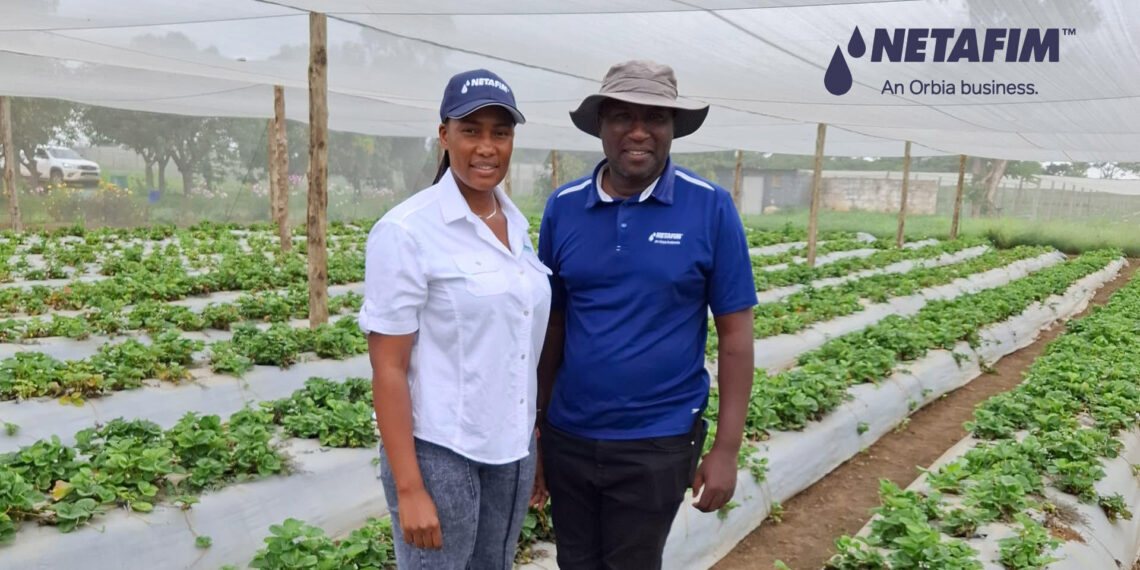
For horticultural farmers in Zambia, reliable and efficient irrigation is central to productivity and profitability. Hellen Kabesh, co-owner and operations manager of Premium Fresh Harvest, shares how Netafim’s precision irrigation technologies have transformed daily operations on their farm.
Moving away from labour-intensive irrigation
Premium Fresh Harvest has been operating for four years and is entering its fifth year of production. The farm specialises in horticulture, producing carrots, beetroot, sweet peppers and strawberries, the latter grown at scale.
“I co-own the farm with one other partner, and I’m responsible for the day-to-day operations and overall management,” Kabesh explains.
Like many farms across sub-Saharan Africa, water availability and efficient use are ongoing concerns. While Premium Fresh Harvest has been fortunate to have a consistent water supply at its location, the lack of irrigation efficiency quickly became a limiting factor.
“When we started farming, we weren’t using drip irrigation. We relied on sprinklers and rain hoses, and it became very tedious, especially for the workers. They had to manually move sprinklers and pipes all the time, and it wasn’t something anyone looked forward to,” Kabesh says.
That changed when the farm partnered with a local supplier who introduced them to Netafim’s precision irrigation solutions.
Related stories
- Netafim precision irrigation: Transforming farming in Kenya
- Netafim leads the drive for water-smart agriculture in Africa
- Netafim celebrates 60 years of driving precision irrigation
Research and innovation
Netafim is actively engaged in trials aimed at optimising irrigation and water management in Zambia, focusing on studying the specific water requirements of different crops to design more efficient irrigation systems.
“Netafim has been involved in researching the integration of water resources management, developing strategies for managing water resources effectively, considering factors such as climate change, soil, water quality, and scarcity,” Nganga notes.
Supporting farmers’ daily operations
Netafim designs its technologies to integrate seamlessly into farmers’ daily operations, supporting Zambian producers in achieving their agricultural goals while promoting sustainability. The company’s precision irrigation systems help reduce costs through labour savings and efficient water use, increase productivity by improving yields and crop quality, and make drip irrigation more affordable for local farmers.
“Netafim has been conducting farmer training across the country on different techniques available and on how to look after these systems,” Nganga explains.
Adapting to climate challenges
Netafim technologies are supporting the region in adapting to climate challenges both locally and globally by enabling real-time crop monitoring through tools like GrowSphere™ for remote management and automation. It offers a resilient and flexible range of driplines, such as Streamline™ X and Aries™, for optimal performance in low-quality water conditions, and promoting sustainable water use while reducing environmental impact.
Installing Netafim drip irrigation
Kabesh explains that the irrigation supplier handled the full system design and guided them on the appropriate accessories and Netafim driplines. After installation, the benefits became clear, with the system operating in a near-automated way.
She adds that its simplicity has made a significant difference on the ground, as workers can easily manage the process by switching on the booster pump and opening the valves, after which the drip system runs consistently without the need to move equipment.
Improved germination and labour efficiency
Beyond ease of use, the impact on crop performance was immediate.
“We noticed a big improvement in germination, especially for direct-seeded crops like carrots and beetroot. With drip irrigation, every bed receives the same amount of water, unlike sprinklers, where distribution can be uneven,” Kabesh says.
She describes drip irrigation as a “game-changer,” not only for crop establishment but also for labour management. The system has significantly reduced labour demands, allowing workers to be redeployed to other areas of the farm where their input is most needed.
Seamless integration and strong technical support
According to Kabesh, integrating Netafim’s technologies into existing farming practices was straightforward.
“It was very easy to adopt, and even the workers were open-minded about the change. Because we didn’t have a drip system before, we were essentially starting from scratch, which made the transition away from sprinklers quite simple.”
She emphasises the importance of on-site technical support during installation, noting that a Netafim representative ensured the system was set up exactly according to the design.
Simple, farmer-managed maintenance
Maintenance has also proven to be manageable and cost-effective. “We handle all maintenance ourselves. After installation, we went through a full site handover, which included guidance on care and maintenance,” Kabesh explains.
Routine upkeep is built into the farm’s daily operations, with filters cleaned after irrigation and the ends of the driplines opened and flushed about once a month to remove any accumulated residues.
Kabesh says durability has been one of the strongest advantages of Netafim’s products.
“In four years, we’ve only had to replace driplines in a few blocks. Some fields are still using the original lines from the initial installation. The accessories are also very durable; we rarely experience damage,” she says.
How Netafim precision irrigation makes a difference
Netafim’s precision irrigation systems help farmers overcome these challenges. Nganga highlights the following benefits:
- Water use efficiency: Drip irrigation delivers water directly to the plant roots, reducing runoff and evaporation while minimising water wastage.
- Climate resilience: Enhanced by enabling farmers to adapt to unpredictable climate patterns, ensuring stability and productivity. For example, most tomato, onion, and potato farmers in Zambia rely on drip irrigation.
- Increased crop yields: Drip irrigation provides optimal growing conditions for crops, resulting in higher yields and improved quality, ultimately leading to greater profitability for farmers.
- Sustainable resource management: Promoted through the efficient use of water and fertilisers, reducing environmental impact.
READ NEXT: Netafim’s precision irrigation helps farmers grow more with less