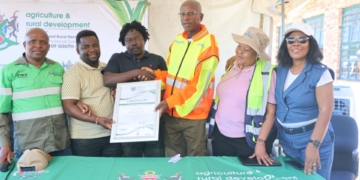
Nonkqubela Pieters, the MEC for rural development and agrarian reform in the Eastern Cape, is pleased with an Afrivet programme that already saw about 7 350 small-scale farmers trained in primary animal health care.
Last week, Pieters visited the project in the Ngcobo district in the former Transkei. This is where leading animal health products provider Afrivet trained these farmers.

The MEC visited the two-year-old Afrivet Emthonjeni dip tank management project which has become a lifeline for the local communal farmer industry.
In August 2019, Afrivet began by training the first 19 of 35 active community animal health workers. They were recruited following a rigorous process involving the people of Ngcobo, the Ngcobo dip tank executive committee as well as Pieters’ department.
Every month, these community animal health workers are trained in different aspects of primary animal health care, explains Afrivet managing director Dr Peter Oberem. Among others, this includes animal observation, early disease detection and dip tank management.
Community-driven development
The small-scale farmers are also equipped with sales and marketing skills to help grow their respective farming enterprises. Farmers also benefit from asset-based community development, a recognised strategy for sustainable community-driven development.

It is encouraging to see young people, especially women, take an interest in livestock farming, says Afrivet director Vuyo Makapela.
“I am quite sure that if we pull together as the private and public sector with our farmers, we can address most of the challenges that face our communities and the country as a whole,” she says.
Makapela believes sustainable agriculture is key in not only addressing food security, but also decreasing crime and unemployment.
“Assisting our communal farmers and transferring knowledge and skills is of utmost importance to us. They are owners of roughly 7 million cattle in the country.”
This year alone, nearly 77 000 community animals have been dipped, says Makapela. Afrivet already bought 60 000 ear tags for 66 Ngcobo dip tanks. To date, more than 19 367 cattle belonging to 2 255 local farmers from 20 dip tanks have been successfully tagged.
LITS system alignment
This is in alignment of the Livestock Identification and Traceability Strategy (LITS), a system which enables the country to rapidly and accurately identify and track animals from birth to slaughter.
LITS furthermore helps rural farmers to comply with national livestock auction regulations in preparation for the upcoming communal livestock auctions.
Makapela says the Ngcobo communal farmers project has spin-offs such as improved human nutrition, health, and welfare. To date, 39 sustainable jobs have been created.
Oberem says the Ngcobo project reminds him of the words of Samuel Thevasagayam, deputy director for global development at the Bill and Melinda Gates Foundation. “Afrivet’s business philosophy is one of being successful through doing good. We are proud of leading the way. Having MEC Pieters visiting our project [last week] is inspiring and motivating.”