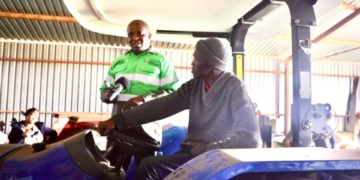
Give women an opportunity to grow, and they will feed the world. Bukeka Buqwana and four other women have taken that idea to the soil in Sterkspruit, Eastern Cape, where their Zakhe Youth Development Primary Co-operative is turning communal land into a growing business.
From spinach and cabbage to ready-to-cook vegetables and sorghum products, they are finding different ways to make their harvest work harder, even as drought keeps testing what they can grow.
Like many South Africans trying to break into the job market, Buqwana spent two years searching for work after obtaining her electrician qualification from Ekurhuleni East College in 2008.
Having grown up in Johannesburg, she eventually decided to return home to Sterkspruit. She started a home garden to feed her family, but as neighbours took interest in her produce, she began selling the surplus.

Growing beyond the garden
In 2022, Buqwana established Zakhe Youth Development Primary Co-operative with four other women: Ntombikayise Mabuyakhulu, responsible for financial oversight; Nomawethu Mkhithika, human resources, research and innovation; Nokusiza Mtshazo, who handles marketing and business development; and Nompiliso Buqwana, who oversees agro-processing, value addition and risk management.
Buqwana leads governance, strategic leadership and agricultural production. “Our vision has always been to create opportunities for rural communities while proving that communal land can be commercially productive,” she says.
The co-op applied for communal land and was allocated 139 hectares under a 20-year agreement.
As demand grew, the women looked for ways to make their produce more convenient for customers, particularly households preparing for traditional ceremonies and funerals.

They began washing, chopping and packaging spinach and cabbage into ready-to-cook vegetable packs. The products are now sold at Boxer Superstores and local households.
Related stories
- Ihawu Lesizwe: Farming co-op empowers youth, grows community
- Taleni Farmers Co-op grows hope in rural Eastern Cape
- Intambanana Co-op: Farming together, growing together
- Kulathi Primary Co-op drives change in rural EC
Finding climate-smart ways to keep growing
As recurring droughts threatened production, the collective turned to climate-smart farming. They invested in shade-net production, drilled a borehole and installed drip irrigation to improve water efficiency.
They also partnered with the Agricultural Research Council (ARC) to research indigenous and drought-tolerant crops, including their nutritional value.
The co-operative has since received funding from the department of social development, the National Development Agency (NDA), the Eastern Cape department of agriculture and the Eastern Cape Development Corporation (ECDC).
The 139-hectare farm currently cultivates 63 hectares, with 10 hectares under cabbage, spinach and potatoes, 50 hectares allocated to sorghum, one hectare for research and trials, and two hectares for indigenous maize. However, limited irrigation remains a major constraint, leaving much of the land unused.

Buqwana says they are working with the department of water and sanitation to secure a water-use licence. The process requires environmental and technical compliance before approval.
The co-operative also rotates crops according to the seasons. In winter, they focus on cabbage, spinach and potatoes, while summer production includes butternut and sugar beans.
“Crop rotation is one of the most important practices on our farm. It helps improve soil health, reduces the build-up of pests and diseases and makes better use of nutrients in the soil.”
For Buqwana, access to water remains central to the co-op’s future.
“As farmers, we all depend on water, so there must be a system that balances agricultural production with protecting rivers and groundwater for future generations.”

Finding the right partners
Buqwana tells Food For Mzansi that funding remains one of the biggest challenges facing emerging farmers, but she has learned that building a successful farming business is not only about securing money.
“It is about building the right partnerships,” she says.
She notes that each organisation that invested in Zakhe Youth Development helped address a different challenge, collectively helping the co-operative grow from a small community garden into a commercial farming business.
The department of social development provided seed capital to drill a borehole and purchase agricultural inputs, laying the foundation for more sustainable production.
The ECDC, through the Imvaba Cooperative Fund, supported the co-operative’s move towards mechanisation, while the department of agriculture provided a tractor and farming implements. As production grew, the NDA provided funding to help the co-operative scale up and move closer to commercialisation.

Another important step was joining Boxer’s Supplier Development Programme. Boxer helped the co-operative enter the formal market, providing access to LGAP training, agricultural inputs and mentorship on what retailers expect from commercial suppliers.
“That support gave us the confidence and knowledge to prepare for supplying the retail sector.”
However, moving from supplying the local community to the formal retail market took three years. “It wasn’t an overnight success,” Buqwana emphasises. “We had to build our production capacity, improve our farming practices and prove that we could produce quality crops consistently.”
Looking ahead, Buqwana wants Zakhe Youth Development to become one of Mzansi’s leading rural agro-processing co-operatives, while proving that communal land can support commercially viable farming.
“We want to move beyond selling raw produce to processing nutritious, climate-resilient foods that improve food security while creating jobs for young people and women in rural communities.”
Bukeka Buqwana
The co-operative’s plans include establishing a fully operational agro-processing facility, completing its packhouse, obtaining Global G.A.P. certification and expanding its range of sorghum-based products.


READ NEXT: Jobless EC graduates strike gold with peanut butter co-op