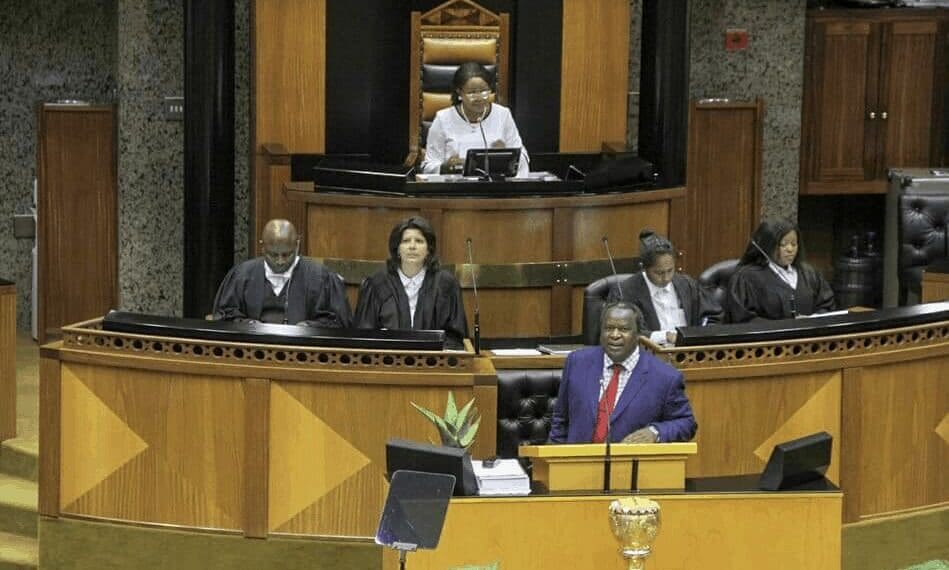
 Finance Minister Tito Mboweni’s maiden budget speech have left South Africans with mixed feelings, and it seems economists are no exception.
Economists that Food For Mzansi spoke to are generally positive about the monetary support that Mboweni announced for new farmers. However, some feel that this does not go far enough. The jury is also out on whether commitments to fiscal discipline will be enough to stave off further downgrades by ratings agencies.
Dr Johnny van der Merwe, an agricultural economist and lecturer at North West University, believes that Mboweni reiterated key messages from President Cyril Ramaphosa’s earlier State of the Nation Address.

“His statement about land reform being accelerated, focusing on agricultural output, exports, food security and attracting investment is positive. In an effort to achieve this, R1.8 billion will be invested into a number of land reform projects while more assistance will be given to small-scale farmers to obtain land.”
Van der Merwe hopes that this will include giving small-scale farmers access to skills development and training as well as the supporting infrastructure to back sustainable production. According to him, Mboweni’s overall message is great news for the agricultural industry (both the commercial and developing sectors) and the economy as a whole.
“It creates policy certainty and will attract investment into the economy of South Africa. Development and sustainable food production is prioritised, which is essential within the context of our current economic and political situation.”
Agriculture took a back seat to state-owned enterprises

Francois Botha, Optimum Investment’s Group Chief Information Officer, believes that Mboweni’s budget speech comments on agriculture were fairly limited. He says that R1.8 billion allocated for the implementation of 262 priority land-reform projects over the next three years, along with R3.7 billion set aside to assist emerging farmers seeking to acquire land to farm, is less than what was expected to be made available to this sector. This is especially true for drought affected areas.
Botha says the agricultural sector is, and will always be, important for food security. It has the ability to create jobs and help grow our economy. Unfortunately, agriculture took a back seat in Mboweni’s budget speech as compared to larger focus areas like Eskom and other state-owned enterprises.
‘Let’s subsidise those who develop new farmers’

Dr Roelof Botha, a leading economist and Joint Managing Director of GOPA Group SA, says the good news for the agriculture sector lies perhaps what the minister did not say.
According to Botha, Mboweni did not refer to land expropriation without compensation, which he says will be a “total disaster”, unless it is confined to land owned by government. “What (Mboweni) did say, is that the diesel price will increase marginally and that there is considerable support for emerging farmers.”
Botha is convinced that many commercial farmers in South Africa will have the opportunity in the next year or two to work hand in hand with new farmers in their geographical regions. These new farmers are probably already part of their supply chain.
“I’m convinced that if news of this cooperation can reach President Ramaphosa’s land reform panel, then one could probably reach a stage where such cooperation can even qualify for forms of subsidy,” says Botha. This could perhaps take the form of reintroduced diesel discounts or even interest-free loans via the Land Bank.
Bigger farmers ‘neglected’ in budget speech

Dawie Roodt, the chief economist at the Efficient Group, says instead of focusing on small farmers, Mboweni should’ve focused more on established farmers.
“Within the agricultural sector he has made announcements about a lot of money that will be made available to small and emerging farmers. Of course, that won’t make a big difference. What we need to do, is pay attention to the training of farmers instead of trying to establish small farmers. They are not as cost-effective as bigger farmers. So, there is more money available for smaller farmers, but it probably won’t help much.”
Will Mboweni’s speech get a thumbs-up from Moody’s?

Jacques Nel, the chief economist at NKC African Economics, believes South Africa’s economy is still haunted by negative influences of the past.
“Years of mismanagement and state capture, aggravated by weak economic growth, are still haunting the economy, as is evident in further fiscal slippage, particularly in the short-term projections.”
He says that although a significant revenue shortfall and a sizeable bailout for Eskom were generally expected, the size of the fiscal deterioration remains concerning. He expects that this will not be received favourably by ratings agencies.
Nel says that he welcomes government’s commitment to fiscal prudence, some tangible measures to address the state salary bill and the reprioritisation towards growth-boosting expenditure. “These should also be considered as positive developments by ratings agencies. It is a budget with a plan, but will the plan be considered bold enough? Whether this will be enough to console Moody’s, the only ratings agency that still considers South Africa’s debt to be investment grade, remains to be seen.”
‘Bureaucrats now control our buying power’

Piet le Roux, the CEO of Sakeliga, says that despite some signs that Mboweni wants to cut the state employee wage bill, and resist attempts to take on more state-owned enterprise debt, the fundamental fiscal trajectory remains deeply concerning. “From the start of his term, and in the run-up to Mboweni’s budget speech, we made it clear that the litmus test for this budget would be whether state expenditure is reigned in substantially. Despite some efforts, we saw the exact opposite. Projected consolidated expenditure still increases by more than price inflation.”
Le Roux says, “What we needed from the 2019 budget speech was a substantial decrease in expenditure. What we got was an increase in expenditure, tax, fuel levies and an exceptionally untimely carbon tax. It increases the strain on the economy and carries the South African fiscus further down an unsustainable path. By in effect increasing income tax, it transfers the buying power workers in the real economy should have had to bureaucrats.”