Tuesday, July 21, 2026
SUBSCRIBE
22 GLOBAL MEDIA AWARDS
Food For Mzansi
  • News
  • Changemakers
  • Lifestyle
  • Farmer’s Inside Track
  • Food for Thought
No Result
View All Result
  • News
  • Changemakers
  • Lifestyle
  • Farmer’s Inside Track
  • Food for Thought
No Result
View All Result
Food For Mzansi
No Result
View All Result
in It Takes a Village

Earthchild Project changing lives, one worm at a time

by Chantélle Hartebeest
21st February 2019
Earthchild Project teaches children how to create their own compost through worm farming which they can later use to grow their own food.

The Earthchild Project teaches children how to create their own compost through worm farming which they can later use to grow their own food.

Share on FacebookShare on TwitterShare on WhatsApp

Don’t underestimate the power of the humble earthworm. They may be crawly and slightly slimy, but they’re changing lives at eight underprivileged schools in Cape Town.

A worm farm project in Lavender Hill and Khayelitsha, both on the Cape Flats, has developed into an educational resource that not only teaches kids to grow their own food, but its influence is spreading into the surrounding communities.

Many parents of learners who are part of the Earthchild Project, a non-profit organisation, are now establishing their own food gardens and using worms to process their organic garbage.

The Earthchild Project was founded in 2006 to help learners develop an understanding of the environment, health and self-development.

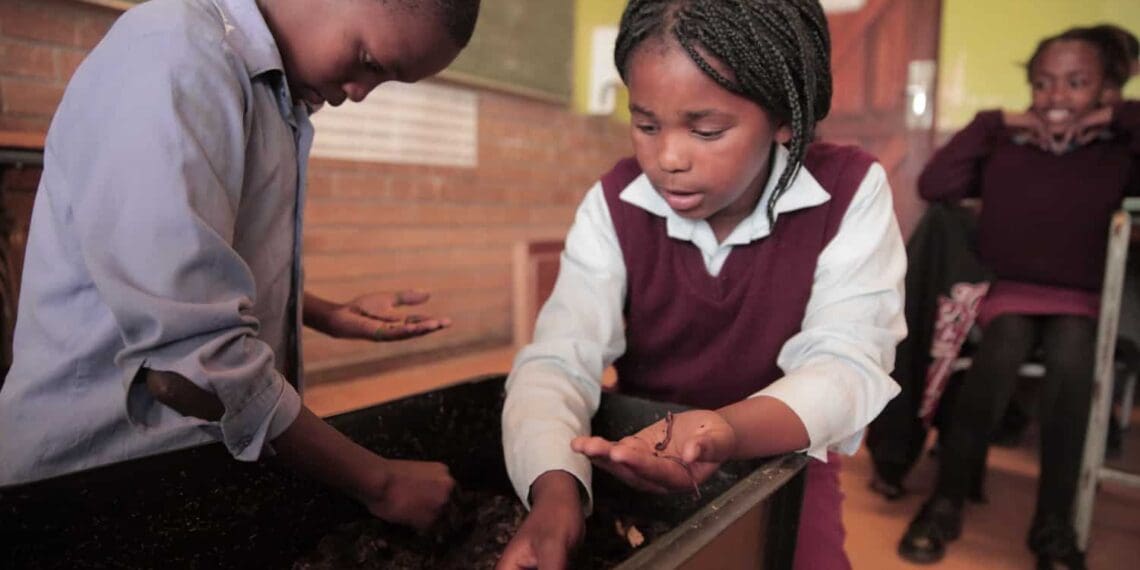
Xoli Funyani, and a few learners at one of the many worm farms established by Earthchild Project in classrooms.
Xoli Fuyani and a few learners at one of the many worm farms established by Earthchild Project in classrooms.

According to environmental education coordinator Xoli Fuyani, the Earthchild Project dreams of a world where individuals are inspired to connect with themselves, each other and the environment. They also aim to develop a new generation who are conscious, confident and responsible “earth children”.

“The effect of teaching children the value of growing their own food and how to make their own compost at a young age is profound,” says Fuyani. “Our approach to education is holistic and focused on health and wellness, life skills and the environment through different programmes integrated with the schools’ curriculum.”

The programmes that they offer at schools include yoga, meditation, organic gardening and environmental education.

Ten years ago the organisation started a worm farm project as an extramural activity at schools. As the project developed, they linked it to the schools’ curriculum to help make learning fun and interactive. “We set up worm farms inside classrooms. This then becomes a tool for children to get their hands dirty, learning about earthworms by observing them at work, learning about their home, their bodies, what they eat and many more other things.”

Earthchild Project has set worm farms at eight schools in the Western Cape.
The Earthchild Project has set up worm farms at eight schools in the Western Cape.

The worm farm also teaches learners how to reuse organic waste that can benefit the earthworms. “The children learn how to reduce and reuse the school’s organic waste by feeding it to worms and watching them turn it into compost, which we then use to grow herbs inside the classroom.”

The kids help to harvest the compost from the worm farms in their classrooms and then use it to plant herbs and vegetables in plastic containers.

“When we are planting our seedlings, we wrap them in our worm compost before putting them into the ground, as the compost carries good nutrients for the plant. We also do experiments where we only feed half our plants and measure the growth,” says Fuyani excitedly.

The vegetable garden is valuable for the children, who often don’t know where the food they eat comes from.

Land is a luxury for many children who live in informal settlements, where there is no space for a garden.

“We use plastic crates which the learners bring from home or the streets. We then show them how to use the crates to make gardens. We also use old two-litre plastic bottles as vertical, indoor gardens to grow herbs.”

The worm farm project has received positive feedback from many people and especially parents who have now also joined in, says Fuyani. “We often hear stories from parents of some children starting their own food gardens at home which then becomes a resource in their families. Every day we have requests for worms as so many are eager to start worm farms at home to help reduce their home organic waste.”

Chantélle Hartebeest

CHANTÉLLE HARTEBEEST is a young journalist who has a fiery passion for storytelling. She is eager to be the voice of the voiceless and has worked in both radio and print media before joining Food For Mzansi.

Tags: FarmingGardeningKhayelitshaLavender HillSchoolsWestern CapeWorm Farm
The Forest of Renewal at Rustlers Valley celebrates the intertwined legacies of Frik Grobbelaar, Anton Chaka and Riky Rick, inviting South Africans to restore the land while cultivating hope, belonging and community. Illustration: ChatGPT
Food for Thought

Rustlers Valley offers a blueprint for South Africa’s renewal

by Ivor Price
18th July 2026

As the Rustlers Valley Memorial Forest is launched in the eastern Free State this weekend, Ivor Price reflects on why...

Read moreDetails
Grain SA appoints Mabuza to lead farmer development

Rising stars: 2026 PGP finalists redefining SA grain farming

18th July 2026
Rooibos heads to space in groundbreaking Mzansi experiment

Rooibos heads to space in groundbreaking Mzansi experiment

18th July 2026

Seriti Institute CEO wins prestigious Best Woman 2026 CSI award

17th July 2026
Farmers and brewers call for budget that builds, not breaks

Minister details Land Bank’s success in boosting black farmers

17th July 2026

Farmers urged to embrace uncertainty and build resilience

Early harvest and larger crops mark unusual 2026 lemon season

SA poultry industry calls for urgent bird flu vaccine rollout

Unused KZN school transformed into a thriving 16-hectare farm

The Karoo’s quiet lesson on trust and truth

Join Food For Mzansi's WhatsApp channel for the latest updates!

JOIN NOW!
Next Post
Agricultural students and bursary holders accompanied by Hortgro chairperson and pome director, Nicholas Dicey (middle). From left is Chad van Wyk, Sakata Lebotse, Boitumelo Mokoena and Michaela-Anne White.

Agriculture can change SA, fruit industry body tells bursary holders

THE NEW FACE OF SOUTH AFRICAN AGRICULTURE

With 21 global awards in the first six years of its existence, Food For Mzansi is much more than an agriculture publication. It is a movement, unashamedly saluting the unsung heroes of South African agriculture. We believe in the power of agriculture to promote nation building and social cohesion by telling stories that are often overlooked by broader society.

Smart vineyard irrigation starts below the ground

Treat food processing as essential national infrastructure – Khoury

Farmers urged to embrace uncertainty and build resilience

SA poultry industry calls for urgent bird flu vaccine rollout

Mother’s legacy, neighbour’s grace: Venessa Simelane’s farm story

Deadline looms: Register water use by 23 July or risk penalties

  • Awards & Global Impact
  • Our Story
  • Contact Us
  • Cookie Policy
  • Privacy Policy
  • Copyright

Contact us
Office: +27 21 879 1824
News: info@foodformzansi.co.za
Advertising: sales@foodformzansi.co.za

Contact us
Office: +27 21 879 1824
News: info@foodformzansi.co.za
Advertising: sales@foodformzansi.co.za

  • Awards & Global Impact
  • Our Story
  • Contact Us
  • Cookie Policy
  • Privacy Policy
  • Copyright

Chat Options

I'm Lerato, your AI assistant!
No Result
View All Result
  • News
  • Changemakers
  • Lifestyle
  • Farmer’s Inside Track
  • Food for Thought

Copyright © 2024 Food for Mzansi

This website uses cookies. By continuing to use this website you are giving consent to cookies being used. Visit our Privacy and Cookie Policy.