
Wednesday, November 25, 2026
SUBSCRIBE
22 GLOBAL MEDIA AWARDS
Food For Mzansi
  • News
  • Changemakers
  • Lifestyle
  • Farmer’s Inside Track
  • Food for Thought
No Result
View All Result
  • News
  • Changemakers
  • Lifestyle
  • Farmer’s Inside Track
  • Food for Thought
No Result
View All Result
Food For Mzansi
No Result
View All Result
in It Takes a Village

EduPlant: ‘A future filled with hand-ups, not handouts’

Since its establishment, EduPlant has done remarkable work with its school gardening and nutrition programme. Permaculturist Bharathi Tugh tells us, ‘We are not only coming with information. We are encouraging self-worth and self-reliance’

by Nondumiso Precious Mncube
23rd January 2022
Add FFM on Google
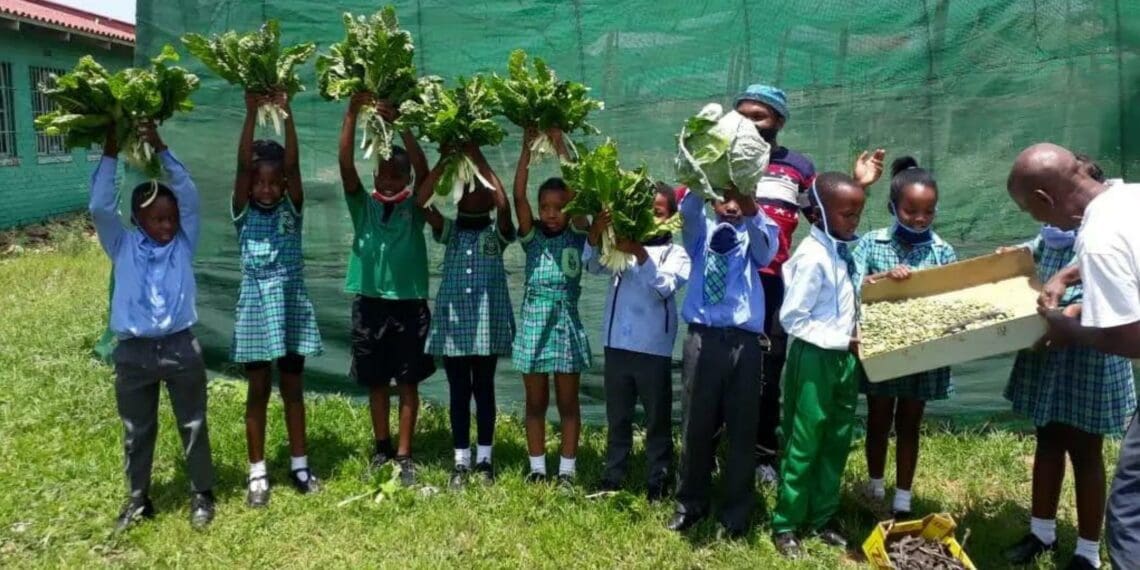
Through a series of workshops EduPlant is equipping children with the necessary resources and skills to put their farming skills into practice at school. Photo: Supplied/Food For Mzansi

Through a series of workshops EduPlant is equipping children with the necessary resources and skills to put their farming skills into practice at school. Photo: Supplied/Food For Mzansi

Share on FacebookShare on TwitterShare on WhatsApp

Looking back, permaculturist Bharathi Tugh believes her upbringing in Umhlatuzana, south of Durban, influenced her opinion that children needed to understand the significance of growing their own food.

Today, she is the KwaZulu-Natal branch manager of Food & Trees for Africa and the driving force behind the EduPlant school gardening and nutrition programme. Since its inception in 1994, EduPlant  has become the largest programme of its kind in southern Africa.

“The passionate earth lover is an unstoppable force of nature,” says Tugh.

Branch Manager Tugh in one of the cluster gardens in KwaZulu-Natal. Photo: Supplied/Food For Mzansi

She recalls having a backyard garden in her childhood home that also reinforced her belief in a sustainable world built on permaculture. Permaculture uses organic and farming practices and, according to Tugh, it is a secret weapon in the fight against food insecurity.

Despite this early passion, Tugh went on to become a special needs teacher after studying at the University of Durban Westville (now known as the University of KwaZulu-Natal), Springfield College of Education, Unisa and Rand Afrikaans University (now the University of Johannesburg). Among her education highlights is a 2005 award as Mzansi’s best special needs teacher.

Tugh tells Food For Mzansi that she became fascinated by environmentalism in her university days.

“The environment that I was in needed attention, so myself and others began revamping it through permaculture. We planted trees and established gardens. The results were amazing and you could tell that the people appreciated and loved how the spaces had been changed by planting.”

In 1995, she began delving deeper into permaculture after volunteering at many organisations. It was in the early 2000s that she discovered Food & Trees for Africa, which has already reached thousands of learners and teachers across the country.

What is permaculture?

According to Tugh, EduPlant is based on permaculture principles, but it does much more than just grow food and enhance nutrition. It encourages sustainable behaviours, environmental ethics, and whole-systems thinking.

This is achieved through a series of workshops that not only equip children, but give teachers the necessary resources and skills. “These workshops enable them to put the farming skills into practices in their schools,” adds Tugh.

There has been many programme highlights, but she will always treasure how different minds and people from all walks of life come together through EduPlant.

EduPlant’s impact extends beyond the learners and school. Photo: Supplied/Food For Mzansi

“Being part of the permaculture committee I have had the chance to witness so many people who come from different backgrounds who have taken the  knowledge that EduPlant has given to them and made it work for them.”

EduPlant, she adds, builds learners’ self-esteem.

“We are not only coming with information. We are encouraging self-worth and self-reliance. We have kids that come to school and have meals [from] their garden. There were school that had no water. The children had to bring in grey water to water the plants.”

Among the thousands of learners reached, one continues to stand out for Tugh. “Jeffry Keshwa, the child who had difficulty reading, is an EduPlant product,” she says proudly.

This “differently abled” former learner has since improved the lives of many others through practising permaculture.

“He built a garden for people who were experiencing similar challenges. When he finished high school, he found a job as a groundsman and used his permaculture knowledge to flourish in the business. He has been there for eight years,” says Tugh.

This garden encouraged experiential learning “since the students could now feel, touch, and experience while studying.”

Sustainable agroecology

Tugh is most grateful for EduPlant’s funders who continue to recognise the programme’s value. As with many other organisations, the last two years were particularly tough as a result of the Covid-19 pandemic.

But the work continued despite schools being closed. The vegetables was ready for harvesting. “I am very grateful that to the guards and principals of the schools who [also] sowed the produce,” she notes, adding that they were inspired by the many people who started planting vegetables in their own backyards during the pandemic.

Teachers from different clusters after the conclusion of an EduPlant work shop .The teachers are given supplies to help them implement what they have learnt .
Photo: Supplied/Food For Mzansi

Tugh hopes that EduPlant will continue to educate children about sustainable agroecology and demonstrate that there are opportunities and long-term jobs in farming.

And while they have reached thousands, there is still much more work to do. EduPlant, she says, will continue to provide a “hand-up” rather than a “hand-out”. “My aim is for every single household to set aside a modest two square meter area in their home to construct small garden patches of gardens.”

ALSO READ: Podcast: Become one with nature through permaculture

Add FFM on Google Follow FFM on Google News

Nondumiso Precious Mncube

Tags: It takes a VillagepermacultureSchool Garden
This week’s agri events: 23 – 27 November
News

This week’s agri events: 23 – 27 November

by Tiisetso Manoko
23rd November 2026

Agricultural events taking place soon include the ARC Beef Performance Awards and RAP Agricultural Empowerment & Partnership Summit. Early-bird tickets...

Read moreDetails

When to plant fodder radish for better livestock feed in droughts

22nd November 2026
Neat rows of young crops cover a sloping green field beneath lush, forested hills and a dramatic, overcast sky.

Private partnerships unlock millions for land reform beneficiaries

21st November 2026
Rooibos industry targets global growth while protecting local roots

African markets offer fresh growth opportunities for SA rooibos

21st November 2026
A woman wearing a straw hat, glasses, and gardening gloves stands in a large field of leafy green crops under a blue sky.

Supplying Joburg Market: Phumla Qwabe grows her next chapter

20th November 2026

AgriSA, IFC partner to streamline sustainable farm finance in SA

Eight-year harvest low threatens survival of SA wheat farms

Why seasonal rainfall averages don’t guarantee maize yields

African markets offer fresh growth opportunities for SA rooibos

Six hard-earned lessons from black-owned wine brands

Join Food For Mzansi's WhatsApp channel for the latest updates!

JOIN NOW!
Next Post
This week's #GatherToGrow features five livestock farming experts who unpack livestock farming and what to farm where. Photos: Supplied/Food for Mzansi

This week's agriculture events: 24 to 30 January

THE NEW FACE OF SOUTH AFRICAN AGRICULTURE

With 21 global awards in the first six years of its existence, Food For Mzansi is much more than an agriculture publication. It is a movement, unashamedly saluting the unsung heroes of South African agriculture. We believe in the power of agriculture to promote nation building and social cohesion by telling stories that are often overlooked by broader society.

Veg prices crash ahead of festive season, squeezing SA farmers

Working with nature: How soil health builds resilient farms

Enza Zaden field days prove crop performance from farm to market

South Africa’s job crisis: Why the agricultural sector is bleeding

Boshof Solar Power backs three-year emerging farmer programme

Why seasonal rainfall averages don’t guarantee maize yields

  • Awards & Global Impact
  • Our Story
  • Contact Us
  • Cookie Policy
  • Privacy Policy
  • Copyright

Contact us
Office: +27 21 879 1824
News: info@foodformzansi.co.za
Advertising: sales@foodformzansi.co.za

Contact us
Office: +27 21 879 1824
News: info@foodformzansi.co.za
Advertising: sales@foodformzansi.co.za

  • Awards & Global Impact
  • Our Story
  • Contact Us
  • Cookie Policy
  • Privacy Policy
  • Copyright

Chat Options

About this assistant

This feature generates automated answers summarised from Food For Mzansi articles. By using it, you are interacting with an AI system (provided by Google), not a human. AI can make mistakes. Please refer to the source articles for verification and citation purposes.

Our staff do not check or moderate Lerato’s answers in advance, but may review some later. Our journalists continue to write and edit all the articles Lerato uses as sources.

To estimate unique and returning web users, we store a random browser ID in this browser. WhatsApp users are counted by phone number. The same person using both channels may be counted twice.

I'm Lerato, your AI assistant!
No Result
View All Result
  • News
  • Changemakers
  • Lifestyle
  • Farmer’s Inside Track
  • Food for Thought

Copyright © 2026 Food for Mzansi