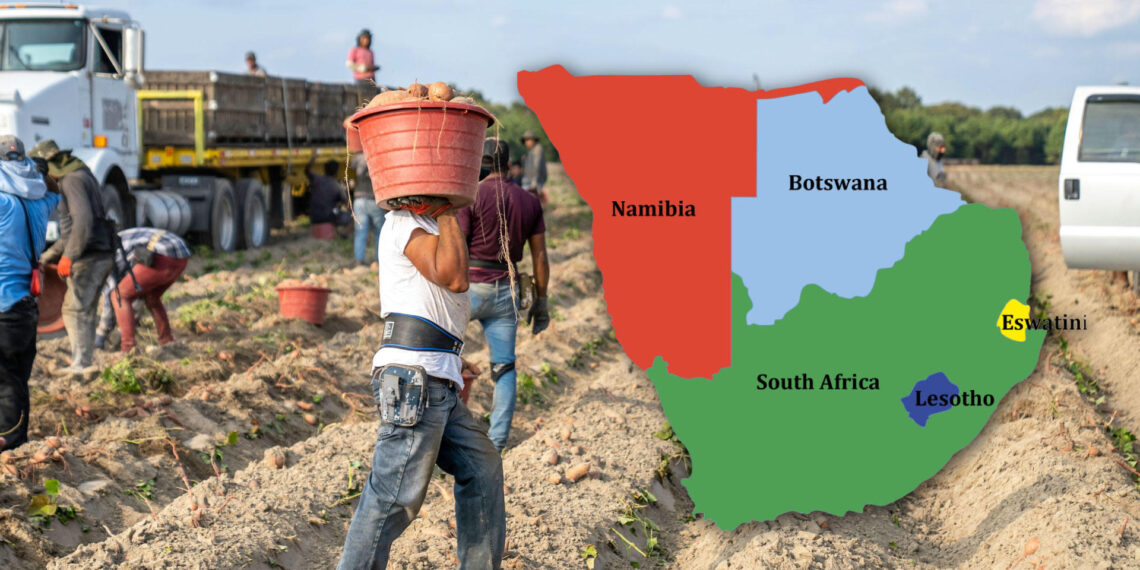
For South African farmers eager to expand their horizons, the Southern African Customs Union (Sacu) offers a practical gateway into export markets. Made up of South Africa, Botswana, Namibia, Lesotho and Eswatini, Sacu is not only the world’s oldest customs union, but also one of the country’s most important trade partners, especially for agriculture.
With zero customs duties, a shared external tariff, and strong retail infrastructure across member states, the union can present a unique opportunity for farmers to access regional markets with reduced red tape and favourable trade terms.
Buhlebemvelo Dube, an agricultural trade and research economist at the National Agricultural Marketing Council (NAMC), unpacks the vital role of regional trade, the opportunities within Sacu, and what South African farmers need to know to become export-ready and grow their agribusinesses across borders.
Related stories
- Podcast: Navigating the many avenues of agri exports
- File your taxes, farmers! SARS compliance crucial for growth
- How to compile a winning agribusiness plan
Understanding Sacu and why it matters
The Sacu region has become crucial for local agribusinesses.
Besides being accessible with comparatively low transport costs, the union serves as a vital source of food for neighbouring countries, with more than 70% of all formal food imports into Lesotho and Eswatini coming from South Africa.
Dube notes that South Africa’s agricultural exports to Sacu are valued at $2.6 billion out of a total of $13.7 billion to the world, with Botswana leading at approximately $900 million (R16.5 billion), followed by Namibia (R15.6 billion), Lesotho (R8 billion), and Eswatini (R7.5 billion).
According to the Agricultural Business Chamber (Agbiz), the Sacu region plays a critical role in South Africa’s agricultural trade. In 2023 alone, it accounted for roughly 20% of the country’s total agricultural exports, matching the value of exports sent to the European Union. However, the composition of goods differs: while the EU predominantly imports fruits and wines, Sacu countries import more grains and beverages from South Africa.
Getting export-ready
One of the key takeaways Dube unpacks is the importance of understanding the export landscape before diving in.
“You have to know or you have to do before you export is to actually have knowledge of the markets that you are entering. You have to understand where there is demand,” he says.
Dube recommends farmers use tools such as NAMC’s Market Intelligence Reports and the Trade Probe to track demand and identify potential markets. Beyond market research, there are critical compliance steps farmers must take.
“For those who are into crops, you have to get the phytosanitary documents ready. For those in the livestock space, you have to have your veterinary certificates ready,” he advises.
He further outlines logistical requirements, including export packaging, cold chain systems, customs registration, and working with clearing agents and cooperatives.

Market research is key
Echoing a common challenge among small-scale farmers, Dube warns against producing without a secure market.
He recommends that farmers engage closely with organisations: “For instance, the monthly market intelligence reports go into detail in terms of analysing the demand, the supply and where the markets are.”
These reports are freely accessible via the NAMC website and cover everything from grains and fruits to livestock trends.
Where to export? Botswana leads the way
Among the Sacu member states, Dube points out Botswana as the most promising export destination for South African farmers. He points to the country’s strong and growing demand for agricultural products, noting that it accounts for the largest share of South Africa’s exports within the region. This consistent growth in trade, combined with Botswana’s well-established retail infrastructure and proximity, makes it an attractive and accessible market for local agribusinesses looking to expand.
“In terms of aggregated exports, Botswana has been by far the largest. To Botswana, we export almost R17 billion, almost half of our exports to [Sacu],” he shares.
Other top destinations include Namibia, Lesotho, and Eswatini. For the past five years, South African exports to [Sacu] have been growing, Dube notes.
Support structures for aspiring exporters
Farmers looking to export can access a range of services through the department of agriculture and NAMC. Dube encourages farmers to tap into existing resources: “There is a need for us to trade as a continent. There is a need for us to identify opportunities and actually trade as a collective instead of trading separately.”
Support is available from the Small Enterprise Development Agency (Seda) to help farmers attend export readiness workshops, and in some cases, they may also offer financial assistance, depending on the farmer’s scale of operation. For small-scale producers, provincial departments of agriculture can also provide valuable guidance and support.
Commodity-specific industry groups also play a key role in providing guidance and support.
You don’t need to be a giant to export
Dube acknowledges a common misconception among small-scale farmers that exporting is only for large commercial producers. While higher volumes make the process easier and more cost-effective, high-value niche market opportunities exist.
Despite the potential in exports, Dube urges small-scale farmers to be cautious and consider focusing on local markets, especially when operating at a limited scale.
Dube points to a real case in the Eastern Cape where a small-scale butternut farmer struggled to turn a profit because transporting small volumes over long distances proved too costly. In contrast, commercial farmers producing at larger volumes benefit from economies of scale, making fewer trips more profitable.
Alone vs. working together
Exporting isn’t a one-size-fits-all approach. According to Dube, the scale should determine the strategy.
“If you’re a small-scale farmer and you have about 1 to 10 hectares, it’s always better to work with the collective, to work with the co-op, so that you can share the logistics,” Dube says.
Working through cooperatives or export hubs provides access to shared transport, streamlined logistics, and improved buyer relationships.
Common export mistakes to avoid
As the saying goes, failing to prepare is preparing to fail. Dube warns that many farmers face costly setbacks because they don’t adhere to export requirements.
“One of the first mistakes, and I think it’s one of the biggest, is that they ignore the phytosanitary rules. Your goods will be rejected at the border gate,” he cautions.
Other frequent issues include:
- Poor packaging: “If you put tomatoes in open crates, it will spoil quickly.”
- Assuming all countries have the same trade rules: “Different countries have different rules and regulations.”
- Lack of formal buyer contracts: “This poses a serious risk in terms of payment.”
- Inadequate post-harvest handling: “It shortens the shelf life of your crops.”
- Working in isolation: “Not being part of a co-op means you’re missing out on money saved in transport and pooled resources.”
He recalls an example of farmers who lost R150 000 in tomatoes destined for Botswana due to a lack of import permits and poor packaging.
Biosecurity and border compliance are essential
Exporters must take biosecurity seriously. Dube notes that different SACU countries have specific requirements. “Botswana has strict biosecurity requirements. They even often have caps on the volumes. Namibia is also strict in terms of its import permits. Eswatini has a high perishables demand but slightly lesser requirements, and Lesotho is highly dependent on South Africa.”
Why Sacu makes sense for SA farmers
Despite broader continental trade ambitions, Dube says Sacu remains an essential platform for South African farmers.
Another advantage of trading within the Sacu region is the removal of duties, which helps boost profit margins for farmers. The trade environment is more streamlined, and countries like Lesotho and Eswatini offer a stable, familiar consumer base that recognises and relies on South African products.
He adds, “We have fast border clearance between South Africa and Botswana – under two hours. We also have access to the supermarkets in Sacu. Shoprite is also in Botswana. Pick n Pay is also there. And also in Namibia, they source from South Africa directly.”
Don’t ignore Africa
Dube encourages farmers to explore opportunities beyond South Africa’s borders but stresses the importance of focusing on the continent first. He notes that many farmers tend to think of exports in terms of markets outside Africa, overlooking the potential within neighbouring regions.
“There are markets in Africa that have strong demand, and there are opportunities to invest in infrastructure, to invest in roads, in cold chain facilities, in the industry itself,” he says.
He concludes with a strong message of encouragement: “There is a need to continually look for new markets, and I do wish that farmers can improve their agribusinesses, work on their profit margins, and I do think we will reach and see the end of the tunnel.”
READ NEXT: Foot-and-mouth disease: What farmers need to know