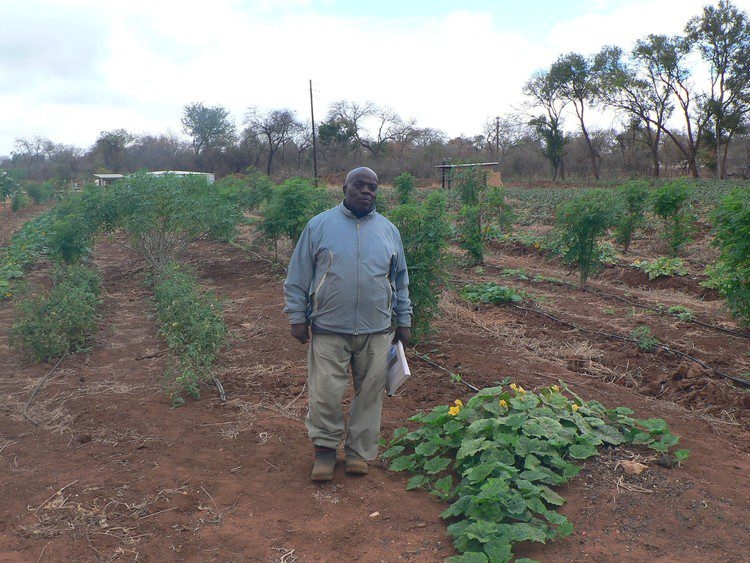
David Mlondobozi is one of dozens of small-scale farmers in Phalaborwa, Limpopo, who have lost land or grazing rights to a huge citrus farming project sponsored by the Motsepe Foundation.
Mlondobozi farms butternuts, tomatoes, green pepper, and chillies on land allocated to him in 2004 by chief Mulungisi Ntsanwisi. He had also earmarked some of his land for his children, but that land is now fenced off for the Majeje Citrus Farming Project.
Mlondobozi fears that the tribal authority will evict him from the rest of his land too.
According to Farmer’s Weekly, the Majeje Citrus Company was established in 2021 as a partnership between the Majeje Tribal Authority, Komati Fruits and Boela Bruwer, an agricultural economist and business adviser. In 2022, the Motsepe Foundation announced that it would inject R30 million into the project, in partnership with Agri SA. The plan was to create about 50 new permanent jobs and 300 seasonal jobs on community land adjacent to the existing successful Komati citrus farms.
“With the support of Agri Enterprises and the Motsepe Foundation, the community will now be able to develop its land and participate in the cultivation of South Africa’s most thriving agricultural commodity,” Agri SA said at the time.
Related stories
Mlondobozi received a letter in March 2024 from “community voices” with the stamp of the tribal authority accusing him of “failing to perform”. The letter said he could use 17 hectares instead of the 50 hectares he was allocated, and ordered him to remove his fences within a week.
His homestead is a stone’s throw from land which has already been cleared and fenced, with gates manned by security guards. When GroundUp visited last month, the motors of earth moving equipment could be heard roaring deep in the bushes.

“We are about to lose the land,” says Mlondobozi.
Mawewe Nkhwashu, a manager at Mopani Farmers’ Association, said more than 100 farmers had already lost grazing land.
“Farmers have lost grazing land and their cattle are roaming in the bushes. The farmers were allocated this land by the traditional council so we expect them to respect their initial decision. It does not make sense when the very same traditional council again displaces the farmers for citrus farming. As an association, we are saying no to any form of eviction,” said Nkhwashu, whose association is already in a battle with the traditional authority over other land a few kilometres away.
To the west of the citrus farming project, cattle from Prieska village are roaming around. Farmers from Khaxani and Nondwe who used the land for grazing have also lost their rights.
Johan Lybon Moungwe, the chairperson of Gravelotte, Seloane and Prieska (GRASP) Cooperative, fears that members of the cooperative will lose their water rights to the project. The cooperative was established in 2012. Members mainly grow vegetables. He says none of the cooperative’s members have been contacted about the citrus project.
“I am of the view that the chief and the government should put trust in the smallholder farmers so that they can prove themselves,” Moungwe told GroundUp.

“I will die fighting for the land as I used to earn a living from farming on this land,” said Mlondobozi,who is also the secretary of GRASP cooperative.
“The Majeje Traditional Council and the Department of Agriculture should respect the views of the small farmers.”
GroundUp tried to contact Komati Foods and the Motsepe Foundation to find out more about the citrus project and possible evictions of small farmers. Robert Mabunda, a manager with the Komati group, referred us to his supervisor, and the supervisor referred us to Bruwer, who is said to be the coordinator of the project. Bruwer said he would not respond, as GroundUp had published a previous article which he said was not accurate, but he did not point out any mistakes. He later told us to contact the Majeje Tribal Council. However, all attempts to reach the chief, Ntsanwisi, or any of his advisors were unsuccessful.
Melissa Anthony from the Motsepe Foundation told GroundUp that she had forwarded all questions to AgriSA, as AgriSA had the information requested. But AgriSA also referred us to Bruwer.
According to the Limpopo Department of Agriculture and Rural Development’s 2023 estimates of provincial revenue and expenditure, the Majeje Tribal Authority had applied for funding and R12 million was to be transferred that year, the same amount in 2024/25 financial year and R10 million in the 2025/26 financial year. In its 2023 annual report, the department said it had approved a request for funding from the Majeje Tribal Authority, of a 40% contribution to the development costs of the estimated R126 million. By the end of March 2023, the department said, 78 hectares of citrus had been established, with 102 hectares of irrigation and R3.2 million in solar energy. Thirty-two workers had been employed, 15 of them permanent.

GroundUp contacted the department to ask about displacement of farmers for the project. But spokesperson Mothose Moshupolongo referred us to the national Department of Agriculture. We pointed out that it was the Limpopo department which had funded the Majeje project, but she again referred us to the national department. On Friday 12 July we contacted Linda Page from the national department, but she did not respond to that WhatsApp message or to a follow-up message on 15 July.
This article was first published by GroundUp.
ALSO READ: Budget for a better climate response in agriculture, urge experts
Sign up for Mzansi Today: Your daily take on the news and happenings from the agriculture value chain.