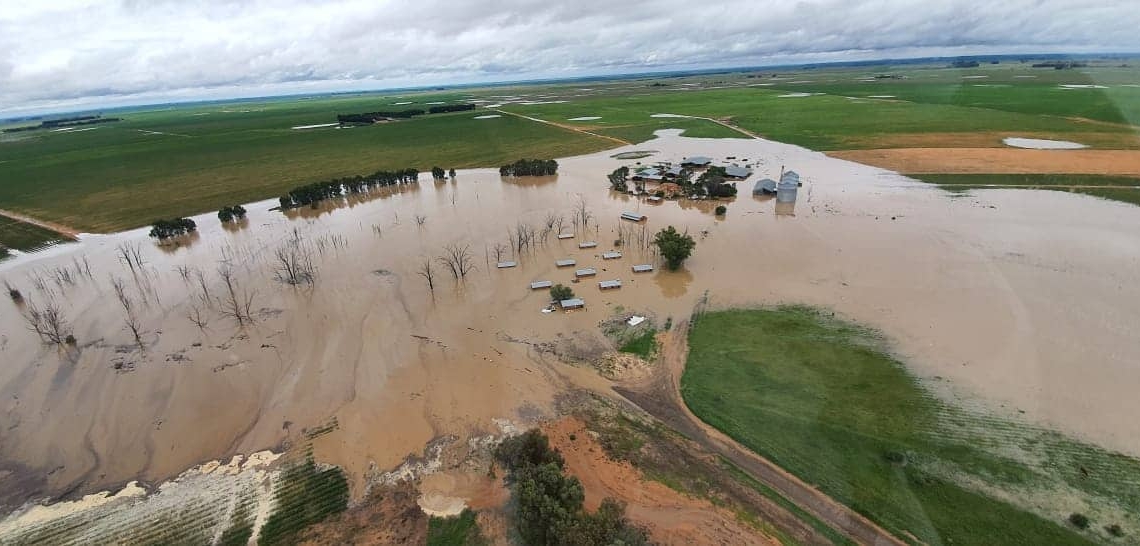

Agricultural leaders in flood-hit provinces fear for the worst amid reports of major damage to farmlands, roads and infrastructure. In the Northern Cape alone, more than 65 000 jobs are on the line due to floods now threatening to collapse a wall meant to protect farms along the Orange River.
Thoko Didiza, the minister of agriculture, land reform and rural development, says 32 000 hectares of arable land are also at risk. Already, hundreds of terrified families left their farms to protect themselves from the fluctuating river.
The river was supposed to be held back by a R1.2-billion flood protection wall designed to keep people and crops safe.

The project was reportedly undertaken to specifically protect South Africa’s raisin and table grape export industry through the construction of 400 kilometre levees.
The walls – 5 metres high and 10 metres wide – were to stretch for roughly 200 kilometre either side of Upington along the lower Orange River system. Construction started in 2012 after the devastating floods a year earlier.
Food For Mzansi understands that the project was due to be completed in 2015, but then extended to 2018.
Farmers, contractors and agricultural organisations from the province say there are 70 kilometres of gaps in the levees’ strategic protection zones.
Northern Cape flood-ravaged

Contractors say nearly R300 million was diverted from the project to other agricultural development projects in the Northern Cape.
With persisting rain, little can be done by contractors to remedy the situation.
Should the Orange River overflow, it could penetrate the vineyards in the area which could cost farmers hundred thousands of Rands, says Nicol Jansen, the president of Agri Northern Cape.

Jansen says that for the next two to three weeks, he suspects there will be high levels in the lower Orange River region. At the moment, that presents the biggest danger.
“The high levels of the Orange River will cause the river to overflow into the perennial crops, such as vineyards. If the situation prolongs, the vineyards will die off.
“It is very costly to plant vineyards again. It cost between R500 000 to R600 000 per hectare to replace that. Thereafter, it takes another three years before it can get into production, so that is the financial impact.
“It is not just the damage the occurs during the flood situation. It is also when the vineyards don’t survive the wet conditions,” he says.
ALSO READ: How to limit rain damage on farmlands
Jansen indicates that it is difficult to say how long it will take before the water levels go back to normal. It all depends on the rainfall in the coming days. However, they hope that the levels will be lower so that the flood walls won’t collapse and cause even greater damage.
Soil erosion in Free State
Meanwhile farmers in the Free State are suffering from soil erosion. They are unable to harvest their wheat, let alone visit their farmlands due to the flooding caused by the heavy rainfall.

Dr Jack Armour, operations manager of Free State Agriculture, says though the rain has been wonderful for livestock farmers, they are faced with some serious problems.
“Something that we have to face head-on is that the conventional practice of agriculture, where people are ploughing deep and leaving the soil bare, is causing a lot of topsoil to be eroded.
“Farmers have not been maintaining proper water ways. As a result, there has been a lot of topsoil washed away. That is a loss for agriculture for the next 100 generations,” he says.
Rain, rain and more rain in the Free State. The Liebenbergsvlei river flowing on it’s way to the Vaal dam. https://t.co/S0qyxZR2mU@FarmersWeeklySA @foodformzansi pic.twitter.com/GDf9wBlC26
— Vrystaat Landbou (@vslandbou) January 5, 2021
Armour indicates that there are also farmers that have maybe planted their crops too close to dams. This could lead to portions of their land being swamped because of the heavy rainfall.
While there are crops that have produced yields, OTHERS are discoloured because of the rain.
Furthermore, many farmers couldn’t get onto their land to spray for pests. They are therefore expecting a lower yield.
Wheat harvest at risk
“There are some farmers in the central and northern Free State that still haven’t managed to harvest their wheat. It is just too wet. Now the wheat has fallen from first grade to the last grade.
“Some of the wheat already started sprouting in the ear. So, there have been losses for people who have had late wheat, but then couldn’t harvest their wheat. There are also many sugar bean farmers that should be harvesting now, and also farmers who planted sunflowers and nectarines.”

Due to the rain, they had to replant, says Armour.
“Sunflowers is always a difficult one when it rains hard, but these are now soft rains, so the people that planted on time and planted earlier have their crops out of the ground,” he says.
Armour adds that the Free State roads are also in terribly bad shape.
“After 15 January, the southern Free State also had massive amounts of rain. There are some areas that have also had over 100 millimetres in one day.
“So, as predicted, the roads washed away because of the poor maintenance in the last 10 to 15 years. The department of roads and safety did not employ people to clean the water ways.”
Limpopo farmers overjoyed

Agri Limpopo’s chief executive, Deidré Carter, says farmers have welcomed the rain after a six-year drought. She indicates that some areas in their province have had a little rain in December 2019, and then no rain again in January last year. The first rain came in December 2020.
Carter says, “Everyone is so grateful. I have asked people if they had any damage. The guys would say, ‘Look, we have lost a pump here and a pump there, but so far, really, the guys are not complaining.”
She states that, however, there is some concern though with the rain in the Lapalala area.
“They have had 300 millimetres of rain in the last 24 hours. At the end of the day, if we are going to continue having these volumes of rain, it may lead to dams collapsing. It cannot handle the rain,” says Carter.
No news is good news in Mpumalanga?

Meanwhile Robert Davel, general manager of Agri Mpumalanga, says he has not received any reports of rain damage.
This could be because not all farmers were in a position to calculate the damage yet.
Davel, however, predicts some serious damage on farms. “I am a bit careful not to try and give you an exact figure, but there will be damage with this type of rain. The damage will be more than normal, but I cannot give you the details.”
Many roads and infrastructure in Mpumalanga have reportedly also been severely damaged.