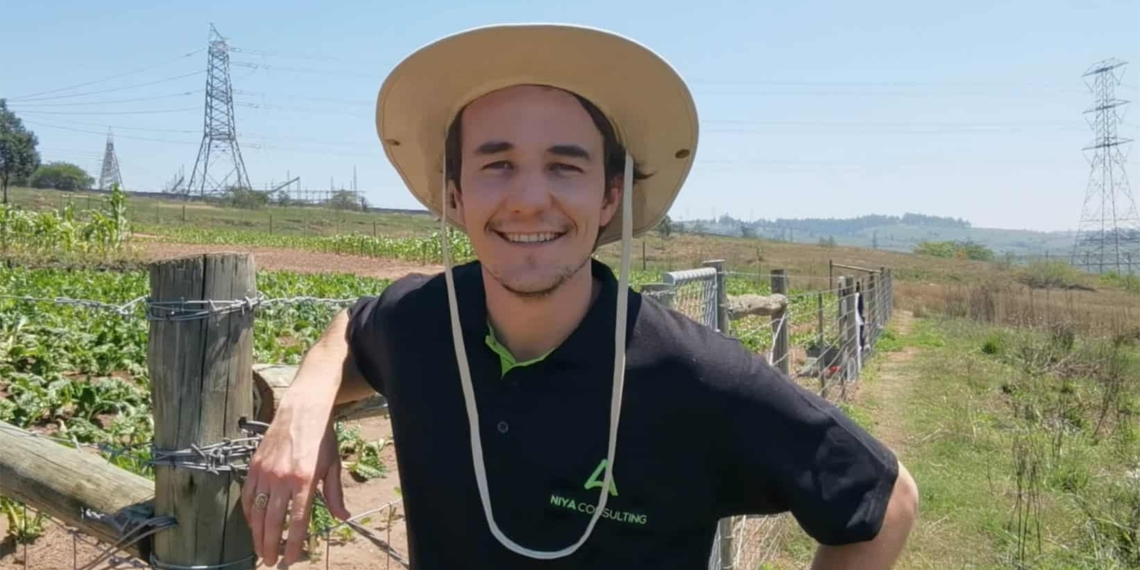

In the heart of La Lucia, north of Durban in KwaZulu-Natal, two brothers are on a mission to change the mindset of land-hungry South Africans. Farming without land is possible.
Rather than waiting for a large piece of land, Daniel and Devon de Sousa advises prospective farmers to set their sights on their own backyards to live out their farming dreams.
The 29-year-old Daniel started The Farm Nearby in 2015 to inspire city dwellers to convert abandoned spaces into fully functional urban farming operations.
“We have become accustomed to thinking we need a large piece of land to become a farmer,” he says.
Older brother Devon (35) adds, “You do not need to have a massive piece of land to be self-sustainable. You can self-sustain in your garden or even your garage.”
The La Lucia duo are trying to promote small-scale farming in urban areas to alleviate the need for more farms in rural areas, he says.
Devon is a practising attorney and runs Niya Consulting, a developmental organisation assisting small businesses and budding entrepreneurs to grow, launch and sustain viable enterprises.
“Just start. what do you have to lose? R50, R20 on seeds? You can start as small as one plant.”
Daniel is a former brand strategist turned urban farmer. Before starting The Farm Nearby, he reveals that he had never farmed before.
“I am a brand strategist and graphic designer on paper. My passion sits with brand strategy and then, obviously, my love for urban agriculture. With the farm, we aim to inspire communities to rethink how our food system works, and to change how we view the places we live in.
ALSO READ: 10 farming ideas that will be lucrative in 2021
“I want to see an urban farm strategically placed in the heart of every urban community and making use of SPIN (“small-plot intensive”) farming techniques that are production-based, sub-acre in scale, low capital intensive, entrepreneurially driven, environmentally friendly and close to produce markets,” Daniel says.
Urban farming is the answer to those pesky farm deterrents that prospective farmers face, like landlessness, lack of funding and zero experience, the brothers believes.
Armed with farming tools, family guidance, and eight years of due diligence through online study, the brothers have managed to create a hub of leafy greens. This includes lettuce, rocket and micro greens over five plots of borrowed land.
“There is nowhere to farm (in the city). We need space in urban areas. It (farming on borrowed land) allowed me to expand my business without having to worry about paying a bank back,” says Daniel.
“I supply a number of restaurants in the area, I managed to grow a relationship with chefs that were happy to work with me.”
First steps in urban farming
The Farm Nearby began as a small, subsidised side-hustle when Daniel started growing plants as a hobby.
“I built my own hydroponic system in the backyard and went as deep as I could with regards to tracking how well that little system worked for home. I was able to decrease the amount of money we were spending on groceries.”
“With the farm, we aim to inspire communities to rethink how our food system works and to change how we view the places we live in.”
Using his background in the branding industry, the younger De Sousa took to the drawing board, dreaming of strategies for mirroring his concept into urban areas throughout the city.
“I wondered how many people were thinking the same way?” Daniel says.
A handful of people in urban areas were constantly looking for fresh inner city produce, he later discovered.
“That just kicked me into hyperdrive to grow that little plot of mine to what it is now.”
Within three months of operation, De Sousa’s crops produced an excess of leafy greens, turning his operations into a lucrative business.
“I was growing too much and ended up selling the leftover crops to neighbours, friends and family and ended up being able to keep that cash flow for myself.”

The early days of his business were turbulent, to say the least. In the first three months, he drove around urban areas pitching his concept to neighbours and people with extra plots, hoping he could rent these spaces and repay them with fresh produce.
Nothing happened in those three months until a curious neighbour gave in. “It was more than enough for me to start off,” Daniel says.
“If we look at how food is grown and how the agricultural sector is run, we can focus on growing our food closer to the city. That allows commercial farmers to focus on exports and numbers that grow the economy and also helps turn emerging farmers into commercial farmers.”
Another stumbling block he tackled in the first two years of business was “a lack of perceived value for urban agriculture,” confirms Daniel.
“That lack of awareness caused a barrier of entry for me to compete on the market. I couldn’t justify to people the difference between buying something off the shelves versus from me.”
Over a period of two years, he managed to the build trust with a small clientele. “Now our business is in a place where everyone is looking for produce grown in the city.”
Brothers and business partners
Some farmers would attest that working with family can be a painful experience.
The De Sousas, on the other hand, work well together. “We can’t clash because we have very different thought patterns. He shares his vision and I support him,” says Devon.
Daniel adds, “I dream a lot and Devon allows me to put that dream into constructive steps to take things further.”
Their advice to prospective farmers who are looking to build enterprises is simple.
“Just start,” Daniel says. “The best time to plant a tree was 20 years ago. The next best time is today.”
A quote to live by, he adds.
Having watched his younger brother build the business from the ground up, Devon says, “Daniel started very small, right next to our driveway. The more he improved, the more he tried. What do you have to lose? R50, R20 on seeds? You can start as small as one plant.”
FREE GUIDE: The ultimate how-to guide for chicken farming