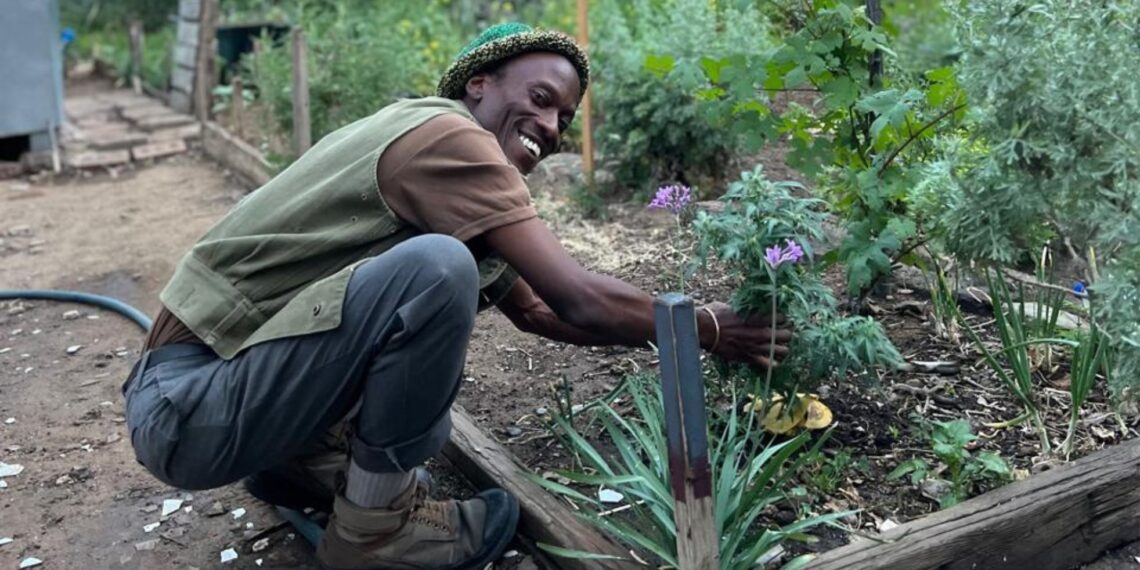
Nearly a decade ago, Mphathi Motha, a former vinyl DJ from Orlando East, Soweto, swapped late nights and loud beats for early mornings and the quiet rhythm of nature.
Armed with just R3 000 in savings and a deep sense of purpose, he began transforming a 30m² x 10m² patch of his grandparents’ yard into a garden rooted in organic and regenerative principles.
Today, his initiative, Soul Indigenous Life, is a vibrant community space for skills development, environmental education, and sustainable farming.
Motha grows herbs, lettuce, imbuya (amaranth), sweet potatoes, yellow beans, cowpeas, onions, cherry tomatoes, and seasonal crops like sorghum, red maize, and pearl millet, along with fresh herbs such as thyme, origanum, wild rocket, and sage.
A fruitful start in permaculture
His journey started in 2016 when Motha got involved in his community through Abems Consulting and Training Institute, an NPO focusing on climate-proofing programmes around Soweto and Gauteng. A week-long training session sparked his love for indigenous crops and food production.
“I began my training in permaculture methods and was fortunate to receive a certificate in environmental studies.”
He adds that they practise organic farming using permaculture and regenerative methods, with a strong focus on zero waste and making their own compost.
He used R3 000 of his savings to purchase farming tools, a basic hosepipe with sprinklers, and seeds to start his garden.
He explains that they operate in a pesticide- and herbicide-free environment. Their farming activities involve using certified organic compost as input, and they do not spray any pesticides on their crops. They advocate for growing food as naturally as possible, and this is a core principle in how they approach their farming space.

“Our busiest times are during the spring and summer seasons, but we also host different events on the farm throughout the year,” he says. “We manage our workload by sharing different tasks, and now and then we involve third parties to assist.”
Sustainable farming partnership
After years of going solo, Motha teamed up with business partner Lutendo Mametsa, who initially joined as a volunteer.
Mametsa handles administration, media, social platforms, and some communication with clients. “We’re both hands-on in the field when it comes to planting, general work, and organising,” explains Mametsa.
He notes that their approach centres around the systems and inputs involved in farming.
“We use beneficial plants such as indigenous marigolds, nasturtiums, and umhlonyane as our main natural pesticide.”
Lutendo Mametsa
Motha adds that umhlonyane helps clean the environment and control insects. They also make their own liquid pesticides and organic fertilisers from plants growing on their farm, including comfrey, borage, wild garlic, and peppermint.
These are used as natural herbicides, and they rely on beneficial insects and reptiles like lizards by creating an environment that attracts them. “This allows us to maintain a natural system and build an ecosystem that supports sustainable food production,” Motha says.
Related stories
- Khanyile’s comeback: Turning poultry failure into seeds of success
- Macadamia mission: Vumisa swaps engineering for farming roots
A holistic approach to farming
Before farming, Motha was involved in uKhamba National Development Projects and worked with the Johannesburg City Parks and Zoo.
He completed an NQF Level 2 qualification in environmental studies, which included training in ecology, nature conservation, and waste management. The three-year programme involved practical experience in permaculture systems and led to certification as an environmental officer and agent.
“This gave me insight and an understanding of the environment as a holistic approach to farming,” says Motha.
He adds that having environmental knowledge allows one to create systems that support organic farming methods. “I applied what I had learnt. When you understand the environment you’re working in, you can build systems that align with nature.”
Food with a purpose
Their client base includes community chefs, especially those who cook using indigenous methods, as well as independent chefs and hawkers based in Orlando East, Diepkloof, Pimville and nearby.
“We recently received a Community Impact Award under the Impact Changemakers category for Soul Indigenous Life,” says Motha.
The award was handed to them on 4 April to recognise entrepreneurs whose ideas contribute to community wellness and livelihoods.
“One school we are currently working with is Morris Isaacson, along with a non-governmental organisation called Thuto Pele. We’re helping design an organic food garden for both the students and the surrounding community,” says Motha.
He adds that they are also involved with the University of Johannesburg’s Food Evolution Research Laboratory (FERL), led by Dr Hema Kesa, where they assist third-year students with food systems-related assignments.
“We’re committed to expanding our work by creating more opportunities – whether it’s through skills-sharing, education, or research. Even learners and students will have a chance to be part of it, if the opportunity arises.”
Motha says Soul Indigenous Life is rooted in food justice, food activism, and environmental health, and they hope to continue this work – restoring the soil, nurturing it, and growing food that nourishes and heals.


READ NEXT: South Africa’s agricultural sector braces for Trump trade turbulence
Sign up for Mzansi Today: Your daily take on the news and happenings from the agriculture value chain.