Tuesday, October 20, 2026
SUBSCRIBE
22 GLOBAL MEDIA AWARDS
Food For Mzansi
  • News
  • Changemakers
  • Lifestyle
  • Farmer’s Inside Track
  • Food for Thought
No Result
View All Result
  • News
  • Changemakers
  • Lifestyle
  • Farmer’s Inside Track
  • Food for Thought
No Result
View All Result
Food For Mzansi
No Result
View All Result
in Advertorial, Food For Mzansi TV

Grow your agribusiness: How to leverage your existing resources

by Staff Reporter
30th August 2020
Share on FacebookShare on TwitterShare on WhatsApp

On today’s episode of Food For Mzansi TV, we chat to MC Loock, senior manager of agribusiness at Standard Bank, about how you can leverage your existing resources more effectively.

One of the most significant ways to do this is to put a diversification strategy in place for your business. But what does this mean, practically speaking? Firstly, it is important to remember that your ability to diversify is often limited by the quality and quantity of resources you have available. Secondly, growth and improvement doesn’t happen overnight; it is often incremental.

So, how do you leverage your resources?

MC Loock, senior manager of agribusiness at Standard Bank. Photo: Supplied.
  • Never stop learning: As the owner of an agribusiness, you need to instil a culture of learning in your workplace. In the agri sector, for example, you could acquire knowledge about which animal breeds are better suited to the local conditions or those that are in high demand. Training your staff is also a key component.
  • Strive for continuous improvement: Bringing innovation into your agribusiness is vital if you want to diversify. But let’s be honest, everybody’s human. Give yourself the leeway to make a few mistakes and learn from them.
  • Differentiate your product: Tell your story. Consumers would like to know where and when a product was produced, by whom, and in what way. Create a unique impression in the consumer’s mind about your product that is distinct from the rest of the marketplace.
  • Investigate the potential of agritourism: The wine industry is one of the best examples where they have successfully used tourism to complement their farming income.

Tune into this episode of Food For Mzansi TV, where Loock gives us a full breakdown of what you can do to leverage your resources effectively.

What role does growth play in a diversification strategy?

Expansion of your product lines or services opens up a whole range of possibilities in your diversification strategy. Even though your business’s diversification may be limited by your available resources, you could use horizontal expansion. This means setting up more production units of a similar nature to optimise your farm’s offering. This will then create the possibility of geographic diversification. Reaching economies of scale also provides the opportunity to expand along the value chain.

The answer to diversification often lies outside the farm gate

  • Do some consultation work for other farmers.
  • Start up a mentorship programme.
  • Form partnerships with people in your area that offer different skills/services that you may lack in your business.

[adsanity id=”18569″ align=”alignnone”/]
Staff Reporter

Researched and written by our team of writers and editors.

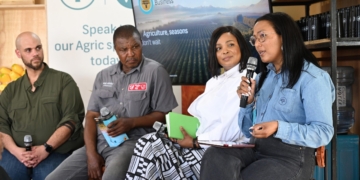
The panellists at FNB Business’s “Farming together” discussion at the Royal Show explored how market access, mentorship, financial discipline and strong commercial relationships can help farmers build sustainable businesses. Featured from the left are Bertram July (FNB’s distribution sales lead), commercial farmer Shakes Shabalala; Sandy Gumede (co-founder of Zulu Girl Wines), and Janis Robson (FNB’s head of development and SME business development). Photo: Food For Mzansi
News

FNB puts relationships at the heart of commercial farming

by Staff Reporter
17th October 2026

From buying a farm with cattle to building a wine brand from scratch, entrepreneurs shared how strong relationships, market access...

Read moreDetails
Agri Skills Transfer students gain hands-on experience at the institution’s Cullinan Farm Training Centre, where agricultural theory meets the realities of commercial production. Photo: Supplied/Food For Mzansi

Build your future in agriculture with Agri Skills Transfer

17th October 2026
Durbanville Hills tastes sweet success at Michelangelo Awards

Promising early conditions predicted for 2027 SA wine harvest

17th October 2026

Reclaiming the kraal: Cultural heritage sparks a farming dream

16th October 2026

How animal welfare and human rights shape food security

16th October 2026

Reclaiming the kraal: Cultural heritage sparks a farming dream

What farmers should know about diarrhoea in lambs and kids

How animal welfare and human rights shape food security

Reluctant farmer scales EC cabbage enterprise to supply Spar

AgriSETA sets the stage for the SAAA’s big night

Join Food For Mzansi's WhatsApp channel for the latest updates!

JOIN NOW!
Next Post
Pictured from left are Thoko Didiza, the minister of agriculture, land reform and rural development, Sandy La Marque, Kwanalu CEO and Dipuo Ntuli, vice-chairperson of SA Canegrowers Association. Photo: Supplied.

Three things happening in SA agriculture today, 31 August 2020

THE NEW FACE OF SOUTH AFRICAN AGRICULTURE

With 21 global awards in the first six years of its existence, Food For Mzansi is much more than an agriculture publication. It is a movement, unashamedly saluting the unsung heroes of South African agriculture. We believe in the power of agriculture to promote nation building and social cohesion by telling stories that are often overlooked by broader society.

Fixing SA’s agricultural visa system to protect seasonal harvests

SA and Namibia reevaluate livestock trade after FMD outbreak

Agda conference to tackle finance, market access and agri growth

Reluctant farmer scales EC cabbage enterprise to supply Spar

Reality check: What SA agri interns really experience on the farm

This week’s agri events: 19 – 23 October

  • Awards & Global Impact
  • Our Story
  • Contact Us
  • Cookie Policy
  • Privacy Policy
  • Copyright

Contact us
Office: +27 21 879 1824
News: info@foodformzansi.co.za
Advertising: sales@foodformzansi.co.za

Contact us
Office: +27 21 879 1824
News: info@foodformzansi.co.za
Advertising: sales@foodformzansi.co.za

  • Awards & Global Impact
  • Our Story
  • Contact Us
  • Cookie Policy
  • Privacy Policy
  • Copyright

Chat Options

About this assistant

This feature generates automated answers summarised from Food For Mzansi articles. By using it, you are interacting with an AI system (provided by Google), not a human. AI can make mistakes. Please refer to the source articles for verification and citation purposes.

Our staff do not check or moderate Lerato’s answers in advance, but may review some later. Our journalists continue to write and edit all the articles Lerato uses as sources.

To estimate unique and returning web users, we store a random browser ID in this browser. WhatsApp users are counted by phone number. The same person using both channels may be counted twice.

I'm Lerato, your AI assistant!
No Result
View All Result
  • News
  • Changemakers
  • Lifestyle
  • Farmer’s Inside Track
  • Food for Thought

Copyright © 2026 Food for Mzansi