Thursday, May 21, 2026
SUBSCRIBE
21 GLOBAL MEDIA AWARDS
Food For Mzansi
  • News
  • Changemakers
  • Lifestyle
  • Farmer’s Inside Track
  • Food for Thought
No Result
View All Result
  • News
  • Changemakers
  • Lifestyle
  • Farmer’s Inside Track
  • Food for Thought
No Result
View All Result
Food For Mzansi
No Result
View All Result
in AgriCareers

Hardship forged Sihle’s passion for animal health

Once a boy who cared for goats in Qumbu, now a veterinary technician! Growing up in hardship never stopped Sihle Mntunje from dreaming big. Through determination, mentorship, and a deep love for animals, he turned his struggles into strength

by Vateka Halile
5th February 2026
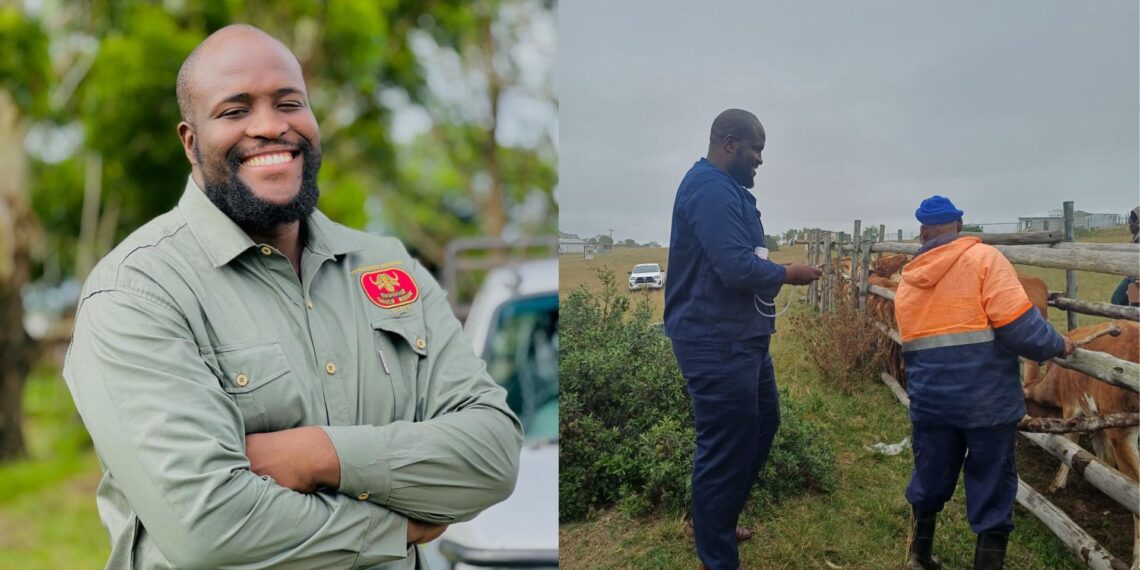
Veterinary technicians are the unsung heroes of our economy. Sihle Mntunje is one of them. Working across the Buffalo City Municipality, he ensures meat safety and helps rural farmers thrive. Photos: Supplied/ Food For Mzansi

Veterinary technicians are the unsung heroes of our economy. Sihle Mntunje is one of them. Working across the Buffalo City Municipality, he ensures meat safety and helps rural farmers thrive. Photos: Supplied/ Food For Mzansi

Share on FacebookShare on TwitterShare on WhatsApp

Like many kids from disadvantaged backgrounds, Sihle Mntunje knows firsthand what poverty feels like. However, he did not let it define him. Mntunje turned to his books, working hard to create a different future, and today he is a veterinary technician in the Eastern Cape.

Coming from Elujecweni location, kuTsolo, he understands the struggle of going to bed hungry. Those experiences are now part of his past, and he promised himself that his own family would never face the same hardships. 

Growing up with four siblings, Mntunje says the journey was never easy. His mother, Novathile, worked as a housekeeper in the surrounding areas and often had to move with her children to stay close to work. 

Learning from caring for livestock

In 2003, they settled in Lotana village, in Qumbu. It was there that Mntunje found space to grow, and where his connection to livestock first took root.

“As a boy, I spent most of my time around animals, learning how to care for cattle, goats, and sheep,” he says. 

FARMER POLL

📢 Which bank is powering your farming journey?

Tell us which bank you use so we can better advocate for the specialised financial tools and accessible capital needed to help South African farmers overcome growth barriers and thrive!

All submissions are kept strictly confidential. 

Having practical skills before completing his studies helped Sihle Mntunje get work more easily. Photo: Supplied/Food For Mzansi

Lotana village became his classroom. The Jara family, for whom his mother worked, raised livestock, and he spent much of his time helping to care for their animals. In those everyday moments, he learned responsibility, patience, and respect.

“Watching livestock grow and remain healthy made me realise how important animals are to families and communities,” he says. 

“That is when I became interested not only in caring for them, but also in understanding their health and diseases.”

When he began to doubt himself, Nokwakha Jara supported his decision to pursue animal health and later assisted him financially so he could continue his studies.

“She supported me financially, which allowed me to continue my education,” he says. “Her encouragement kept me going during difficult times.”

Her husband, Mandla, often returned home carrying animal medicines and veterinary tools. 

“Watching him treat sick animals always caught my attention,” he tells Food For Mzansi. “Seeing him in action shaped my dream of becoming an animal health technician.”

In 2014, Mntunje matriculated and was awarded the overall best achiever across all subjects. He was also recognised by the department of education as the only learner in his cluster to pass pure mathematics during the June examinations.

He later enrolled at Tsolo Agriculture and Rural Development Institute, where he completed a diploma in animal health, with additional training in meat inspection and artificial insemination.


Related stories
  • South Africa bleeds vets amid critical shortage
  • Wealth in dirt: Crop scientist’s plan B becomes farming destiny
  • Herbal heritage: Eastern Cape agripreneur boosts livestock health

Hands-on learning hones his skills

Mntunje graduated in 2020 as a veterinary technician and currently works mainly as a field-based practitioner, with occasional office duties. 

His career began even before graduation, when he worked as a farm manager at Qhamani Nande, a role that later led him to East London, where he took up another farm management position at Melody Farm.

“I started working before I graduated because I had tractor servicing skills and practical knowledge of livestock,” he says.

In 2021, he was selected for the department of agriculture’s entrepreneurship programme as an intern. A year later, he secured a permanent position as a veterinary technician, overseeing farms within and beyond the Buffalo City Municipality in the Eastern Cape. 

“Most companies employ based on skills and attitude,” he says. “Skills are something you can learn, but attitude comes from within. With the right attitude, you stand a better chance of succeeding.” 

His responsibilities include animal disease identification and control, parasite management through dipping and deworming, treatment of sick animals, animal identification, and disease surveillance through field sampling sent to veterinary laboratories for diagnosis.

Sihle Mntunje says working closely with communities helps protect animals from deadly diseases and contain outbreaks. Photo: Supplied/Food For Mzansi

The critical role of animal health

Mntunje explains that veterinary technicians play a critical role in eradicating animal diseases, supporting farmers to improve productivity, and strengthening food security, particularly in rural areas. Their work also contributes directly to the national economy and public health.

“We also play a big role in controlling zoonotic diseases, which are diseases that can be transmitted from animals to humans,” he says, mentioning rabies, anthrax, and tuberculosis among the most common examples.

He further explains that in abattoirs, veterinary public health officials and meat inspectors ensure that meat sold for human consumption is safe and disease-free.

“They are placed there specifically to make sure meat is free from hazardous substances and diseases, from slaughter to dispatch.” 

Mntunje encourages young people interested in the field to fully commit to learning.

“Give your all when you can,” he says. “Learning helps you grow and find solutions.”

ALSO READ: Animal health: A quick check-up with Dr Mpho Maja

Sign-up for the latest agricultural news delivered straight to your inbox every day with Mzansi Today!

Vateka Halile

Vateka Halile grew up in rural areas of Cofimvaba in the Eastern Cape. She was raised in a traditional family setting and found writing to be a source of comfort and escape. Vateka participated in an online citizen journalism course through Food For Mzansi, and her passion for health and medicine-related stories was born. Her dedication to community work and love for social justice and solidarity spaces is evident in her quality time with the community when she isn't working.

Tags: Animal healthEastern CapeInspire meVeterinary Sciences
News

Infrastructure crisis deepens strain on storm-battered fruit farmers

by Staff Reporter
19th May 2026

Storms have devastated Western Cape orchards, but the biggest threat now is a severe power crisis. With 6–10 power pylons...

Read moreDetails

Why SA should embrace landrace seeds during global uncertainty

19th May 2026

Dairy giant expands with Ladismith Cheese Company deal

19th May 2026
Development finance key to growing future commercial farmers

Development finance key to growing future commercial farmers

18th May 2026
‘Cayenne Chilli Lady’ brings the heat with 8.5ha farming success

‘Cayenne Chilli Lady’ brings the heat with 8.5ha farming success

18th May 2026

Development finance key to growing future commercial farmers

Farminist founder blends farming skills with smart business

Beating the rot below ground: How to protect your root crops

KZN’s agri gateway grows: Dube AgriZone 2 opens new doors

Diamond fibre: How Angora farmers can crack the mohair market

Join Food For Mzansi's WhatsApp channel for the latest updates!

JOIN NOW!
Next Post

NWK strengthens rural education with laptop sponsorship

THE NEW FACE OF SOUTH AFRICAN AGRICULTURE

With 21 global awards in the first six years of its existence, Food For Mzansi is much more than an agriculture publication. It is a movement, unashamedly saluting the unsung heroes of South African agriculture. We believe in the power of agriculture to promote nation building and social cohesion by telling stories that are often overlooked by broader society.

Limpopo farmers’ day: Collaboration, compliance take centre stage

Wild at heart: Shane Ngwenya swapped fear of snakes for science

Nyhontso outlines billions to boost land reform and viability

Sugarcane milling starts strong amid Tongaat crisis, cheap imports

Diamond fibre: How Angora farmers can crack the mohair market

Climate variability moves from background risk to core driver of South African agriculture

  • Awards & Global Impact
  • Our Story
  • Contact Us
  • Cookie Policy
  • Privacy Policy
  • Copyright

Contact us
Office: +27 21 879 1824
News: info@foodformzansi.co.za
Advertising: sales@foodformzansi.co.za

Contact us
Office: +27 21 879 1824
News: info@foodformzansi.co.za
Advertising: sales@foodformzansi.co.za

  • Awards & Global Impact
  • Our Story
  • Contact Us
  • Cookie Policy
  • Privacy Policy
  • Copyright
No Result
View All Result
  • News
  • Changemakers
  • Lifestyle
  • Farmer’s Inside Track
  • Food for Thought

Copyright © 2024 Food for Mzansi

This website uses cookies. By continuing to use this website you are giving consent to cookies being used. Visit our Privacy and Cookie Policy.