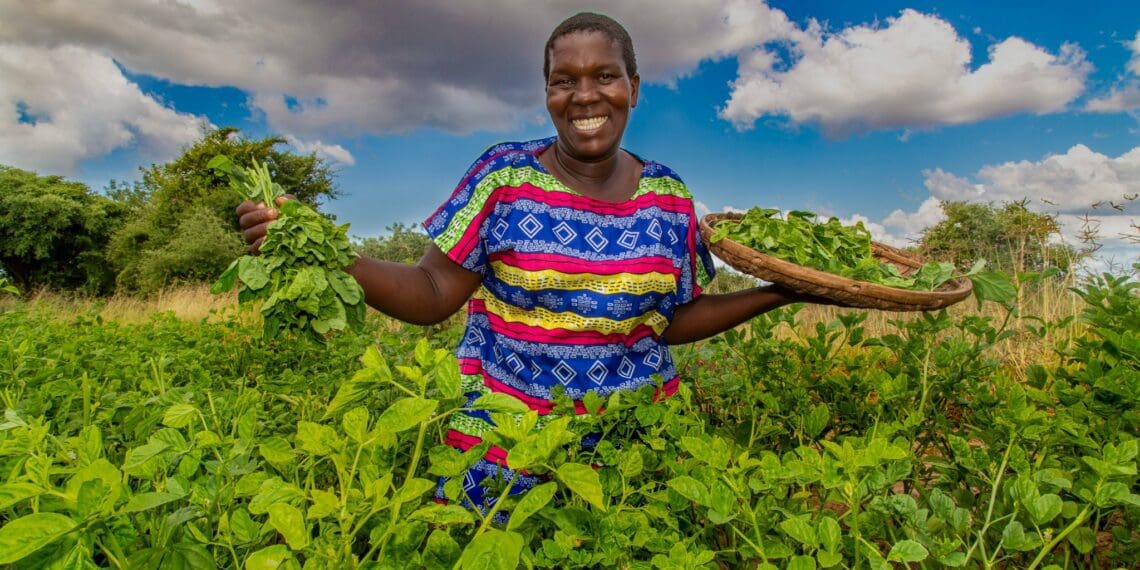
Cultivating one hectare of maize used to be an arduous task for Precious Banda, a farmer in Zambia. It would take her hundreds of hours to prepare her land before sowing and to keep it weed-free until harvest – equipped with nothing but a small hoe. She says it was backbreaking work: “I can still feel it.” For a few years now she has hired a tractor, and a neighbour sprays herbicides for her. “Life has become so easy,” she says.
But she has also noticed changes around her farm. There are fewer bees and – most worrying for her – fewer caterpillars, which used to make a delightful dish.
Precious Banda’s story is a perfect example of the situation millions of African farmers face.
Agricultural development is high on the policy agenda of African countries, as seen in the Agenda 2063 of the African Union. But while it’s needed to reduce poverty and hunger, agricultural development often clashes with biodiversity, which is declining at an alarming rate. Losing biodiversity could reduce food security by undermining ecosystem services like pollination, nutrient cycling and maintenance of water supplies. Wild food sources could also be lost.
In a new paper, we as researchers in economics, agronomy and ecology emphasise the importance of biodiversity-smart agricultural strategies. With Precious Banda’s story in our minds, we argue that such strategies need to pay much more attention to agricultural labour dynamics.
Biodiversity and agricultural labour
Biodiversity is lost when agricultural land expands and when farming is more intense. In Africa, 75% of agricultural growth comes from farmland expansion into forests and savannas. This leads to habitat loss and fragmentation. Farming more intensely curtails expansion, but may make the landscape less biodiverse and often leads to the use of more chemicals such as pesticides.
The importance of biodiversity-friendly agriculture is starting to be recognised more widely. But efforts to encourage it often neglect trade-offs with farm labour needs. We argue that ignoring these needs will undermine the success of biodiversity conservation efforts.
Farmers can reduce heavy labour by adopting technologies such as mechanisation and herbicides. For example, our previous research in Zambia showed tractors cut land preparation time from 226 to 10 hours per hectare. And in Burkina Faso, herbicides are referred to as “mothers’ little helpers” because they reduce women’s work in the fields.
But labour-saving technologies can negatively affect biodiversity through farmland expansion, farmland simplification, land degradation and spillover effects. For example, in an earlier study in Benin, Kenya, Nigeria, and Mali, we found that mechanisation sometimes led to the removal of trees and hedges from farms, and changed plot sizes and shapes. This resulted in a loss of farm diversity and of a healthy “patchwork” of habitats. Pesticides can harm soil life, water systems and insect populations if badly regulated and managed, as is often the case.
The problem with biodiversity-enhancing technologies
Biodiversity-enhancing technologies have the opposite problem: farmers often don’t adopt them because they add to the labour burden. Examples include inter-cropping (growing different crops close to each other) and planting basins (shallow indentations in the soil to provide a suitable environment for crops and place inputs). In Zimbabwe, a study noted that planting basins could be labour-intensive without always increasing yields.
Farmers typically adopt technologies and practices that use the least labour and provide high and stable yields, but those can be bad for biodiversity conservation.
What’s needed instead are biodiversity-smart technologies that enable farming with low labour, high yields and high biodiversity.
Biodiversity-smart agriculture
One potential solution is to adapt machines to farm size – and not the other way around. Smaller machinery can easily manoeuvre around trees, hedges and other landscape features that are key for biodiversity.
Combining smart biological solutions (like crop rotation) and mechanical ones (like precision spraying) is a path to lower pesticide use. In our paper, we discuss many other options, too.
For example, in plantation agriculture, tree islands can improve biodiversity without reducing yields, as shown in a recent study.
Biodiversity-smart technologies reduce the costs (in terms of yield and labour) of biodiversity conservation for individual farmers. That increases the likelihood of adoption. Where conservation comes with higher costs than benefits, financial compensation may also be needed. This could, for example, be in the form of certification schemes or payment for ecosystem services.
Solutions for biodiversity and people
Farm-level solutions have to be accompanied by efforts at the landscape level. These might be careful land-use planning and monitoring to preserve biodiversity hotspots and keep habitats connected. Our case study from Ethiopia shows that multi-functional landscapes can be planned to “work for biodiversity and people”.
We argue that biodiversity-smart agricultural development requires a shift in both policymaking and research and development. Conservation ecologists must pay more attention to economic and social sustainability. Without accounting for labour issues, conservation efforts are unlikely to succeed. At the same time, agricultural scientists have to embrace multiple goals beyond yields.
Our paper shows technological, agronomic and institutional innovations for biodiversity-smart agriculture exist. But more needs to be done to scale them. If successful, they can help to feed the growing population, improve the livelihoods of farmers, and conserve biodiversity before it is too late.
This article was first published on The Conversation and written by Thomas Daum, Frédéric Baudron, Ingo Grass, Matin Qaim, and Regina Birner.
ALSO READ: Women’s Day: Join us at our Soul To Soil brunch
Enjoyed reading? Tell us why with a quick 5-min survey
Sign up for Mzansi Today: Your daily take on the news and happenings from the agriculture value chain.