The year 2021 has been a tumultuous one in agriculture but it delivered its share of inspiration as well! The movers and shakers of farming in Mzansi once again did what farmers do best – persevering in feeding the nation.
As the year draws to a close, Food For Mzansi revisits the inspirational stories that made the country sit up and take notice. These were the year’s top 10 most read profiles on local farmers and agripreneurs:
1. How Hosea started a farming business with just R9000
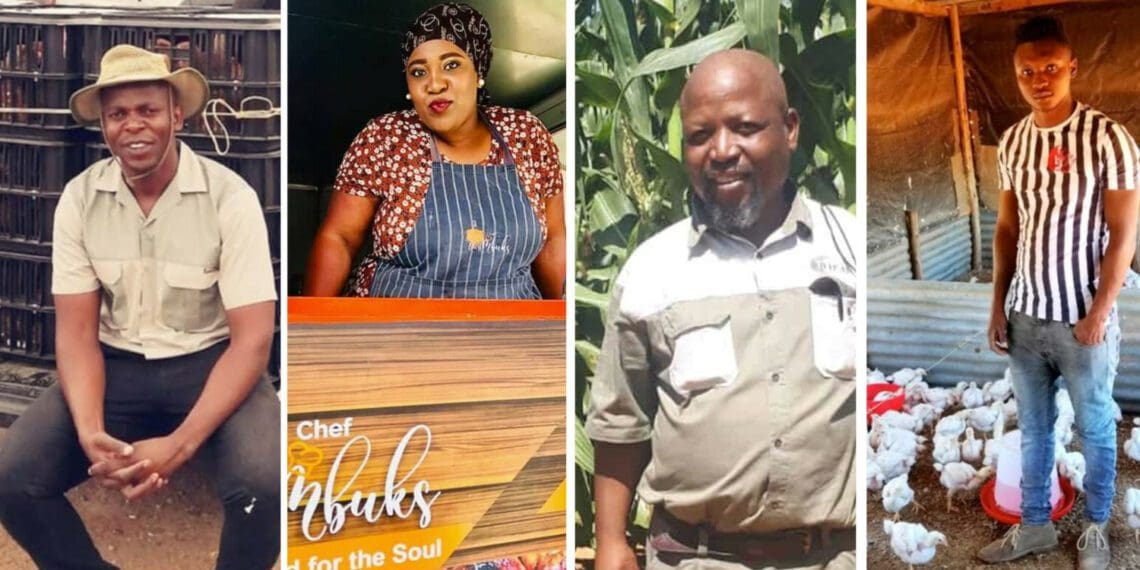
Thabang Hosea made his farming dream a reality after he had worked as a street hustler for two years. During the lockdowns of 2020, the 25-year-old decided to quit his egg selling and photography business to take up poultry farming.
“Farming had always been my childhood dream, but I just never had the capital to pursue it before. Around September of 2020 I had saved up R6000 from my hustling businesses and I felt it was enough for me to quit. I also sold my laptop for R3000 to an Indian shop in my neighbourhood, which gave me R9000 altogether.”
Savings in hand, Hosea bought 300 broilers from a local poultry producer and started renting a two-hectare plot from the Musina local municipality in Limpopo. “At the end of November of that year, I started to sell my broilers to my community for R90 each and I made a profit of R27 000,” he recalls.
Although his journey hasn’t been without setbacks, he also added indigenous boer goats to his operation in January this year. “I currently have 33 goats and I won’t be selling anytime soon,” he told Food For Mzansi.

2. From varsity dropout to fabulous foodie – on R350
With only a R350 child support grant in her pocket, Pumla Gobelo started Mbuks Catering Services in Butterworth in the Eastern Cape a decade ago. “I started my business right after I dropped out of third year evarsity. I studied retail business management at the Vaal University of Technology. Some people don’t believe me when I say I started this business with R350 from child support.”
The beginning wasn’t easy, though. For starters, Gobelo was often fat-shamed in the village she now calls home. Imbukumbuku [the fat one] was a favourite insult amongst her new neighbours when she relocated to Butterworth. “It disturbed me at first. I shared this with my mentor and he said, “You know what? To spite them, let’s call you Chef Mbuks. And that’s where the term ‘Mbuks’ came from.”
She ran her business cooking delicious and hearty food from a friend’s pub, and finally saved up enough money to make her initial dream of owning a food truck come true in 2020. “I wanted to own a mobile kitchen but had no funds [when I first started]. Ten years later, boom, I bought my mobile kitchen. I love my job more than anything. I wake up every day and hustle and the feedback is always positive.”
Read more about the fabulous foodie here.

3. Gauteng, meet your new Young Farmer of the Year
It may have been his curiosity and passion that attracted him to farming. But it is his hard work, dedication and innovative thinking that led 24-year-old Jose Gonsalves to win the Agri Gauteng and Santam Young Farmer of Year competition this year.
The vegetable, fish and layer farmer from Boksburg was named the winner of the competition in August 2021, after outcompeting thousands of farmers from across the province. So, it’s somewhat hard to believe that he wasn’t really interested in farming at first.
“My father is a farmer, but I didn’t really have a keen interest in agriculture when I was younger. You know, when you’re young and you’re at school a lot of your friends’ parents drive off in nice cars. You then start asking them what their dads or mothers do. To cut a long story short, I ventured off to study actuarial science, which is a very tough degree and also a very well-remunerated career.
“After being exposed to the first year of studying, I passed and got a few distinctions. But I just decided that this is not for me and I went back into farming.”
From that day onwards, all it took to become the farmer he is today, was hard work, dedication and a healthy dose of passion. “At the end of the day, being passionate about something and being driven to do what you do every day is what makes you successful, I believe.”
See Food For Mzansi’s rapid-fire interview with Gonsalves here.

4. Chilli farmer builds a solid business on just one hectare
It started with a few seeds that he sowed in his backyard. Now, a couple of years later, Ndivhuho Nengwenani is supplying produce to major supermarkets and markets in his area – all still grown in the very same 1-hectare backyard plot.
“After I graduated and could not find a job at what I studied, which is Media Studies, I got a temporary job at one of the retail outlets,” he recalls. “I then decided to save money so that I can get back to farming as it was something I did from an early age.”
In 2019 he planted 10 000 chilli peppers, with no idea of how he was going to sell them, who were going to be his customers or how he was going to take his produce to the market. But his brother hooked him up with some contacts and today, still through backyard farming, he supplies serrano chilli peppers to Spar supermarkets in Thohoyandou as well as the City Deep and Springs fresh produce markets.
What’s more is that he has recently added tomato and cabbage to his supply basket.
Although his backyard plot has served him well, he hopes that whenever he starts getting more clients, he will get a piece of land and have his own farm. “I have big dreams and I am very ambitious. I want to have my own farm, supply my produce abroad and open my own fruit and vegetables market store.”
Read Nengwenani’s full story here.

5. Free State ‘black gold’ breeder shares his secrets to success
Christian (Chrisjan) van Tonder sadly passed away in November this year, when he was shot after a business transaction in Gauteng.
During an earlier interview with Food For Mzansi, the Drakensberger cattle breeder from Lindley in the eastern Free State, said he had always known that he would one day feed the nation.
His agricultural knowledge was built up by his father, Colyn, who made sure that his son was acquainted with baling hay, feeding animals and maintaining farm equipment at a very young age. Agriculture eventually became all he could think about and it was the subject of his studies until he was forced to join his father on the farm before he could finish his qualification.
His father passed away shortly after, and a lot of work a challenging time awaited him as the new head of the family business. Dairy was no longer profitable and Van Tonder shifted his focus to Drakensberger cattle.
What made the transition more bearable was the wise teachings and lessons his father left behind. “My dad taught me honesty, integrity, hard work, to think of solutions to problems instead of making hasty mistakes, as well as providing knowledge and assistance where there is a need,” he told Food For Mzansi.
Van Tonder’s advice to new farmers was to be wary of taking advice from every Tom, Dick, and Harry. “Identify the right people if you have a problem, rather than listening to ten different people. Don’t lend your ears to too many farmers.”
Read the original interview with Van Tonder here.

6. ‘Start big,’ advises Gauteng pig farmer
Pig farmer and #SoilSista Nthabiseng Mathebula’s journey into farming was both based on a lifelong passion for animals and a desire to contribute to her family’s farming goals. After she finished matric, she had intended on fulfilling her childhood dream of going to veterinary school. Instead, she settled on animal production.
“I generally had this love for animals growing up,” she recalls. “My passion for animals is why I wanted to do veterinary sciences initially, but then, when my parents started the farm, it felt like it was sort of on time.”
Mathebula graduated from Tshwane University of Technology (TUT) in 2009 and joined the family business in 2011, which was started by Mathebula’s parents while she was studying and gaining some internship experience.
Ten years later, the pig farming business, based in Vanderbijlparkpark in Gauteng, is still run by her mother, herself and her two younger brothers. “I am overseeing the pig production unit, the admin side of the business, and the abattoir side. I love what I am doing.”
To read more about their established family business and Mathebula’s advice to farmers, click here.

7. Meet the app-building brothers who farm for the future
In agriculture, two heads are always better than one. In the case of Eric and Willem van Zyl, this approach led to amulti-lingual farming app.
More than two years since its launch, The Agri Assistant app has become a go-to for hundreds of farmers. Features on the app include a countrywide listing of organisations that support farmers. It also references material for various agricultural products, including soil types, planting schedules, pests, and disease control.
The two brothers share an endearing story of complementing each other perfectly. Young Eric spent so much time with his father that by the end of his primary school days, he already knew that agriculture was for him.
Willem, on the other hand, was not too convinced. He initially wanted to pursue agriculture as a child, but ended up studying computer software and started working in the IT industry.
Today this partnership serves them well. Willem has the technical expertise while Eric has the farming knowledge and industry contacts. “It’s always nice when we attend meetings together because we complement each other so well,” Willem explains.
Read the full Food For Mzansi story on their vision and journey here.

8. From going bust to supplying Spar in just 6 months
After Inga Qeja lost his car dealership due to the lockdown, he moved back home to start over. In the Eastern Cape village of Mbokotwane he began farming and found a hidden treasure that would transform many lives.
“I was a car salesman with a sales and marketing background. My company, called Inga’s Auto Consultancy, was assisting people who were blacklisted to remove their names from the credit bureau, so they could purchase cars,” he says.
The clients dried up with the protracted lockdown, the business went under and Qeja had to return home.
“I started a garden because farming had always been a dream of mine. I planted spinach, cabbage and maize in my 40m x 40m home garden and started selling the vegetables to the people in my community,” he says.
The demand grew steadily and he eventually sold his produce in the centre of town, not far from the local Spar.
“I was approached by the owner of Spar who asked me to supply her with 300 bunches of spinach. She indicated that she had noticed that people were not buying the spinach in her shop but were rather buying mine, and she was curious as to why. Until she saw how fresh and big my spinach was…”
Today, Qeja is still going strong, he employs almost a dozen people in his farming business and provides gardening skills to six different projects in the community.
Read his inspiring story here.

9. Side hustle: How a teacher became an egg farmer in lockdown
After his initial business idea of selling fast foods fell through in 2018 due to inadequate market research, Ntoampe Mashamaite from Polokwane, Limpopo chose to try his hand at poultry farming as a side hustle. It would also better suit his working hours as agricultural science teacher at Shakoleng Secondary School.
While most businesses were shaken by the country’s Covid-19 lockdown early last year, Mashamaite made the bold move to venture into poultry farming, specifically egg production. He sold off some of the fast food equipment to fund his new business, called Mash Mates Poultry Project.
He then erected a chicken house in his parents’ backyard in Moletjie Schoonveld village in Polokwane, within which he placed his egg layers. As schools were temporarily on hold, the teacher had the leeway to fully look after his 200 egg-laying Lohmann chickens.
Mashamaite now supplies local people and neighbouring communities as a subsistence farmer and can’t wait for school holidays to visit the farm to check on his livestock. Yes, he took his first steps into livestock farming when he bought two Bonsmara cows and one Nguni.
The Nguni is currently grazing with his parents’ livestock in their backyard kraal, while the other two are with his uncle, who leases two farms elsewhere in Limpopo.
Of course, his advice to young farmers include doing solid research!
Read more about Mashamaite’s side hustle here.

10. From teacher, taxi owner to commercial crop farmer
Although Shadrack Mbele from Lindley in the Free State was a teacher by profession, he always had an aptitude for business. When he saw an opportunity in the taxi industry in Qwaqwa in the late 80s, he seized it with both hands and became a taxi owner.
But the Eastern Free State taxi industry faced unrest in the early nineties. With the persuasion of his late father Ephraim Mbele and wife Nthepa Elina Mbele he decided to leave the taxi industry and partnered with his father to start a farming business in 1993. “We sold all the taxis and the minibuses to buy dairy cattle,” he says.
Father and son got their business off the ground thanks to solid prior farming experience, then bought the farm Danielrus in Harrismith in 2000, and received funding through the Land Redistribution for Agricultural Development programme project (LRAD).
The pair pursued dairy farming until 2005 and in 2006 they ventured into crop farming because dairy farming was not bringing in the profit they desired anymore. Then, in 2007 his father passed away and he was forced to run Danielrus farm on his own.
Today Mbele is a thriving commercial farmer who specialises in mixed farming. He grows crops such as soya beans and maize as well as sugar beans. He currently supplies his maize to VKB, AFGRI and Grain Zone and he sells his beans to Tiger Brands and Schoeman Boerdery in Mpumalanga.
His future goal is to become part of the whole food value chain and his advice to aspiring young farmers is to be patient. “There is no quick money in farming; you need to be patient because returns take time. But there is a future in farming because everybody needs three meals per day and there is not a single person who will not need food.”

ALSO READ: Dr Ruben Richards: farmer, peacemaker, changemaker
Get Stories of Change: Inspirational stories from the people that feed Mzansi.