Wednesday, October 21, 2026
SUBSCRIBE
22 GLOBAL MEDIA AWARDS
Food For Mzansi
  • News
  • Changemakers
  • Lifestyle
  • Farmer’s Inside Track
  • Food for Thought
No Result
View All Result
  • News
  • Changemakers
  • Lifestyle
  • Farmer’s Inside Track
  • Food for Thought
No Result
View All Result
Food For Mzansi
No Result
View All Result
in Inspiration

Mother-daughter duo empowers 100 farmers through retail access

How do emerging farmers bridge the gap to formal retail? For Bethel Estate, the answer lies in consistent quality and strategic partnerships with Freshmark. Mother and daughter, Gugu and Lungi, have not only grown their business but also helped 100 other small-scale farmers enter the value chain

by Staff Reporter
8th May 2026
For Gugu Dlamini (left) and her daughter Lungi Ndelu, family is at the heart of Bethel Estate. Photo: Shoprite

For Gugu Dlamini (left) and her daughter Lungi Ndelu, family is at the heart of Bethel Estate. Photo: Shoprite

Share on FacebookShare on TwitterShare on WhatsApp

A powerful story of resilience, purpose and generational legacy is unfolding on Bethel Estate, a farm in rural KwaZulu-Natal, where a mother and daughter are growing far more than just fresh produce. 

Bethel Estate is led by 58-year-old Gugu Dlamini and her daughter, Lungi Ndelu (30), who work in a family-run business on a farm in Inhlamvini, supporting livelihoods across their community – despite them having no agricultural experience to begin with. 

“We didn’t know anything about farming,” says Dlamini. “It was more of a calling – that the land could offer greater fulfilment than my corporate job was giving me at the time.” 

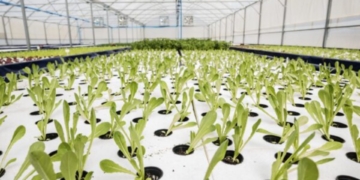
After purchasing the land in 2016, Dlamini spent years learning the ropes before planting their first five hectares of lettuce in 2019. What followed was an early breakthrough that changed everything. 

“We invited buyers to see our first crop, and we received a 100% uptake,” she recalls. “That’s when we knew this could work.” 

Getting their produce to market

Today, Bethel Estate supplies fresh produce to Freshmark, the Shoprite Group’s fresh fruit and vegetable procurement, buying and distribution arm.  As Africa’s largest buyer of fresh produce, Freshmark connects farmers directly into the formal retail supply chain, sourcing primarily from local producers and distributing to stores across the continent. 


Related stories
  • Betty Nkoana’s gardens bring hope to struggling families
  • NW agripreneur creates condiments with care and purpose
  • Bongeka’s backyard business grows from 100 to 3000 broilers
  • How Refilwe brewed her mother’s gemere into a business

Freshmark works closely with the farm, providing forward demand planning, grading and quality standards, and structured procurement processes. Produce from Bethel Estate is delivered to the Freshmark Distribution Centre, from where it is distributed to retail outlets including Shoprite, Checkers and Usave stores.  

This support, combined with consistent off-take agreements, has given the farm the stability to plan planting cycles, manage risk and invest in growth. With a predictable buyer and clear standards to work towards, Bethel Estate has improved quality, increased volumes and grown sustainably over time – helping to overcome logistical and market-access barriers that often limit emerging farms. 

Bethel Estate is led by Gugu Dlamini (left) and her daughter, Lungi Ndelu. Photo: Shoprite

Building on this experience, the farm established the Tshala Nathi farmer support programme to help emerging vegetable farmers navigate and prepare for formal retail opportunities. Through mentorship and hands‑on support, the programme helps farmers strengthen their operations and meet the requirements of formal markets – opportunities that are often out of reach for small-scale producers. 

Working in partnership with local government, Tshala Nathi addresses one of the biggest challenges facing emerging farmers: entering formal markets and maintaining a consistent supply. 

“Having a guaranteed route to market changes everything,” says Ndelu. “It allows you to plan, invest and grow with confidence.” 

Freshmark’s Divisional Head Buyer, Pieter van Zyl, says that certainty is often what unlocks long-term growth for emerging farmers. 

“Our partnership with Bethel Estate shows what’s possible when farmers consistently meet quality and supply requirements,” he says. “That reliability builds trust, allows us to support them at scale, and gives Gugu and Lungi the confidence to grow, invest and bring other farmers into the value chain – which is what ultimately makes a farming business sustainable.” 

Choosing the farm – and the future

But the story behind the farm is just as important. Ndelu, a University of Cape Town BCom accounting graduate, initially had her doubts. 

“I honestly thought it was a crazy idea,” she admits. “But when I stepped onto the farm, I fell in love with the work and what it could mean for the community.” 

Her turning point came during a family crisis, when her mother spent months in the hospital caring for a loved one. 

“We had already planted, and someone needed to be on the farm,” says Ndelu. “I couldn’t let everything go to waste, so I moved there. That’s when it became our shared mission.” 

Through their partnership with Freshmark, Bethel Estate’s mother-and-daughter duo, Gugu Dlamini (middle) and Lungi (right), bring produce into formal value chains. Photo: Shoprite

Helping other farmers

Since then, Bethel Estate has grown into a multi‑million‑rand operation, while also creating pathways for other small‑scale farmers to grow. 

The farm now works with around 100 farmers, most of them women, by aggregating their produce and helping them reach larger wholesale and retail markets. 

“Many of these farmers can’t reach large markets on their own,” explains Ndelu. “By working together and through our partnership with Freshmark, we’re able to bring their produce into formal value chains.” 

Beyond market access, their work supports jobs across the community – from farmworkers to packing and transport teams. 

For Dlamini, the purpose is simple: “We are here to be a blessing to other families,” she says. 

Stronger than the setback

Their journey has not been without challenges. In 2024, the farm was looted, leaving widespread damage. 

“They took everything – even the roof tiles,” Dlamini says. Despite the loss, they chose to rebuild. 

“You need resilience in farming – financially, mentally and spiritually,” says Ndelu. “Right now, we’re in a season of replanting.” 

Beyond the rebuild, the heart of Bethel Estate has always been family. Along the way, many partnerships have played a role, but at the centre of the farm is the bond between a mother and her daughter. 

“We are very close,” says Dlamini. “Lungi brings execution, and I bring strategy.” 

Now a mother herself, Ndelu sees the farm as more than a business – it is a legacy taking shape. 

Her one‑year‑old daughter already represents the next generation of their journey. 

READ NEXT: Reviving legacy: Former retail worker trades till for the soil

Sign-up for the latest agricultural news delivered straight to your inbox every day with Mzansi Today!

Staff Reporter

Researched and written by our team of writers and editors.

Tags: Commercialising farmerCrop farmersInspire meKwaZulu-NatalShopriteWomen in Agriculture
This week’s agri events: 19 – 23 October
News

This week’s agri events: 19 – 23 October

by Tiisetso Manoko
19th October 2026

There is a lot happening in the final months of 2026! Get all the information on the Villiersdorp Show, livestock...

Read moreDetails

Stop the rot: Four steps to slash post-harvest losses

18th October 2026
A standing ovation for agriculture’s incredible talent! The Agri’s Got Talent 2026 top three celebrate their achievements: winner Honey Katoo of Endulini Fruit in Patensie, alongside runner-up Clareece Vlotman of Wolfpack in Wolseley and finalist Lwandile Nantsi of Laastedrift in Ceres. Photo: Supplied/Food For Mzansi

Patensie claims Agri’s Got Talent crown for second year running

17th October 2026
The panellists at FNB Business’s “Farming together” discussion at the Royal Show explored how market access, mentorship, financial discipline and strong commercial relationships can help farmers build sustainable businesses. Featured from the left are Bertram July (FNB’s distribution sales lead), commercial farmer Shakes Shabalala; Sandy Gumede (co-founder of Zulu Girl Wines), and Janis Robson (FNB’s head of development and SME business development). Photo: Food For Mzansi

FNB puts relationships at the heart of commercial farming

17th October 2026
Agri Skills Transfer students gain hands-on experience at the institution’s Cullinan Farm Training Centre, where agricultural theory meets the realities of commercial production. Photo: Supplied/Food For Mzansi

Build your future in agriculture with Agri Skills Transfer

17th October 2026

Reluctant farmer scales EC cabbage enterprise to supply Spar

SA and Namibia reevaluate livestock trade after FMD outbreak

Becoming bankable: How to get your farm ready for finance

Reclaiming the kraal: Cultural heritage sparks a farming dream

Promising early conditions predicted for 2027 SA wine harvest

Join Food For Mzansi's WhatsApp channel for the latest updates!

JOIN NOW!
Next Post
Revycare fungicide: BASF’s cutting-edge solution for citrus black spot, featuring the new Revysol ingredient for enhanced disease control and easier application. Photo: Supplied/Food For Mzansi

Late mandarins stabilise after years of strong growth

THE NEW FACE OF SOUTH AFRICAN AGRICULTURE

With 21 global awards in the first six years of its existence, Food For Mzansi is much more than an agriculture publication. It is a movement, unashamedly saluting the unsung heroes of South African agriculture. We believe in the power of agriculture to promote nation building and social cohesion by telling stories that are often overlooked by broader society.

CPAs urged to register for free governance support toolkits

Potatoes and tomatoes plunge while avocado prices soar

Becoming bankable: How to get your farm ready for finance

Fixing SA’s agricultural visa system to protect seasonal harvests

SA and Namibia reevaluate livestock trade after FMD outbreak

Agda conference to tackle finance, market access and agri growth

  • Awards & Global Impact
  • Our Story
  • Contact Us
  • Cookie Policy
  • Privacy Policy
  • Copyright

Contact us
Office: +27 21 879 1824
News: info@foodformzansi.co.za
Advertising: sales@foodformzansi.co.za

Contact us
Office: +27 21 879 1824
News: info@foodformzansi.co.za
Advertising: sales@foodformzansi.co.za

  • Awards & Global Impact
  • Our Story
  • Contact Us
  • Cookie Policy
  • Privacy Policy
  • Copyright

Chat Options

About this assistant

This feature generates automated answers summarised from Food For Mzansi articles. By using it, you are interacting with an AI system (provided by Google), not a human. AI can make mistakes. Please refer to the source articles for verification and citation purposes.

Our staff do not check or moderate Lerato’s answers in advance, but may review some later. Our journalists continue to write and edit all the articles Lerato uses as sources.

To estimate unique and returning web users, we store a random browser ID in this browser. WhatsApp users are counted by phone number. The same person using both channels may be counted twice.

I'm Lerato, your AI assistant!
No Result
View All Result
  • News
  • Changemakers
  • Lifestyle
  • Farmer’s Inside Track
  • Food for Thought

Copyright © 2026 Food for Mzansi