After losing her husband, Betty Nkoana spent her days walking through Krugersdorp in Gauteng, trying to fill the emptiness and keep her mind busy. These walks inspired her to start Hope Park Children’s Health Campus, with three crop gardens, a daycare centre, and a feeding scheme supporting women and children in her community.
In 2006, Nkoana resigned from a job she loved to care for her ill husband. When he passed away in June 2007, she was left with memories, no job, and no direction.
The grief was overwhelming, and to cope, she started paying attention to her surroundings. “I began visiting a nearby informal settlement to distract myself and keep busy until the kids came home from school,” she says.
Turning pain into purpose
During these visits, she began to see the quiet weight others carried, women struggling in ways no one spoke about, and it stayed with her.
Nkoana noticed the struggles of vulnerable women, many trapped in abusive relationships.
She learned that some stayed with their abusers because they were the breadwinners, and the women felt they had no other way to provide for their children. “Women normalise abuse just to put a meal on the table,” she explains.
She also saw teenage girls dropping out of school due to pregnancy or shame, often manipulated by older men who promised to provide for them.
Nkoana began volunteering, helping vulnerable women and children, and seeking people who could support her initiatives with administration and transport.

In 2010, she found a partner willing to help her turn her vision into action. She brought women together and started homestead gardens, learning the basics online.
“We only began receiving formal training in 2018, supported by Checkers and Fruit & Trees for Africa,” she says.
The collective grew from 10 to 33 women. For a year, they taught them how to run small businesses from home. Nkoana says this work gave the women a sense of purpose and independence.
“Many came back saying they felt respected at home and that things had changed.” Their gardens thrived, providing food and income for their families.
Related stories
- Reviving legacy: Former retail worker trades till for the soil
- Sinovuyo Senior Club grows food, love, and care in Khayelitsha
- Sabelani Co-op gives Bongani Nkosi purpose and a future
- Agrolimo Farms: Tebogo turns schoolyards into Soweto’s pantry
Feeding a community
Based in Munsieville, Mogale City, in the West Rand District, the collective began approaching local authorities and partners for support. Eventually, Mogale City granted them a piece of land to work on.
They received help, such as JoJo tanks, though the irrigation system didn’t work as planned.
Over time, six men joined the group, inspired by the impact the collective was making in the community. They later added a daycare centre, providing a safe and educational environment for children.
Seeing the ongoing need, Nkoana introduced a feeding scheme using vegetables grown in the gardens, supported by sponsors like Checkers in Centurion.
“We are a group of women committed to keeping our community clean,” she says.
“We identify sites, clear them, and create plots where women can plant, especially those who have no space at home.”

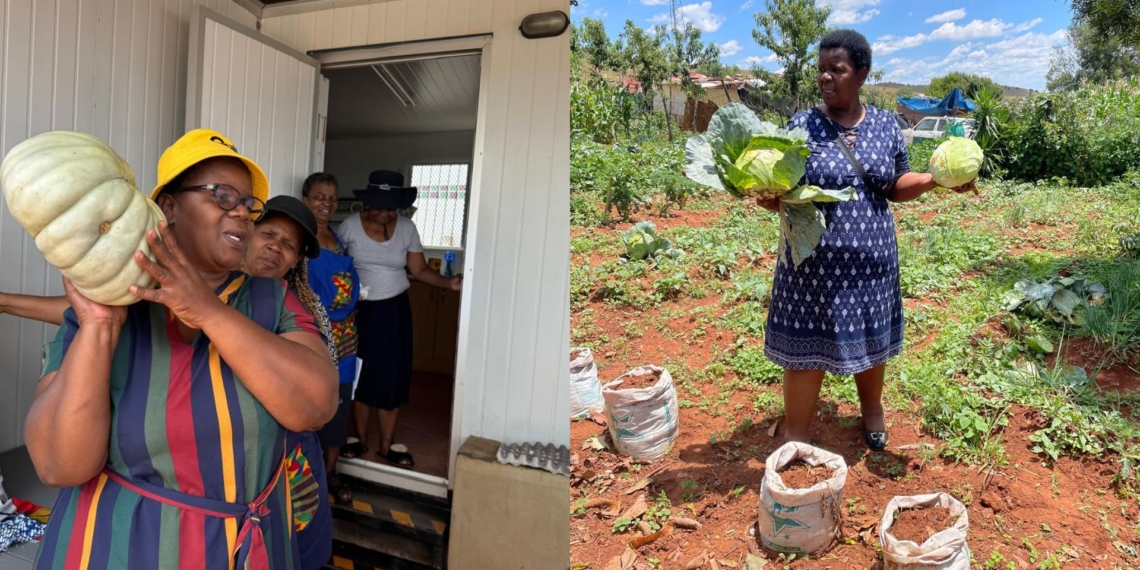
The gardens now grow spinach, cabbage, onions, tomatoes, cauliflower, broccoli, green peppers, strawberries, corn, herbs such as thyme, basil, rosemary, comfrey, turmeric, and even fruit trees.
“In 2018, we started the feeding scheme. Today, we feed 300 children daily, and 57 families benefit from these gardens.”
Looking back, Nkoana proudly says the gardens have helped reduce the number of children going to bed hungry, giving parents a reliable source of food even when money is tight.
She adds that the gardens have also transformed previously neglected areas, turning dumping sites into cleaner, productive spaces for the community.
Women leading change
In 2020, they introduced poultry, including Hy-Line layers and broilers, providing eggs and meat for the community.
A few years later, in 2026, the Hope Park Children’s Health Campus Garden received support through Shoprite’s Act For Change initiative, helping the business expand.
As their work grew, they faced challenges such as limited water and repeatedly planting the same crops. “We learned that crop rotation and companion planting, like cabbage with spring onions, naturally repel pests,” Nkoana explains.

They have partnered with Yenzukhle Training and Development in Muldersdrift to learn advanced planting methods.
Looking ahead, they plan to establish three more gardens in Munsieville to combat poverty, food insecurity, and domestic abuse, while empowering women. They credit Fruit and Trees for Africa for guidance on organic farming and crop protection.
Most importantly, this group shows that it takes one idea and collective action to build a strong and healthy community.
READ NEXT: Small-scale food gardens win big in Shoprite’s Act For Change