Monday, November 9, 2026
SUBSCRIBE
22 GLOBAL MEDIA AWARDS
Food For Mzansi
  • News
  • Changemakers
  • Lifestyle
  • Farmer’s Inside Track
  • Food for Thought
No Result
View All Result
  • News
  • Changemakers
  • Lifestyle
  • Farmer’s Inside Track
  • Food for Thought
No Result
View All Result
Food For Mzansi
No Result
View All Result
in Commercial Farmer, Young Farmer

‘I am happy in agriculture,’ says 31-year-old farm manager

by Duncan Masiwa
21st June 2019
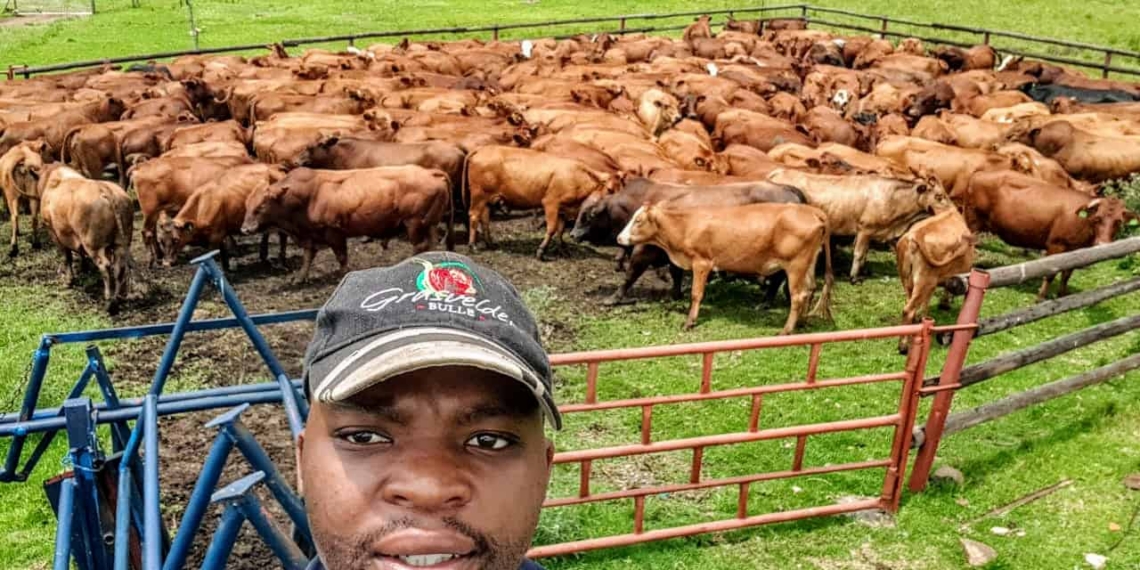
Nsika Shabalala manages the cattle farming department at Afrikan Farms in Mpumalanga.

Nsika Shabalala manages the cattle farming department at Afrikan Farms in Mpumalanga.

Share on FacebookShare on TwitterShare on WhatsApp

With much humility, Nsika Shabalala tells me: “Farming chose me, before I could choose anything else.”

Nsika Shabalala (31) has always been a bit of a shy one. As the second of three brothers, he took on the role as the more reserved brother. But working in agriculture has given him more confidence. “When you’re a farm manager, there’s no time to be shy,” he says.

His office is a 4500-hectare farm called Afrikan Farms, situated in Amersfoort, about two hours from Johannesburg.

The farm’s activities include sheep rearing for meat, experimental pig farming, beef cattle farming and a cattle feedlot, which Shabalala closely manages. Their beef production includes Beefmaster, Symons bulls and Brahman crosses.

They also produce maize and soya beans together with BB Boerdery Agri Trust and have recently started planting Crisp Red apples.

Nsiki Shabalala contributes his success to his uncle who he fondly refers to as uMalume.
Nsika Shabalala attributes his success to his uncle who he fondly refers to as uMalume.

Shabalala’s journey at the farm started about ten years ago when he moved to Mpumalanga to live with his uncle.

As he recalls, it all happened after his parents passed away and he had to move to his “uMalume” (uncle), Vusi Khanyile, owner and founder of Afrikan Farms. “When my parents passed it was decided that me and my brothers had to live with different relatives. The eldest moved to Johannesburg and the youngest moved to Kwazulu-Natal.”

Although it was difficult at first, Shabalala believes that being separated from his brothers had a beautiful purpose. “I had to quickly learn how to grow up and be a man,” he explains.

Growing up in the township of Mooi River in KZN, the brothers were surrounded by criminal activities. “We were lucky to make it out of there. Many young people end up being stuck there,” Shabalala says.

When Shabalala moved in with his uncle, he was about to enter high school. He attended Sinethemba Secondary. Despite not understanding why he had to attend an agricultural school, Shabalala decided not to question his uncle’s decision to enrol him there.

“We were taught not to question our elders, so technically I had no say in the matter,” he laughs.

Looking back, Shabalala says he can now see that his uncle was busy investing in him and that it was always his plan for him work on Afrikan Farms. “I was an average student at school, but uMalume kept on believing in me.”

After graduating from Cedara Agriculture college in 2010, Shabalala joined the farm as assistant farm manager and had his work cut out for him. “When I started at the farm there were very few systems in place and most of the people that worked there had experience. However, they lacked in scientific knowledge.”

Shabalala majored in beef production and since his joining, the farm has seen tremendous growth. Today, Afrikan farms has a herd of 2000 Beefmaster-type beef cattle which includes 1200 breeding cows and a feedlot that can manage 400 cattle at a time.

“We started implementing controlled breeding seasons, initiated necessary vaccinations programs and did routine disease checks,” the farm manager says.

The results of his hard work started showing, because in 2018 the Agricultural Research Council (ARC) awarded Afrikan Farms the National Commercial Beef Producer of The Year Award.

“When I studied at Cedara College of Agriculture, I realized that there can be success in farming if it is managed properly and treated as a business,” Shabalala says.

Afrikan Farms beef production includes Beefmaster, Symons bulls and Brahman crosses.

Farming has given him a new perspective on life. As children, the brothers would simply visit the farm to have fun and play with the horses, but now he’s contributing to the farm’s success.

While having a role in Afrikan Farms’ success, Shabalala attributes his success in farming to his uncle.

“uMalume took the responsibility of raising me as his own and he’s invested a lot in me. I want to honour his dedication to my family and making me believe that I could have a bright future in agriculture.”

Every day Shabalala goes out into the fields to tend to the cattle and monitor their well-being. “I am happy in agriculture. My journey in farming has been a journey of love, hope and patience.”

Duncan Masiwa

DUNCAN MASIWA is the assistant editor at Food For Mzansi, South Africa’s leading digital agriculture news publication. He cut his teeth in community newspapers, writing columns for Helderberg Gazette, a Media24 publication. Today, he leads a team of journalists who strive to set the agricultural news agenda. Besides being a journalist, he is also a television presenter, podcaster and performance poet who has shared stages with leading gospel artists.

Tags: Agricultural Research CouncilARCBeefmasterMooi RiverMpumalanga
Experts warn NC farmers of below-normal rainfall this summer
News

Experts warn NC farmers of below-normal rainfall this summer

by Olwam Mnyande
6th November 2026

As dry conditions persist, agricultural researchers urge farmers to utilise early weather warnings when choosing crop varieties and managing herd...

Read moreDetails
Commonwealth farming looks to partnerships for a stronger future

Commonwealth farming looks to partnerships for a stronger future

5th November 2026
Your Sunday lunch has a story: How red meat keeps rural SA moving

Your Sunday lunch has a story: How red meat keeps rural SA moving

5th November 2026
Fiscal gains won’t lift agriculture without logistics fixes

Life after Agoa: ‘SA’s exclusion is not the end of US trade’

5th November 2026

AgriSA backs Grain SA in fight over soybean pricing fairness

5th November 2026

Kat River crisis threatens EC farming, food security, and livelihoods

Meet the judges: Shoprite’s Act For Change Food Garden Competition

New PGP CEO to drive developing grain farmer success

This week’s agri events: 09 – 13 November

From notebook to digital: You don’t have to digitalise your farm overnight

Join Food For Mzansi's WhatsApp channel for the latest updates!

JOIN NOW!
Next Post
Christie Davids is an award winning agriworker who was born and raised on Packwood Farm in Franschhoek, where his parents worked and lived.

Hard work pays off for champion agriworker

THE NEW FACE OF SOUTH AFRICAN AGRICULTURE

With 21 global awards in the first six years of its existence, Food For Mzansi is much more than an agriculture publication. It is a movement, unashamedly saluting the unsung heroes of South African agriculture. We believe in the power of agriculture to promote nation building and social cohesion by telling stories that are often overlooked by broader society.

This week’s agri events: 09 – 13 November

Kat River crisis threatens EC farming, food security, and livelihoods

SA wool and mohair take centre stage at Commonwealth gathering

Ending Agoa access deals new blow to SA wine industry

Family roots run deep: Mkhize turns family garden into agribusiness

CropLife SA urges farmers to close critical training gaps

  • Awards & Global Impact
  • Our Story
  • Contact Us
  • Cookie Policy
  • Privacy Policy
  • Copyright

Contact us
Office: +27 21 879 1824
News: info@foodformzansi.co.za
Advertising: sales@foodformzansi.co.za

Contact us
Office: +27 21 879 1824
News: info@foodformzansi.co.za
Advertising: sales@foodformzansi.co.za

  • Awards & Global Impact
  • Our Story
  • Contact Us
  • Cookie Policy
  • Privacy Policy
  • Copyright

Chat Options

About this assistant

This feature generates automated answers summarised from Food For Mzansi articles. By using it, you are interacting with an AI system (provided by Google), not a human. AI can make mistakes. Please refer to the source articles for verification and citation purposes.

Our staff do not check or moderate Lerato’s answers in advance, but may review some later. Our journalists continue to write and edit all the articles Lerato uses as sources.

To estimate unique and returning web users, we store a random browser ID in this browser. WhatsApp users are counted by phone number. The same person using both channels may be counted twice.

I'm Lerato, your AI assistant!
No Result
View All Result
  • News
  • Changemakers
  • Lifestyle
  • Farmer’s Inside Track
  • Food for Thought

Copyright © 2026 Food for Mzansi