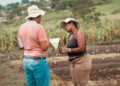
A new book by agricultural researcher Dr Naudé Malan is challenging how South Africa approaches the development of urban and small-scale farmers, arguing that current support systems are misaligned with the realities of farming in densely populated urban environments.
The book, Nxazonke: Urban Agriculture Enterprise Development, draws on more than a decade of research and practice developed through the University of Johannesburg’s Soweto campus initiative, iZindaba Zokudla, which Malan helped establish in 2013.
What began as a farmer–student participatory technology project evolved into a long-running engagement platform at UJ Soweto Campus, running until 2025.
It functioned as what Malan describes as a “public innovation laboratory”, bringing together farmers, researchers, NGOs, and private sector actors to explore agricultural technologies, production systems, and market opportunities in real time.
The initiative also included partnerships such as the Slow Food Eat-Ins in 2016 and 2017, where alternative food systems and community-based production models were tested and discussed.

Rethinking how small farmers are supported
At the core of Malan’s book is a critique of how small and urban farmers are typically supported in South Africa. He argues that development programmes often fail because they try to apply commercial-scale agricultural models to farmers operating in highly constrained urban environments.
According to Malan, a fundamental gap exists in how profitability is conceptualised for small-scale farming enterprises. He argues that most interventions focus on inputs and training, but rarely address the central question of how farmers can become sustainably profitable.
This, he suggests, requires a shift in thinking: urban agriculture must be treated as a distinct economic system rather than a scaled-down version of commercial farming.
Nxazonke: circular production systems
A central concept in the book is “Nxazonke”, which refers to the cyclical integration of biological processes within farming systems. This includes crops, animals, soil processes, and organic waste streams operating in interconnected cycles.
Related stories
- Malan on agriculture’s path: ‘Get the poor down from the cross’
- Agriculturalists give these books the thumbs-up
- Agriculture leaders unite at Sihlobo’s book launch
- Urban farming: Farmers who flourish in Mzansi’s cities
Malan argues that when these systems are properly integrated, farms can generate multiple forms of output simultaneously. These include food products, compost, fertiliser, worms, and other by-products that can each carry economic value.
He suggests that this circular approach allows small farms to maximise productivity within limited land areas while reducing dependence on external inputs.

Urban farming as a distinct opportunity
The book highlights that urban and small-scale farmers operate under fundamentally different conditions from large commercial farms. Malan argues that they should therefore follow different development pathways.
Urban farmers, he notes, often lack capital but have access to labour, informal markets, and organic waste streams that can be converted into productive inputs. Cities also provide dense consumer markets where fresh produce can be sold directly.
He highlights the potential role of informal retail systems such as spaza shops as critical distribution points for urban farmers, enabling them to compete on freshness and price without relying on large supply chains.
Critique of conventional agricultural models
Malan’s work also questions the widespread promotion of industrial agricultural systems, including mechanisation, hybrid seeds, and chemical inputs. He argues that these approaches are often financially and technically inaccessible to smallholders and can lead to long-term ecological and economic challenges.
He suggests that high input costs and dependence on external supply chains make it difficult for small farmers to achieve profitability under conventional models.
Instead, the book explores lower-cost biological production systems that rely on open-pollinated seeds, composting, and integrated waste reuse.
Toward “liberation agriculture”
In some of his earlier work, Malan has referred to the idea of a “liberation agriculture”, drawing inspiration from liberation theology movements in Latin America. In Nxazonke, this idea is extended into practical agricultural design.
He argues that small farmers should be able to produce food at very low cost while still accessing high-value retail markets. This requires reducing dependency on expensive inputs and rethinking how production systems are structured.
The book also engages with approaches such as Zero Budget Natural Farming and “appropriate technology” frameworks promoted by organisations like Practical Action, which advocate for intermediate-scale solutions that sit between high-tech industrial systems and low-tech subsistence farming.
Waste as a productive input
One of the most distinctive elements of Malan’s approach is the integration of urban waste into agricultural production systems. He proposes structured waste exchange systems where households can trade organic waste for discounted food, creating closed-loop local economies.
Organic waste, he argues, can be transformed into compost and fertiliser, while recyclables can generate additional income streams for farmers through partnerships with reclaimers.
These systems reduce input costs while also addressing urban waste challenges, creating what he describes as mutually beneficial urban–rural resource flows.
The book also notes the importance of combining multiple agricultural techniques rather than using them in isolation. Malan argues that productivity increases significantly when systems such as deep trench gardening, mulching, irrigation, tunnels, and companion planting are integrated into a single production model.
He suggests that many smallholder development programmes fail because they introduce technologies individually rather than encouraging system-level integration.
Beyond production, Malan envisions urban farmers playing broader roles as educators, marketers, and community organisers. He argues that social media platforms offer new opportunities for farmers to connect directly with consumers, build brands, and promote agricultural education.
Farms, in this model, become multifunctional spaces that combine food production with training, retail, and community engagement.
A call to rethink development priorities
Ultimately, Nxazonke calls for a fundamental rethinking of how agricultural development is approached in South Africa. Malan argues that small and urban farmers should not be measured against industrial benchmarks, but supported in building systems that are economically viable within their own contexts.
He stresses that the book is intended primarily for farmers rather than academics, and calls for researchers and institutions to follow the innovations emerging from farming communities themselves.
For Malan, the central message is clear: small-scale urban farming has untapped economic and social potential, but unlocking it requires a shift away from conventional agricultural thinking and toward locally grounded, integrated production systems.
The book is available as a free download through the University of Johannesburg Press.
READ NEXT: Mpondoland’s soil-to-pharmacy vision takes root