Urban agriculture is one way for people to overcome their utter disappointment in the government and become more self-reliant, say urban gardeners and academic experts. And with the cost of living in South Africa rocketing, along with the rising unemployment rate, city dwellers should waste no time in setting up food gardens on their nearest pavement.
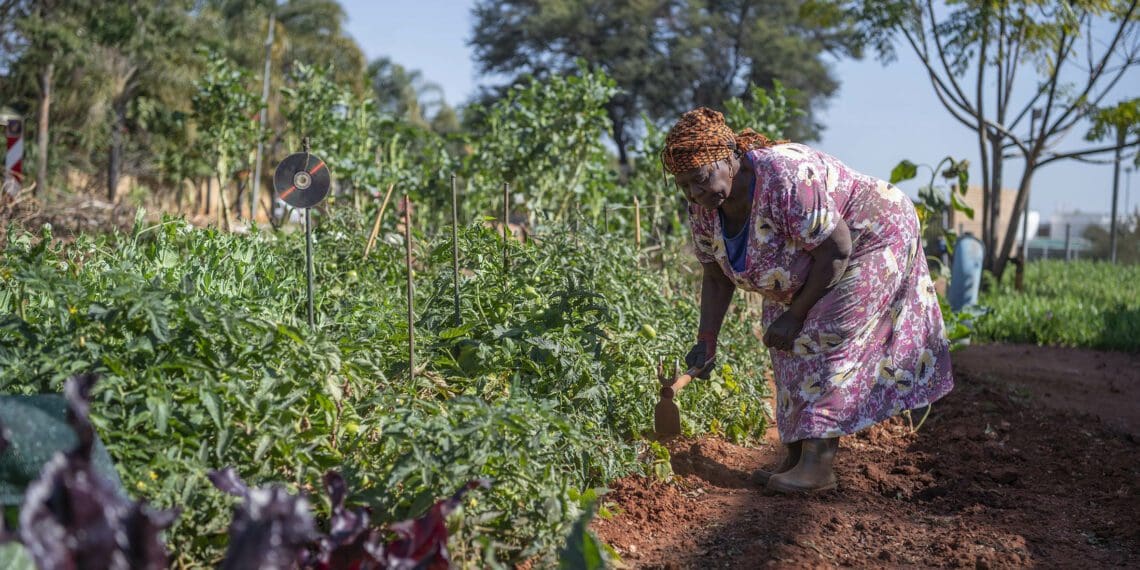
From growing food, the next step is sharing it, and from there the apartheid and class-based spatial barriers that still exist today will break down, says Pretoria pavement gardener Djo BaNkuna. He grows bananas, herbs, avocadoes, spinach, beetroot, sweet potatoes and onions in his backyard and on the pavement outside his home, which he and his wife, a social worker, distribute to child-headed and unemployed families in nearby Soshanguve.
“Many of us cannot begin to imagine the hunger that is out there. It makes me cry when I see a young child of five who has not eaten for two days living right here in Soshanguve, close to the mall. There are child-headed households where one girl of 13 years old is raising five children who have to wake up and go to the mall and pick up scraps of food. Our country is in very bad shape,” says BaNkuna.

Forging his own path
He became famous in November when metro police officers ordered him to rip out the vegetables he had planted on the pavement outside his home, and replace them with flowers or grass, and pay a R1 500 fine. When he refused to do either, BaNkuna was summoned to appear in court, where the case against him was withdrawn.
“I would encourage gardens, although our government is not progressive in that sense. Unfortunately the gospel of Pick ’n Pay and Shoprite is being drummed up so much that people have lost all sense of reliance on themselves and nature, yet the soil is there to give us food,” he says.
“Once you have an onion and cabbage, all you need is pap. And after that, you will find you don’t need pap, you actually need a potato that you have also planted. The combination of those three is a meal. A lot of people in Soshanguve look at me very strangely when I say I grew this cabbage in my pavement garden. For many of us now, food is in the mall.”
Nourishing the soil
Melissa Britz is the co-creator of Oppieyaart (On the Yard), a backyard medicinal garden focused mostly on indigenous plants that she and partner Lucelle Campbell, set up in their backyard in Elsies River on the Cape Flats.
The project has not yet expanded to the pavement, but is making and distributing compost to support other urban agriculturalists and improve the fertility of the sandy soil in the area, which is not suitable for growing vegetables. In the backyard are enormous piles of compost made of leaves, used rooibos teabags, grass clippings and vegetable peelings from neighbours. What the Oppiyaart team doesn’t use for compost, they use to create mulch, both of which they give away free.
“For people just starting out, one of the most important things is to protect soil from the sun, because there is life in the soil: organisms, worms, bacteria and fungi that are all sensitive to light and the heat of the sun. The easiest thing to do is mulch with whatever is available in your area,” Britz says.
Sandy soil cannot retain water and because of climate change and changes in rainfall patterns, urban farmers must increase the capacity of the soil to hold water, she says.

Innovative alternatives
Britz has just harvested ginger that took eight months to grow and she pulls out a handful of the dark brown, moist earth that it was growing in – the result of her soil-building and composting efforts to change the soil from sandy to loamy. She also enhances the soil with worm manure. “A worm farm doesn’t have to be expensive. We have an old bath with worms in it and this also puts nutrients back into the soil.”
Both projects harvest rainwater simply by putting bins, empty drums and other containers in corners where the roofs of their houses channel water down. Expensive harvesting systems made up of water tanks and guttering are not necessary, they say.
Oppieyaart team member Robert Wolfe decants this rainwater into empty cooldrink bottles, then stacks and stores it for them to use in the dry months to water their gardens. “We almost had a room that was filled with two-litre bottles,” says Britz.
BaNkuna doesn’t have gutters on his house but collects up to 1 000 litres of water a night when it rains hard, simply by putting containers under the corners of his roof.
Garden to table
It is vital for everyone possible to plant a home food garden now, says Munyaradzi Chitakira, a Unisa professor and expert in climate-smart livelihoods in rural and urban areas. “Food prices are going up, people are losing jobs and people need to think of how they can beef up their household food supplies. Getting fresh food and organic food is very important as you can control the food.
“If you don’t have land, use buckets and tins, anywhere that you can grow some food instead of having to buy everything,” Chitakira says, adding that municipalities should set aside land and security guards for large communal food gardens.
Many tiny food gardens are an integral part of climate-smart urban agriculture. They are resilient to climate shocks as they ensure food security for families who will be affected by climate change. The crops themselves reduce greenhouse gas emissions, which are further reduced when fewer commercial farm vegetables need to be trucked around the country.

Urban agriculture expert, Juanee Cilliers, agrees that local community gardens are vital to establishing shorter food supply chains and more sustainable forms of agriculture.
Research has already shown that existing food gardens are a valuable part of the economic and social development of communities. “The potential of these innovative markets has not yet been explored and could prove to be the catalyst for urban communities in South Africa to address food security, employment opportunities, empowerment prospects and entrepreneurial development,” says Cilliers.
Bridging the divide
BaNkuna has researched how rising unemployment has caused starvation even in rural villages near Tzaneen in Limpopo – a fertile region with high rainfall – where residents have historically planted crops and been self-sufficient. “I found that village kitchens need to be established even there, because there is hunger in the villages. When you eat pap with salt, it is not a fun thing. It is very painful,” he says.
In the grip of extreme hunger, collective shock at rampant corruption in government, a changing climate and catastrophic mudslides in KwaZulu-Natal, BaNkuna says ordinary people must never give up on collectively healing the nation – and this must start by ending the practice of hiding food away.
“We don’t have to hide food. It is a necessity like air. When we share food, the Van Tonders will start to talk to the Ngobenis and the Ngobenis will start to talk to the Mahmoods. We will start to bridge the divide between our spatial barriers,” he says.
BaNkuna is currently interviewing fellow pavement gardeners for a book. He recently met a woman who has planted 100m of pavement that at harvest time, will be enough to feed 100 families.
“We really need to have people go back to nature and self-reliance. Yes, you can go to Pick ’n Pay and buy soap. That is normal. But there is no reason for you to buy an onion or a sweet potato,” he concludes.
This story was originally written by Anna Majavu and published on New Frame.
Get Stories of Change: Inspirational stories from the people that feed Mzansi.