Nematodes are terrestrial, microscopic organisms with many cells and unsegmented bodies which pose a great threat to farmers in South Africa.
Commonly referred to as “roundworms”, these organisms are so little, you need a microscope to observe the plant-eating nematode species. Despite the life stages of some species seeming pear-shaped, females, ineffective juveniles and other life stages (males included) frequently have a long, slender appearance.
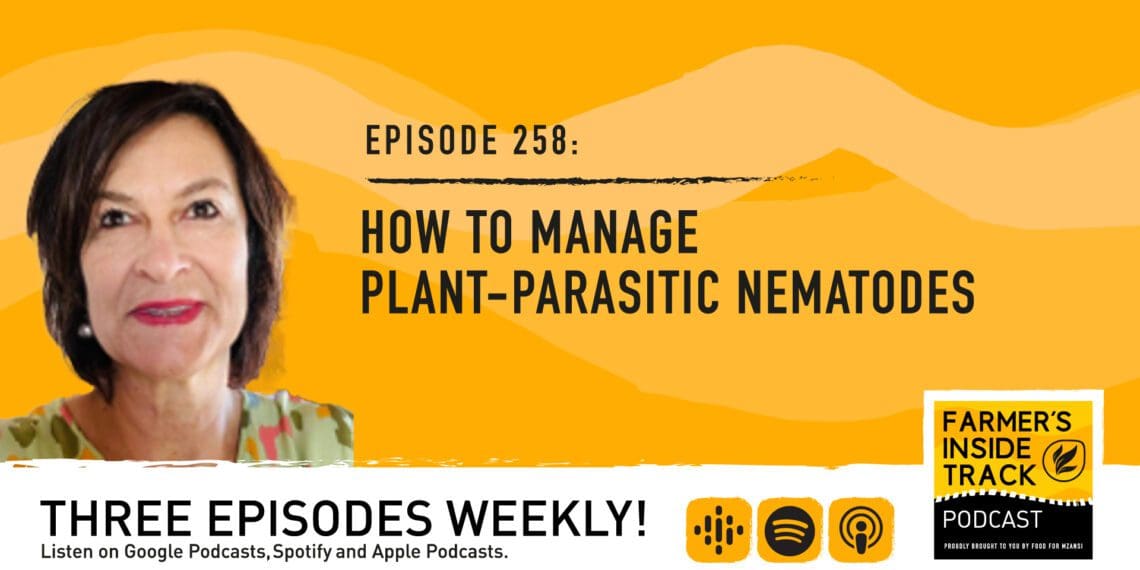
In this episode, Professor Driekie Fourie, technical lead at Syngenta shares what exactly they are and how high-risk the roundworms are for growers in South Africa. She also explores ways to mitigate or possibly prevent nematodes from penetrating healthy soil and causing major damage.
Good and bad nematodes
Believe it or not, not all nematodes are bad news. The beneficial ones play an important role in nutrient cycling in soils and feed on other organisms. In the episode, Fourie unpacks the good ones which she refers to as; entomopathogenic nematodes, bacterivores, fungivores, omnivores and predator nematodes.
The ‘bad ones’ are referred to as the parasitic nematodes – “The biggest one is about 11 mm long but a few micrometres in diameter and it can be seen as a little thread in a counting dish when extracted in water and when an expert identifies it,” Fourie explains in the episode.
In this episode, Fourie also discusses:
- How to deal with nematodes
- Signs to look out for
Want to know more? Listen to the full episode of Farmer’s Inside Track.
Option 1: Click here to listen on Spotify (all mobile and other devices).
Option 2: Click here to listen on any Apple device.
Option 3: Click here to listen on Google Podcast.
READ NEXT: Land reform holds the key to youth job creation
Sign up for Farmer’s Inside Track: Join our exclusive platform for new entrants into farming and agri-business, with newsletters and podcasts.