Friday, October 23, 2026
SUBSCRIBE
22 GLOBAL MEDIA AWARDS
Food For Mzansi
  • News
  • Changemakers
  • Lifestyle
  • Farmer’s Inside Track
  • Food for Thought
No Result
View All Result
  • News
  • Changemakers
  • Lifestyle
  • Farmer’s Inside Track
  • Food for Thought
No Result
View All Result
Food For Mzansi
No Result
View All Result
in Farmer's Inside Track

Podcast: Heat stress help for crop farmers 

Unlike floods or hail, heat stress can last for days making it difficult for farmers to deal with even though plants are resistant and quite adaptable. But if bred correctly, crops can survive

by Octavia Avesca Spandiel
3rd March 2023
Podcast: Heat stress help for crop farmers 

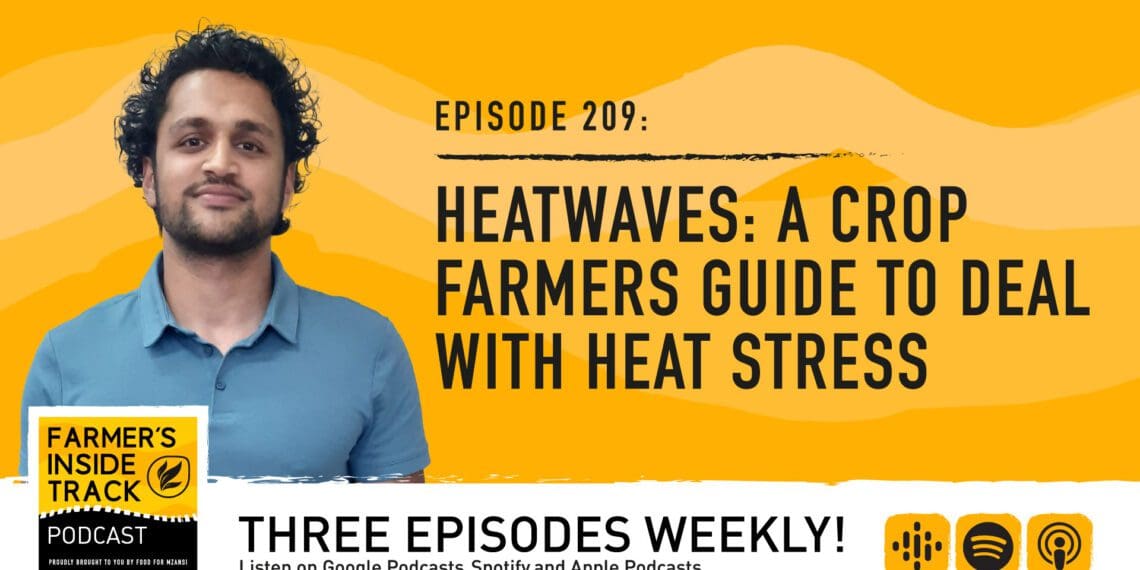
Wafiq Essop, an agronomist and technical support and business developer at AfriNat, shares his expertise with farmers. Photo: Food For Mzansi

Share on FacebookShare on TwitterShare on WhatsApp

Heat stress is an abiotic stress known as a rise in temperature beyond the threshold level for a period of time. It can cause irreversible damage to plant growth and development which ultimately leads to lower yields for farmers.

In this edition of Farmer’s Inside Track, Wafiq Essop, an agronomist and technical support and business developer at AfriNat, shares his expertise with farmers on how to protect their crops, from intercropping to keeping your soil healthy.

Plants and crops have been around for centuries and one thing we can be certain of is that they are resistant and quite adaptable. But when crops are vulnerable and the breed isn’t correctly nurtured to survive within the environment, a natural occurrence of too much heat can have quite the effect on crops, says Essop.

“Lots of plants have quite a lot of resistance when it comes to heat. Plants have survived when there weren’t always sufficient nutrients and when the climatic conditions weren’t always ideal. With that being said, lots of plants have quite a decent resistance to heat and if you breed them correctly, they can survive,” he explains.

Understanding how damaging heat can be on crops

Too much heat, however, can be quite damaging to crops. Essop explains that a farmer can lose 25% of yield per day due to excessive heat on plants.

“You can have a reduction of at least a quarter of your yield if heatwave conditions are experienced for a day. It is not like hail or flooding that hits you once. It  can have a substantial amount of damage really quickly,” he adds

He cautions farmers to look out for sunburn too, which tends to have an effect on the overall quality of fruit.

When the heatwave occurs later during the day, it won’t cause a lot of damage. It’s when it starts early in the morning when farmers should prepare for damage.

In this episode, Essop also discusses:

  • Methods to protect crops;
  • Intercropping benefits; and
  • Tips to farmers.

Want to know more? Listen to the full episode of Farmer’s Inside Track. 

Option 1: Click here to listen on Spotify (all mobile and other devices).

Option 2: Click here to listen on any Apple device. 

Option 3: Click here to listen on Google Podcast.

ALSO READ: Harvesting in the heat? Tips to protect your skin

Sign up for Farmer’s Inside Track: Join our exclusive platform for new entrants into farming and agri-business, with newsletters and podcasts.  
Octavia Avesca Spandiel

Raised by a close-knitted family who loves her deeply, Octavia believes in the philosophy of ‘I am because you are'. This former news and content editor for radio is now living her best life in the agricultural sector as a commercial journalist at Food For Mzansi. Her soft spot for poetry and passion for life, writing and traveling inspires her to write compelling stories. Apart from being an excellent writer, Octavia has an educational background in youth work and loves working with people. 

Tags: crop damageHeat stressheatwaves
Record farm exports overshadowed by growing drought disaster
Food for Thought

By-laws vs. livelihoods: Barriers facing WC smallholder farmers

by Nobulumko Nkondlo
21st October 2026

Without land access or basic infrastructure, informal farmers across the Western Cape are caught in a cycle of non-compliance and...

Read moreDetails

CPAs urged to register for free governance support toolkits

21st October 2026

Potatoes and tomatoes plunge while avocado prices soar

20th October 2026
Becoming bankable: How to get your farm ready for finance

Becoming bankable: How to get your farm ready for finance

20th October 2026

Fixing SA’s agricultural visa system to protect seasonal harvests

20th October 2026

Agda conference to tackle finance, market access and agri growth

SA and Namibia reevaluate livestock trade after FMD outbreak

Eskort announces Herman Janse van Rensburg as group CEO

Karoo sheep tallow finds new purpose in Mzansi beauty brand

Potatoes and tomatoes plunge while avocado prices soar

Join Food For Mzansi's WhatsApp channel for the latest updates!

JOIN NOW!
Next Post
Umlimi waseNorth West Utshala Ipulazi

Umlimi waseNorth West Utshala Ipulazi

THE NEW FACE OF SOUTH AFRICAN AGRICULTURE

With 21 global awards in the first six years of its existence, Food For Mzansi is much more than an agriculture publication. It is a movement, unashamedly saluting the unsung heroes of South African agriculture. We believe in the power of agriculture to promote nation building and social cohesion by telling stories that are often overlooked by broader society.

Eskort announces Herman Janse van Rensburg as group CEO

Agda pushes for pathways to commercialise emerging farmers

Karoo sheep tallow finds new purpose in Mzansi beauty brand

Why simple farm records beat complex systems

Crowdfunding breathes new life into neglected Limpopo citrus farm

Mogogelo farmers receive packhouse and cold storage facilities

  • Awards & Global Impact
  • Our Story
  • Contact Us
  • Cookie Policy
  • Privacy Policy
  • Copyright

Contact us
Office: +27 21 879 1824
News: info@foodformzansi.co.za
Advertising: sales@foodformzansi.co.za

Contact us
Office: +27 21 879 1824
News: info@foodformzansi.co.za
Advertising: sales@foodformzansi.co.za

  • Awards & Global Impact
  • Our Story
  • Contact Us
  • Cookie Policy
  • Privacy Policy
  • Copyright

Chat Options

About this assistant

This feature generates automated answers summarised from Food For Mzansi articles. By using it, you are interacting with an AI system (provided by Google), not a human. AI can make mistakes. Please refer to the source articles for verification and citation purposes.

Our staff do not check or moderate Lerato’s answers in advance, but may review some later. Our journalists continue to write and edit all the articles Lerato uses as sources.

To estimate unique and returning web users, we store a random browser ID in this browser. WhatsApp users are counted by phone number. The same person using both channels may be counted twice.

I'm Lerato, your AI assistant!
No Result
View All Result
  • News
  • Changemakers
  • Lifestyle
  • Farmer’s Inside Track
  • Food for Thought

Copyright © 2026 Food for Mzansi