Wednesday, July 22, 2026
SUBSCRIBE
22 GLOBAL MEDIA AWARDS
Food For Mzansi
  • News
  • Changemakers
  • Lifestyle
  • Farmer’s Inside Track
  • Food for Thought
No Result
View All Result
  • News
  • Changemakers
  • Lifestyle
  • Farmer’s Inside Track
  • Food for Thought
No Result
View All Result
Food For Mzansi
No Result
View All Result
in Farmer's Inside Track

Podcast: How Mzansi should deal with FMD

South Africa has seen an unprecedented outbreak of foot-and-mouth disease in five of its provinces in recent months. Afrivet CEO Dr Peter Oberem gives insight into the origin of the disease and how the country can manage the outbreaks

by Vateka Halile
4th May 2022
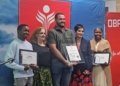
Tumi Moleko Mkomo form I canna, Arne Verhoef from Hemphub, Louis Swanepoel, owner of Ubali pomegranate and prickly pear farm, and Dr Peter Oberem chief executive at Afrivet. Photo: Supplied/Food For Mzansi

On this episode, Tumi Moleko Mkomo from I canna; Arne Verhoef from Hemphub; Louis Swanepoel, owner of Ubali pomegranate and prickly pear farm; and Dr Peter Oberem, CEO at Afrivet. Photo: Supplied/Food For Mzansi

Share on FacebookShare on TwitterShare on WhatsApp

With foot-and-mouth disease (FMD) cases skyrocketing in Mzansi, Dr Peter Oberem, chief executive at Afrivet, breaks down how the sector can better manage these outbreaks currently rampant in five provinces.

Joining us on this week’s Farmer’s Inside Track, Oberem kicks off by explaining the origin of FMD. He points out that the disease evolved thousands of years ago and was first detected in buffalo.

“The virus and the buffalo evolved together for quite a long time and have hence adapted to each other. So the buffalo nowadays show no symptoms whatsoever. They just carry the disease,” Oberem explains.

Looking at it historically, the outbreaks started in the early 1900s. However, there were slow increases in number. The reason why prior to 1930 there were no foot-and-mouth outbreaks, is because at the end of the 19th century – in the 1890s – there was a very severe epidemic of rinderpest, Oberem says.

“It came down from the north and spread down [the] south until eventually in the 1900s it got to Cape Town.”

According to Oberem, rinderpest affects the ruminants including the buffalo. The buffalo population was nearly eliminated, he recalls, together with hunting and anything else that went with it. 

“So, there were very low numbers of buffalo, it was little contact between cattle and buffalo.” 

Furthermore, he says that the loss of international FMD free status has severely impacted South Africa’s agricultural industry. “To give you an example, we lost our accreditation as being FMD free in the FMD free zones. Also [about] 700 game harvesters lost their jobs and until today they don’t have their jobs back,” he explains.

“70% of our wool clip is sold to China and [the country] for a period refused to accept wool from South Africa. You can imagine if suddenly, 70% of our market for our really good product just disappears. It’s an absolute disaster.”

Further in the podcast, Oberem unpacks:

  • The impact on meat exports;
  • Avoiding future outbreaks, and more.

Want to know more? Listen to the full episode of Farmer’s Inside Track

Option 1: Click here to listen on Spotify (all mobile and other devices).

Option 2: Click here to listen on any Apple device.

Option 3: Click here to listen on Google Podcasts.

ALSO READ: Limpopo govt. plugging the holes in its FMD response

Sign up for Farmer’s Inside Track: Join our exclusive platform for new entrants into farming and agri-business, with newsletters and podcasts.
Vateka Halile

Vateka Halile grew up in rural areas of Cofimvaba in the Eastern Cape. She was raised in a traditional family setting and found writing to be a source of comfort and escape. Vateka participated in an online citizen journalism course through Food For Mzansi, and her passion for health and medicine-related stories was born. Her dedication to community work and love for social justice and solidarity spaces is evident in her quality time with the community when she isn't working.

Tags: AfrivetDr Peter OberemFoot-and-mouth diseaseLivestockPodcast
The Forest of Renewal at Rustlers Valley celebrates the intertwined legacies of Frik Grobbelaar, Anton Chaka and Riky Rick, inviting South Africans to restore the land while cultivating hope, belonging and community. Illustration: ChatGPT
Food for Thought

Rustlers Valley offers a blueprint for South Africa’s renewal

by Ivor Price
18th July 2026

As the Rustlers Valley Memorial Forest is launched in the eastern Free State this weekend, Ivor Price reflects on why...

Read moreDetails
Grain SA appoints Mabuza to lead farmer development

Rising stars: 2026 PGP finalists redefining SA grain farming

18th July 2026
Rooibos heads to space in groundbreaking Mzansi experiment

Rooibos heads to space in groundbreaking Mzansi experiment

18th July 2026

Seriti Institute CEO wins prestigious Best Woman 2026 CSI award

17th July 2026
Farmers and brewers call for budget that builds, not breaks

Minister details Land Bank’s success in boosting black farmers

17th July 2026

The Karoo’s quiet lesson on trust and truth

Climate change: SA’s food processors are feeling the heat

Seriti Institute CEO wins prestigious Best Woman 2026 CSI award

Rising stars: 2026 PGP finalists redefining SA grain farming

How this KZN agricultural advisor is bringing tech to rural fields

Join Food For Mzansi's WhatsApp channel for the latest updates!

JOIN NOW!
Next Post
Every chicken produces thousands of feathers, with tonnes of them ending up as waste. Imagine if we could do more with this source of keratin and nutrients. Photo: Supplied/Food For Mzansi

The chicken feather revolution has begun

THE NEW FACE OF SOUTH AFRICAN AGRICULTURE

With 21 global awards in the first six years of its existence, Food For Mzansi is much more than an agriculture publication. It is a movement, unashamedly saluting the unsung heroes of South African agriculture. We believe in the power of agriculture to promote nation building and social cohesion by telling stories that are often overlooked by broader society.

Smart vineyard irrigation starts below the ground

Treat food processing as essential national infrastructure – Khoury

Farmers urged to embrace uncertainty and build resilience

SA poultry industry calls for urgent bird flu vaccine rollout

Mother’s legacy, neighbour’s grace: Venessa Simelane’s farm story

Deadline looms: Register water use by 23 July or risk penalties

  • Awards & Global Impact
  • Our Story
  • Contact Us
  • Cookie Policy
  • Privacy Policy
  • Copyright

Contact us
Office: +27 21 879 1824
News: info@foodformzansi.co.za
Advertising: sales@foodformzansi.co.za

Contact us
Office: +27 21 879 1824
News: info@foodformzansi.co.za
Advertising: sales@foodformzansi.co.za

  • Awards & Global Impact
  • Our Story
  • Contact Us
  • Cookie Policy
  • Privacy Policy
  • Copyright

Chat Options

I'm Lerato, your AI assistant!
No Result
View All Result
  • News
  • Changemakers
  • Lifestyle
  • Farmer’s Inside Track
  • Food for Thought

Copyright © 2024 Food for Mzansi

This website uses cookies. By continuing to use this website you are giving consent to cookies being used. Visit our Privacy and Cookie Policy.