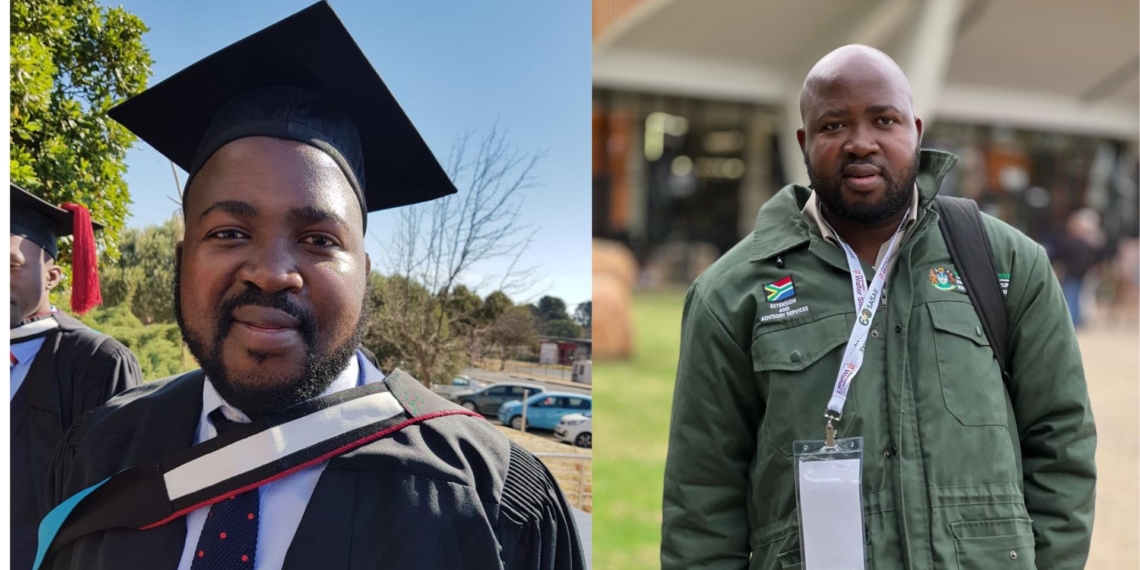
Growing up in Greytown, KwaZulu-Natal, Nhlakanipho Nzama spent his boyhood herding cattle and helping his family grow imifino and amadumbe. When his father bought a tractor to help local communities plough their land, Nhlakanipho jumped right in. Today, that village grit guides him as a KZN agricultural advisor.
Watching his dad leave the taxi industry to help the community brought him closer to the land, but the real shift happened in 2001 when he was in grade 7.
“My mom was listening to Reggie Khumalo on Ukhozi FM’s Cobelela Falaza,” Nzama recalls. “There was an advertisement for a new agricultural college opening in Baynesfield, outside PMB [Pietermaritzburg]. They wanted learners who would start the following year in grade 8.”
His mother grabbed the opportunity. That November, they went down for the open day at Zakhe Agricultural College, which was a brand-new school for boys.
Learning the discipline of farming
Nzama became one of the 24 pioneer learners at the school. The boys did classroom work from 07:30 to 13:00, then went straight into heavy farm practicals.
“If you were in animal production that week, you started your practicals at 4 am before class,” Nzama says. “We rotated every week to make sure we worked in all spheres of the farm.”
After matric, he took that discipline to the University of Zululand, graduating with a BSc in agricultural economics. A department of agriculture bursary led to a permanent job after his studies, and he officially stepped into his advisor role in 2012, working hands-on with farmers across Vryheid and Zululand. He later completed his master’s in sustainable agriculture at the University of the Free State in 2018.

He tells Food For Mzansi that his primary focus is crop production, specifically grains and vegetables.
“As a project officer, I also implement local initiatives and use my agricultural economics background to write business plans for our clients.”
Related stories
- Sibongile’s plant passion: Healing crops and feeding Mzansi
- Wealth in dirt: Crop scientist’s plan B becomes farming destiny
- Crop scientist Anele Danisa bridges gap between lab and land
- Wild at heart: Shane Ngwenya swapped fear of snakes for science
The daily grind
“My day-to-day work is to provide hands-on advisory services,” Nzama says. “I visit farmers on their land, check their produce, and advise accordingly.”
This includes running monthly grain study groups and introducing soybean production alongside Grain SA. He also launched a pilot seed project with Capstone and participates in community ‘war rooms’ to tackle local challenges with targeted field training.
When the seasons shift, his duties adapt. “In the dry season, I take yield records and maize samples, and help transport crops to the market.”

Breaking barriers to innovation
Nzama has noticed a common misconception among upcoming farmers that new technologies are too complicated or only meant for large commercial operations.
He champions accessible, user-friendly tools, from mobile weather forecasts and the O-VELD WhatsApp tool to precision farming and drones. Introduced correctly, he says these technologies drastically improve productivity, but shifting old mindsets remains a challenge.

“Adoption is slower with climate-smart and conservation agriculture,” he notes. “Some farmers still view climate variability as temporary rather than a long-term reality requiring new practices.”
To accelerate this, he advocates for hands-on demonstrations, engaging tech-savvy youth, and partnering with the private sector.
“Farmers need tangible evidence that innovations are practical, profitable, and suited to their local conditions,” he emphasises. By uniting government researchers, agricultural officers, the private sector, and farmers, Nzama believes the sector can build a resilient, food-secure future for rural communities.


READ NEXT: From Porterville to Clanwilliam: AgriCareers breaks barriers!