Saturday, November 21, 2026
SUBSCRIBE
22 GLOBAL MEDIA AWARDS
Food For Mzansi
  • News
  • Changemakers
  • Lifestyle
  • Farmer’s Inside Track
  • Food for Thought
No Result
View All Result
  • News
  • Changemakers
  • Lifestyle
  • Farmer’s Inside Track
  • Food for Thought
No Result
View All Result
Food For Mzansi
No Result
View All Result
in News

SA Pink Lady apples see strong growth across European markets

Despite late-season weather challenges, Tru-Cape’s Pink Lady apple exports surged across Europe and the UK this season. Leveraging microclimates from Ceres to the Langkloof, South Africa now supplies 80% of Southern Hemisphere Pink Lady apples

by Staff Reporter
3rd October 2026
Add FFM on Google
Several Pink Lady apples against a solid pink background, with one bearing a heart-shaped brand sticker.

Premium Pink Lady® apples sourced from Tru-Cape’s key South African growing regions, where UK export volumes surged by over 16% this season. Photo: Tru-Cape

Share on FacebookShare on TwitterShare on WhatsApp

Sustained European demand and a 16% volume increase in the UK have propelled Tru-Cape Fruit Marketing to new export heights as South Africa’s leading Pink Lady supplier.

Tru-Cape’s Pink Lady shipments to Europe have increased dramatically since 2020, reflecting sustained growth in demand for the brand among European customers.

“The sustained growth in our shipments reflects the strength of both the Pink Lady and the Tru-Cape brands and the demand for it among our European customers,” said Stefanie de Puysseleir, responsible for the European marketing of Tru-Cape’s apples and pears.

From South Africa to the world

Growth has also been evident in the UK, where almost all of Tru-Cape’s Pink Lady retail programmes recorded growth this season. Volumes increased by more than 16% to UK retailers, where the brand has become an increasingly important part of the apple category.

Karlien van Zyl, export manager to the UK and Ireland at Tru-Cape, said, “The growth in Pink Lady is particularly encouraging and strengthens our position with key UK retailers for future seasons.”

According to Calla du Toit, procurement director at Tru-Cape, the company’s extensive producer base supports consistent Pink Lady supply. Its producers are spread across South Africa’s main apple-growing regions, including the Witzenberg Valley, Koue-Bokkeveld, Bo-Swaarmoed, Elgin, Vyeboom, Grabouw, Villiersdorp and the Langkloof.


Related stories
  • Tru-Cape partners with Harvard on premium apple strategy
  • Tru-Cape cherries target China amid bumper 2025 crop
  • New leadership to boost Tru-Cape’s African expansion
  • Thokoman turns 25, backs food security with R500k commitment

“These regions have different microclimates that are well suited to good colour development in Pink Lady apples,” says Du Toit. “Our geographical spread also means that our production risk is well diversified, ensuring that Tru-Cape have good Pink Lady apples year after year.”

The 2026 season was not without challenges. Storms and strong winds towards the end of the harvesting window in the Ceres and Villiersdorp areas resulted in bruising as fruit was blown from trees. The first part of the season, however, was positive, with strong demand supporting Tru-Cape’s continued growth in the market.

Pink Lady’s significance to South Africa

The South African apple industry has a long trading relationship with the UK and Europe, dating back to the 1980s, Du Toit explained. Pink Lady was developed with production in both hemispheres to provide year-round availability, and South Africa, and particularly Tru-Cape, has become an important source for Northern Hemisphere markets during the Southern Hemisphere season.

“Initially, we were uncertain how the brand would fare in these markets, but over time we realised that the colour was good and that the UK, in particular, has a preference for Pink Lady’s taste,” he said. “The business has grown steadily over the years, and we underestimated the increase in consumption in the UK and Europe.”

South Africa now supplies around 80% of Southern Hemisphere Pink Lady apples.

Pink Lady is also significant within the South African apple industry. When Pink Lady and Cripps Pink – the same variety sold without the Pink Lady brand – are combined, South Africa exports close to nine million MK6-equivalent cartons, making it the country’s largest apple export category after Gala.

Du Toit believes the long-term prospects for Pink Lady in Europe and the UK remain strong. “Tru-Cape is increasingly becoming a player to reckon with and a preferred partner for European and UK importers,” he said.

READ NEXT: Feed relief brings hope to drought-stricken Loeriesfontein farmers

Red stylized leaves resembling flames enclosed in a rounded, irregular red border on a white background.

Sign-up for the latest agricultural news delivered straight to your inbox every day with Mzansi Today!

Add FFM on Google Follow FFM on Google News

Staff Reporter

Researched and written by our team of writers and editors.

Tags: Agricultural exportsApple exportsFruit industryICYMI
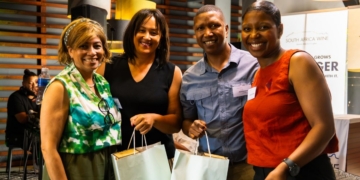
Karin Kleinbooi, executive director for inclusion and development at South Africa Wine; Berene Sauls of Tesselaarsdal Wines; Denzel Swarts of Zoetendal Vineyards; and Mahalia Kotjane of Three Quarters Wines at South Africa Wine’s Inclusive Growth Indaba 2026. Photo: Food For Mzansi
News

Six hard-earned lessons from black-owned wine brands

by Ivor Price
19th November 2026

Four wine entrepreneurs share their costly mistakes and biggest breakthroughs. Their lessons offer valuable insights into building profitable, sustainable wine...

Read moreDetails
A young woman crouches in a community garden, holding a green tomato to show an older man standing beside her in an apron.

Why giving farmers seedlings isn’t enough to beat the next drought

19th November 2026
Neat rows of green crops stretch across a vast field toward rolling hills under a cloudy sky.

AgriSA, IFC partner to streamline sustainable farm finance in SA

19th November 2026
Cuts of raw red meat displayed on trays behind a glass butcher's counter.

Festive demand vs. El Niño: What’s driving SA’s livestock market?

18th November 2026
Karin Kleinbooi, executive director for inclusion and development at South Africa Wine, spearheaded the Inclusive Growth Indaba 2026, championing the view that transformation and industry competitiveness must go hand in hand. Photo: Food For Mzansi

Beyond the bottle: How black-owned wines can win market share

18th November 2026

Climate risk is business risk: How farmers can prepare for El Niño

Six hard-earned lessons from black-owned wine brands

Tulbagh Cannery closure leaves WC farmers fighting for fair terms

SA agriculture sheds 34 000 jobs as input costs squeeze farmers

Why is your farm dam losing water? Look beyond just leaks

Join Food For Mzansi's WhatsApp channel for the latest updates!

JOIN NOW!
Next Post
People gather near clay and thatched-roof buildings in a rural village under a partly cloudy sky.

Rural development in SA: Why land ownership isn’t enough

THE NEW FACE OF SOUTH AFRICAN AGRICULTURE

With 21 global awards in the first six years of its existence, Food For Mzansi is much more than an agriculture publication. It is a movement, unashamedly saluting the unsung heroes of South African agriculture. We believe in the power of agriculture to promote nation building and social cohesion by telling stories that are often overlooked by broader society.

Private partnerships unlock millions for land reform beneficiaries

African markets offer fresh growth opportunities for SA rooibos

Supplying Joburg Market: Phumla Qwabe grows her next chapter

How Alkelp is turning seaweed into biostimulants that deliver value on the farm

Climate risk is business risk: How farmers can prepare for El Niño

Eight-year harvest low threatens survival of SA wheat farms

  • Awards & Global Impact
  • Our Story
  • Contact Us
  • Cookie Policy
  • Privacy Policy
  • Copyright

Contact us
Office: +27 21 879 1824
News: info@foodformzansi.co.za
Advertising: sales@foodformzansi.co.za

Contact us
Office: +27 21 879 1824
News: info@foodformzansi.co.za
Advertising: sales@foodformzansi.co.za

  • Awards & Global Impact
  • Our Story
  • Contact Us
  • Cookie Policy
  • Privacy Policy
  • Copyright

Chat Options

About this assistant

This feature generates automated answers summarised from Food For Mzansi articles. By using it, you are interacting with an AI system (provided by Google), not a human. AI can make mistakes. Please refer to the source articles for verification and citation purposes.

Our staff do not check or moderate Lerato’s answers in advance, but may review some later. Our journalists continue to write and edit all the articles Lerato uses as sources.

To estimate unique and returning web users, we store a random browser ID in this browser. WhatsApp users are counted by phone number. The same person using both channels may be counted twice.

I'm Lerato, your AI assistant!
No Result
View All Result
  • News
  • Changemakers
  • Lifestyle
  • Farmer’s Inside Track
  • Food for Thought

Copyright © 2026 Food for Mzansi